


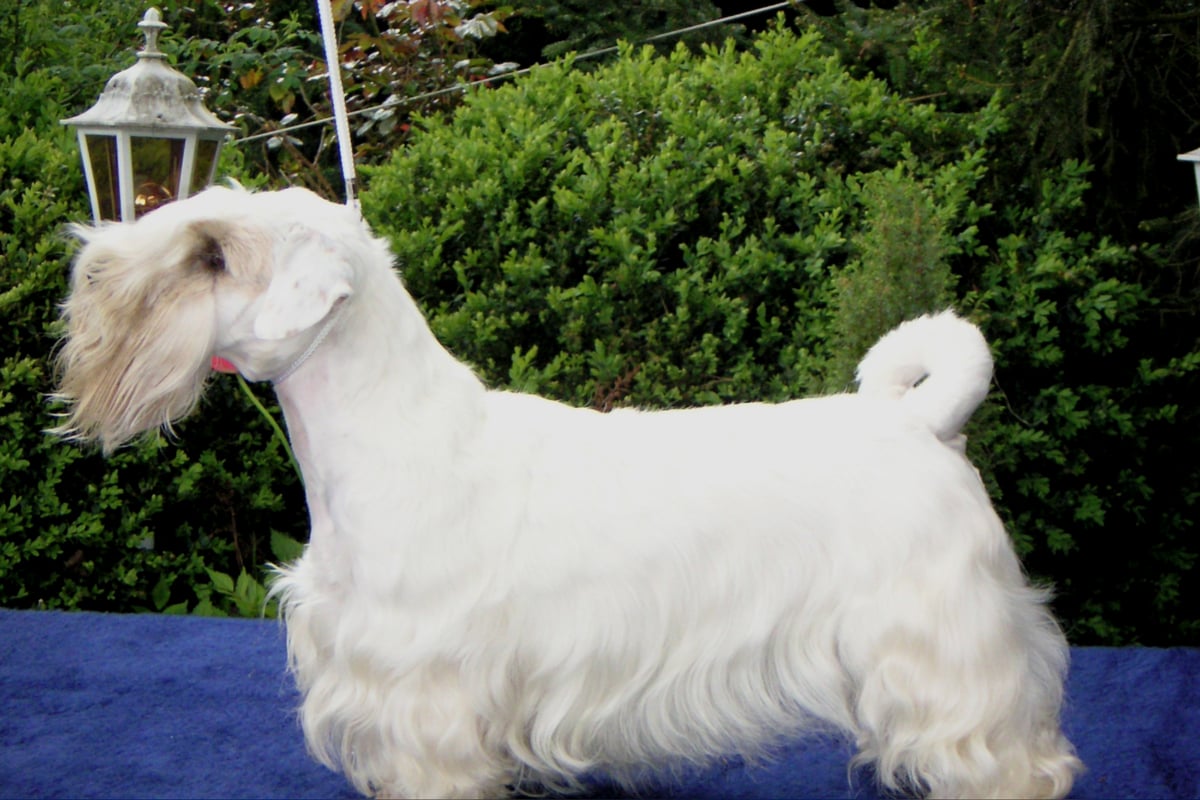
Sealyham Terrier
The Sealyham Terrier is a Welsh terrier of 8 to 10 kg and 25 to 31 cm, recognized by the FCI under number 74. Created in the 19th century on the Sealyham estate (Pembrokeshire, Wales) by Captain John Edwardes to hunt badgers, otters, and foxes over rugged terrain, recognized by the British Kennel Club in 1910. Since 2010, fewer than 50 annual registrations with the Kennel Club UK — well below the threshold of 300 that defines Vulnerable Native Breeds — and barely 10 to 20 LOF-registered puppies a year in France. Life expectancy 12 to 14 years.
- Weight
- 8 to 10kg
- Height
- 25 to 31cm
- Life expectancy
- 13years
- Monthly cost
- 70 to 120€
Personality profile
Energy 3/5
Independence 4/5
Trainability 2/5
Good with children 3/5
Barking 4/5
Space needed 2/5
Attachment to home 3/5
Good with strangers 2/5
Good with dogs 2/5
Good with cats 2/5
Coat care 4/5
Exercise needs 3/5
Scores given on measured axes, data confidence: medium.
Living with a Sealyham Terrier
Description
A low, elongated silhouette, short-legged, with a powerful torso built to go to ground. FCI standard 74 describes a double coat: a dense, soft undercoat, a harsh, dense outer coat — exclusively white, with or without yellow, tan, or brindle markings on the head and ears. The head is long and broad, with a powerful jaw suited to a firm grip — a functional trait inherited from its hunting use. The ears, drooping and folded, frame the distinctive muzzle. The tail was traditionally docked but remains full-length in countries where docking is banned.

Temperament
A tenacious, strong-willed Welsh terrier: the Sealyham decides for itself when to cooperate and doesn't respond to coercion. Less outgoing than the Welsh Terrier, it maintains a genuine attachment to its household without excessive displays. Wary of strangers — it doesn't approach spontaneously and watches visitors silently before accepting their presence. Vocal and prone to barking at outside stimuli; hard to interrupt once set on something. With household children, cohabitation is possible under adult supervision — abrupt gestures or forced handling trigger a defensive reaction. Its hunting instinct toward small animals remains intact.
Training
Low trainability (2/5): the Sealyham was selected for initiative and independent persistence, not for obedience to repeated commands. It learns quickly what holds immediate interest and ignores the rest. Positive reinforcement exclusively, sessions of 5 to 8 minutes, varied and unpredictable to maintain attention. Physical punishment or coercion generates passive resistance and defensive reactions. Training should begin from 8 weeks — an untrained adult is very difficult to correct. Nose work and exploratory activities suit its digging instincts well.

Feeding
160 to 220 g of premium kibble a day for an 8 to 10 kg adult, in 2 meals. A small-breed diet, high in protein (26-30%), without excess fat to keep body mass in check. Watch the ration after spaying/neutering — weight gain is quick and not very visible on this short-bodied build. Calcium needs are standard; no specific diet is documented for the breed.
Affiliate links, no extra cost to you. Legal notice

Living conditions
An apartment or a house without a large garden are both acceptable — its exercise needs are moderate (45 to 60 minutes a day across two outings). Its low stature and compact build adapt to smaller spaces provided olfactory and physical stimulation are ensured. A deep fence (at least 50 cm) is essential if a garden is available, due to its digging instinct and unreliable recall once on a scent trail. Resistant to the cold and damp climate of its native Welsh Pembrokeshire. Sensitive to heat: avoid direct sun exposure in summer. Suits a calm or semi-active household best.

Grooming and coat care
A double coat requiring stripping (hand-plucking the dead hair) 3 to 4 times a year to maintain its harsh texture and characteristic whiteness — clipping progressively softens the outer coat and fades the white to grayish over several cycles. Weekly brushing with a soft slicker brush to prevent matting in the dense undercoat. The mustache and beard hair, characteristic of the muzzle's shape, need regular attention to avoid food staining. Few groomers in France are trained in this rare standard — plan for a specialized budget or learn stripping yourself. Monthly ear cleaning; nails every 3 to 4 weeks.

Health
A generally favorable health profile for common conditions, but particular vigilance is needed regarding genetics: the population descends from a very limited number of breeding dogs, which restricts genetic diversity — ask for the litter's inbreeding coefficient before purchase. Congenital deafness: documented in the breed, linked to white pigmentation (MITF gene) — the BAER test (Brainstem Auditory Evoked Response) is recommended on puppies before placement. Primary open-angle glaucoma reported in the breed — annual eye monitoring advised after age 6. Mild hip dysplasia occasionally documented. No specific neurological syndrome comparable to Scottie cramp. Life expectancy 12 to 14 years.
Breed history
The Sealyham Terrier owes its existence and its name to Captain John Edwardes, who developed the breed on his Sealyham estate in Pembrokeshire, Wales, between 1850 and 1891. His goal was a white terrier easily spotted while hunting, brave enough to go to ground against badger and otter, and compact enough to work in wet, rocky terrain. The exact ancestry remains debated — the Dandie Dinmont Terrier, the white Bull Terrier, and the Fox Terrier are mentioned in historical sources. Recognized by the British Kennel Club in 1910, FCI number 74, Group 3 Section 2. The breed reached its peak popularity in the 1920s-1950s, notably carried by British celebrities and aristocrats. Since the 1980s, registrations have fallen below 50 a year at the Kennel Club UK, well under the threshold of 300 for the "Vulnerable Native Breed" classification, and barely 10 to 20 LOF puppies a year in France.
Getting ready for your Sealyham Terrier
Five essentials to line up before day one.
Affiliate links, no extra cost to you. Legal notice
FAQ: Sealyham Terrier
Sources
- FCI Standard No 74 · FCI breed standard 74, Group 3 Terriers, Section 2 Small-sized Terriers
- AKC Breed Profile — Sealyham Terrier · AKC Sealyham Terrier breed profile, Terrier Group
- The Kennel Club — Vulnerable Native Breeds · Kennel Club UK, Sealyham Terrier classification Vulnerable Native Breed, registrations <50/year since 2010
FCI, Fédération Cynologique Internationale, the world body that has codified breed standards since 1911. FCI number 74 is assigned to the Sealyham Terrier.
Breeds similar to a Sealyham Terrier

