


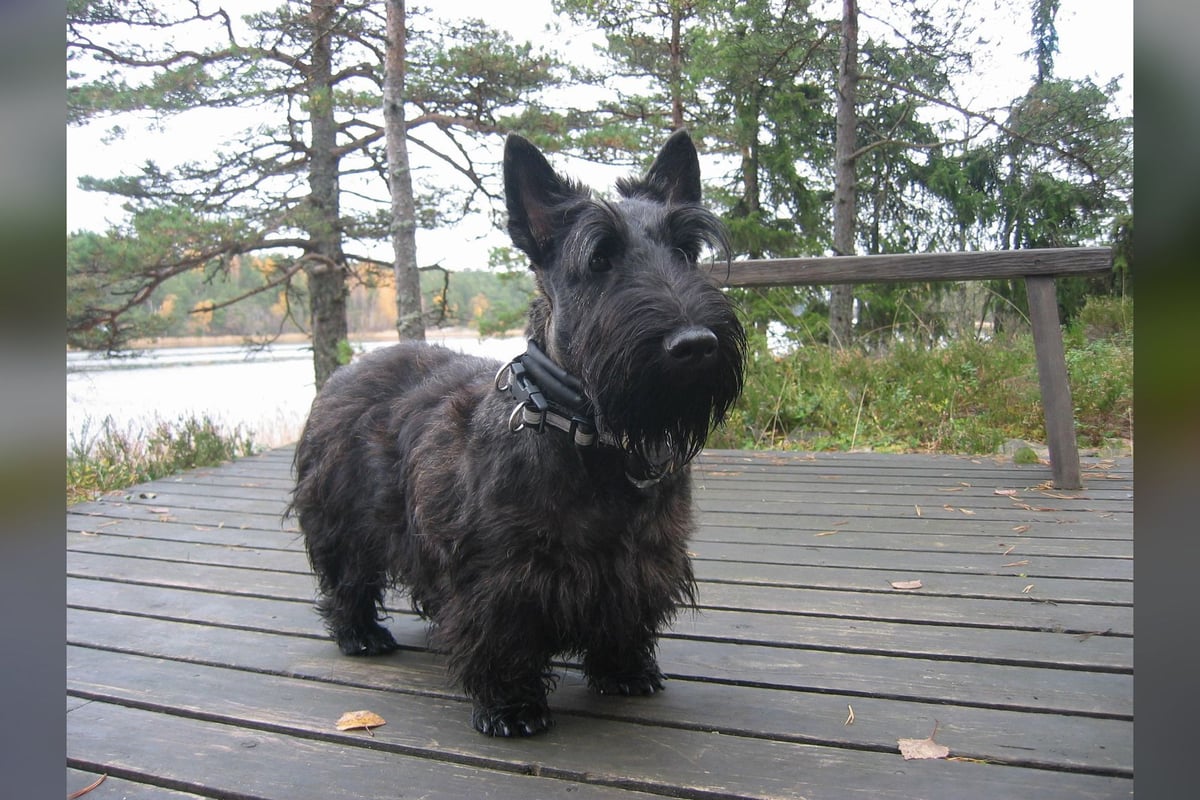
Scottish Terrier
The Scottish Terrier (Scottie) is a Scottish terrier of 8 to 10 kg and 25 to 28 cm, recognized by the FCI under number 73. A breed particularly affected by cancer: risk of bladder urothelial carcinoma 18 to 20 times higher than the average across all breeds, with lymphoma and melanoma overrepresented. The neurological syndrome known as "Scottie cramp" is specific to the breed. Life expectancy 11 to 13 years.
- Weight
- 8 to 10kg
- Height
- 25 to 28cm
- Life expectancy
- 12years
- Monthly cost
- 70 to 120€
Personality profile
Energy 3/5
Independence 5/5
Trainability 2/5
Good with children 3/5
Barking 4/5
Space needed 2/5
Attachment to home 2/5
Good with strangers 2/5
Good with dogs 2/5
Good with cats 2/5
Coat care 4/5
Exercise needs 3/5
Scores given on measured axes, data confidence: high.
Living with a Scottish Terrier
Description
The Scottish Terrier stands out for its low, elongated silhouette, short-legged, with a long, narrow head carried high. FCI standard 73 describes a double coat — a dense, soft undercoat, a harsh, dense, straight outer coat about 5 cm long — in three permitted colors: black (the most common), brindle, and wheaten. The ears are small, erect, with a fine point. The tail, carried straight or slightly curved, is thick at the base and tapered. Its body mass concentrated into a compact frame gives it an imposing bearing for its size.

Temperament
Independent to the point of ranking among the least obedient breeds in Stanley Coren's working/obedience intelligence ranking. The Scottie makes its own decisions, responds little to repeated commands, and picks the contexts in which it chooses to cooperate. Loyal to its household in a quiet way — it marks its presence without excessive displays. Reserved with strangers, verging on marked wariness: it doesn't approach spontaneously and has little tolerance for unsolicited contact. With children it knows in the household, tolerant if interactions are structured; defensive and unpredictable with unfamiliar children who make abrupt gestures. Vocal and persistent: once set on barking or digging, hard to interrupt.
Training
Low to moderate trainability (2/5): the Scottie regularly ranks near the bottom of obedience rankings, not for lack of intelligence, but for lack of motivation to comply with repeated commands. It learns quickly what interests it and ignores what bores it. Positive reinforcement exclusively, sessions of 5 to 8 minutes, varied, with high-value food rewards. Physical restraint or punishment generates stubbornness and can trigger defensive aggression. Training should begin at a young age — an untrained adult Scottie is difficult to reshape. Nose work is an activity particularly well suited to its tenacity.

Feeding
160 to 220 g of premium kibble a day for an 8 to 10 kg adult, in 2 meals. An omega-3-enriched diet (EPA/DHA) is recommended for atopic individuals. No particular diet is documented as protective against bladder carcinoma: prevention relies on veterinary follow-up, not the food bowl. Avoid weight gain in spayed/neutered individuals — obesity worsens joint strain.
Affiliate links, no extra cost to you. Legal notice

Living conditions
An apartment or small house without a garden is acceptable — its exercise needs are moderate for a terrier (45 minutes a day is enough). A fence buried deep (at least 50 cm) if a garden is available, since its digging instinct is intact. Recall is unreliable once it's on a scent trail. Tolerates cold temperatures and the climate of the Scottish Highlands very well — cold and damp don't affect it. Sensitive to heat: do not leave it exposed to direct sun in summer. Prefers a calm or semi-active household; ambient hyperactivity stresses it.

Grooming and coat care
A double coat requiring stripping (hand-plucking the dead hair) every 8 to 12 weeks to maintain its harsh texture and color. Clipping softens the outer coat and fades the black coat to grayish-brown over several cycles — acceptable for a companion dog, disqualifying for showing. Weekly brushing with a soft slicker brush to prevent tangles in the undercoat. The Scottie's characteristic beard and eyebrows are hand-trimmed to maintain the silhouette. Monthly ear cleaning; nails every 3 to 4 weeks.

Health
Cancer: transitional cell carcinoma of the bladder (urothelial carcinoma) is the breed's major predisposition, with a massive excess risk documented by several North American veterinary epidemiological studies (Morris Animal Foundation, Purdue University) — figures and aggravating factors detailed in the FAQ. Lymphoma and cutaneous melanoma are also overrepresented in the breed. Von Willebrand disease type III: a hereditary coagulation disorder from a deficiency in von Willebrand factor — a bleeding risk during surgery, with a genetic test available and recommended before any procedure. Scottie cramp: an autosomal recessive neurological syndrome causing muscle spasms, an arched gait, and locomotor difficulties during exertion or excitement — affected individuals lead a normal life between episodes. Skin atopy documented in the breed. Life expectancy 11 to 13 years.
Breed history
The Scottish Terrier descends from Scottish Highland terriers used to hunt fox, badger, and rodents on Scotland's rugged terrain. The name is attested in British writings from the early 19th century onward. The first standard was established in 1879, the first breed club in 1883 in Glasgow. Recognized by the FCI under number 73, Group 3 Section 2. The breed gained international recognition between the two World Wars — Franklin D. Roosevelt owned a Scottie named Fala, who became one of the most famous American presidential dogs.
Getting ready for your Scottish Terrier
Five essentials to line up before day one.
Affiliate links, no extra cost to you. Legal notice
FAQ: Scottish Terrier
Sources
- FCI Standard No 73 · FCI breed standard 73, Group 3 Terriers, Section 2 Small-sized Terriers
- AKC Breed Profile · AKC Scottish Terrier breed profile, Terrier Group
FCI, Fédération Cynologique Internationale, the world body that has codified breed standards since 1911. FCI number 73 is assigned to the Scottish Terrier.
Breeds similar to a Scottish Terrier

