


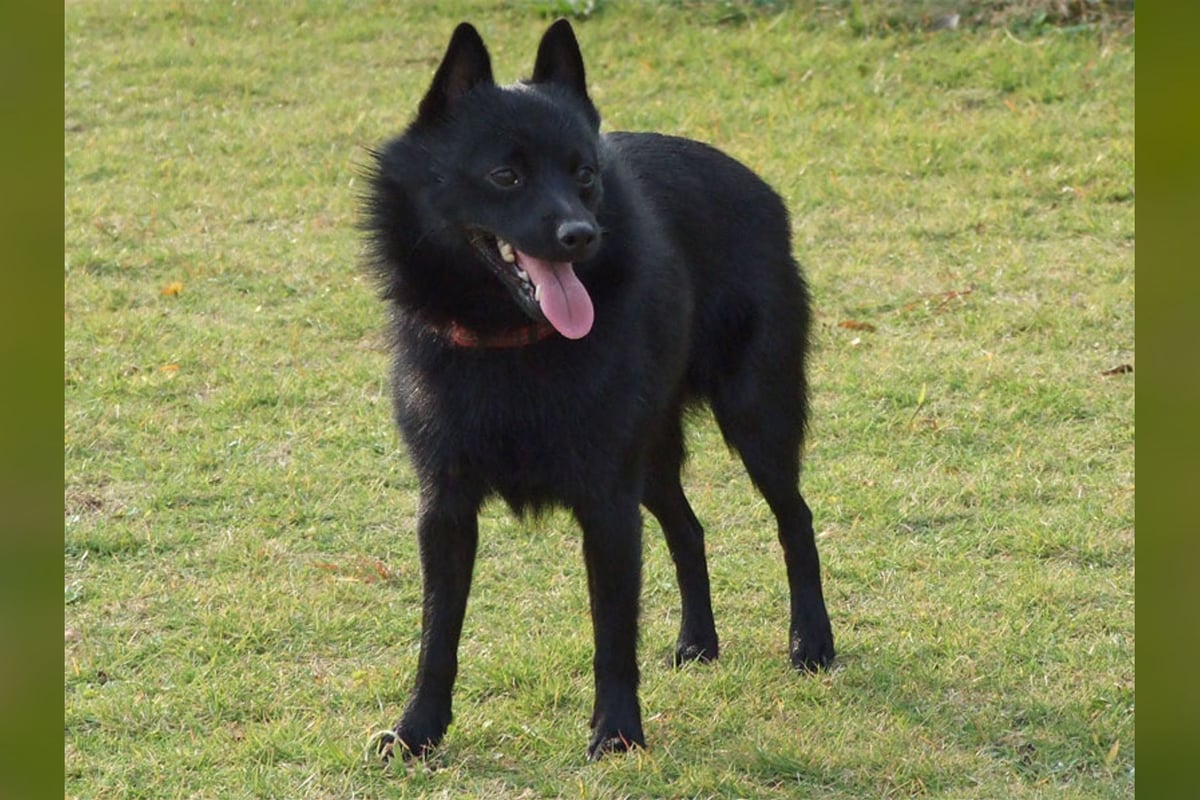
Schipperke
The Schipperke is a small Belgian herding dog whose Flemish name literally means "little skipper" — a guardian of barges on the canals between Antwerp and Ghent from the 17th century onward. Recognized by the FCI under number 83 (Group 1), it weighs 3 to 9 kg for 25 to 33 cm. Its dense black double coat with a pronounced ruff and its natural tail-less state (born tailless in most individuals) are its two distinctive anatomical traits.
- Weight
- 3 to 9kg
- Height
- 25 to 33cm
- Life expectancy
- 14years
- Monthly cost
- 55 to 90€
Personality profile
Energy 4/5
Independence 4/5
Trainability 3/5
Good with children 3/5
Barking 4/5
Space needed 2/5
Attachment to home 3/5
Good with strangers 2/5
Good with dogs 3/5
Good with cats 3/5
Coat care 3/5
Exercise needs 3/5
Scores given on measured axes, data confidence: high.
Living with a Schipperke
Description
A stocky, square silhouette, a compact gait, a short back sloping slightly toward the croup. Abundant, harsh, straight outer coat forming a thick ruff around the neck, a jabot on the chest, and breeching on the hindquarters. Dense, woolly undercoat providing effective thermal insulation. Exclusive color: intense black with no color markings whatsoever per the FCI standard. Wedge-shaped (fox-type) head, small triangular erect ears. Naturally absent tail (tailless) or very short in the vast majority of individuals — this is not a surgical docking.

Temperament
A natural barker at level 4/5: the Schipperke barks at every perceived intruder, passerby outside the window, or suspicious noise in the hallway — an alert function directly inherited from its role as barge guardian. This vocal behavior must be channeled from the first weeks through desensitization and teaching a "quiet" command. Wary of strangers without being a biter, it accepts introductions made by its handler. Very curious, a compulsive explorer, it never sits still. Independent-minded: it takes initiative and regularly tests established limits.
Training
Intelligent but opportunistic: it learns commands quickly and workarounds just as quickly. Short sessions (10-12 minutes) with positive reinforcement and regularly refreshed exercises give the best results. Its strong independence (4/5) makes consistency essential — any rule dropped for a week is treated as repealed. Suitable dog sports: agility (its natural agility predisposes it to this), nose work, rhythmic obedience. Priority should go to bark desensitization for cohabitation in dense housing.

Feeding
100 to 200 g of premium kibble a day for a 5-6 kg adult, in 2 meals. Small to medium kibble size (8-10 mm diameter). No marked predisposition to obesity, but weigh portions carefully: an individual at +15% of its ideal weight puts added strain on its kneecaps. Good-quality food: the breed doesn't require a specific formula, but kibble containing glucosamine is advised from age 6 for active individuals.
Affiliate links, no extra cost to you. Legal notice

Living conditions
Suited to apartment living thanks to its small size, provided at least 45 to 60 minutes of daily outdoor physical activity are ensured. Two 20- to 30-minute outings plus a play or mental exercise session cover its needs. An enclosed garden is appreciated but not essential. The main challenge in an apartment building: managing barking — without early work, it becomes incompatible with neighbors. Good cold tolerance thanks to its dense undercoat. Sensitive to summer heat: walks during cool hours above 26 °C, a ventilated indoor space.

Grooming and coat care
Regular weekly brushing with a pin brush or wide-toothed comb to detangle the ruff and jabot. Intensified care during the two seasonal shedding periods (spring and fall) when the undercoat sheds massively: brushing 3 times a week for 3 to 4 weeks. The dense ruff around the neck is the area most prone to matting. Monthly or twice-a-month bath. No professional grooming needed as routine: the FCI standard prohibits any artificial coat trimming.

Health
Life expectancy 13 to 15 years, among the highest in Group 1. A specific and documented genetic predisposition: mucopolysaccharidosis type IIIB (MPS-IIIB), also called Sanfilippo syndrome type B, is an autosomal recessive lysosomal storage disease. Affected dogs show progressive ataxia, behavioral disturbances, and cognitive decline starting at 2-4 years. A DNA test is available (Laboklin, Antagene) and recommended for all breeding dogs. Secondary predispositions: hip dysplasia (mild, rarer than in large breeds) and patellar luxation. Thyroid function to monitor after age 7.
Breed history
The breed is documented in the Flemish region from the 17th century onward under the name "Spitske" or "Spitsken." Belgian tradition places the first exhibition devoted to them in Brussels in 1690, which would make it one of the oldest known dog shows. The first official standard was set in 1888 in Belgium. Recognized by the FCI under number 83, Group 1, Section 1. Introduced to Great Britain around 1887 and to the United States in 1888. Its popularity in Belgium and the Netherlands remains high, with about 800 to 1 000 births registered annually in Western Europe.
Getting ready for your Schipperke
Five essentials to line up before day one.
Affiliate links, no extra cost to you. Legal notice
FAQ: Schipperke
Sources
- FCI Standard No 83 — Schipperke · FCI breed standard 83, Group 1 Sheepdogs and Cattledogs, Section 1 Sheepdogs
- AKC Breed Profile — Schipperke · AKC Schipperke breed profile, Miscellaneous Class / Non-Sporting Group
- Société Centrale Canine — Schipperke · SCC — official standard and French LOF data for the Schipperke
FCI, Fédération Cynologique Internationale, the world body that has codified breed standards since 1911. FCI number 83 is assigned to the Schipperke.
Breeds similar to a Schipperke

Belgian Shepherd Dog (Malinois)
Sheepdogs and Cattledogs (except Swiss Cattledogs)
20 to 30 kg
