


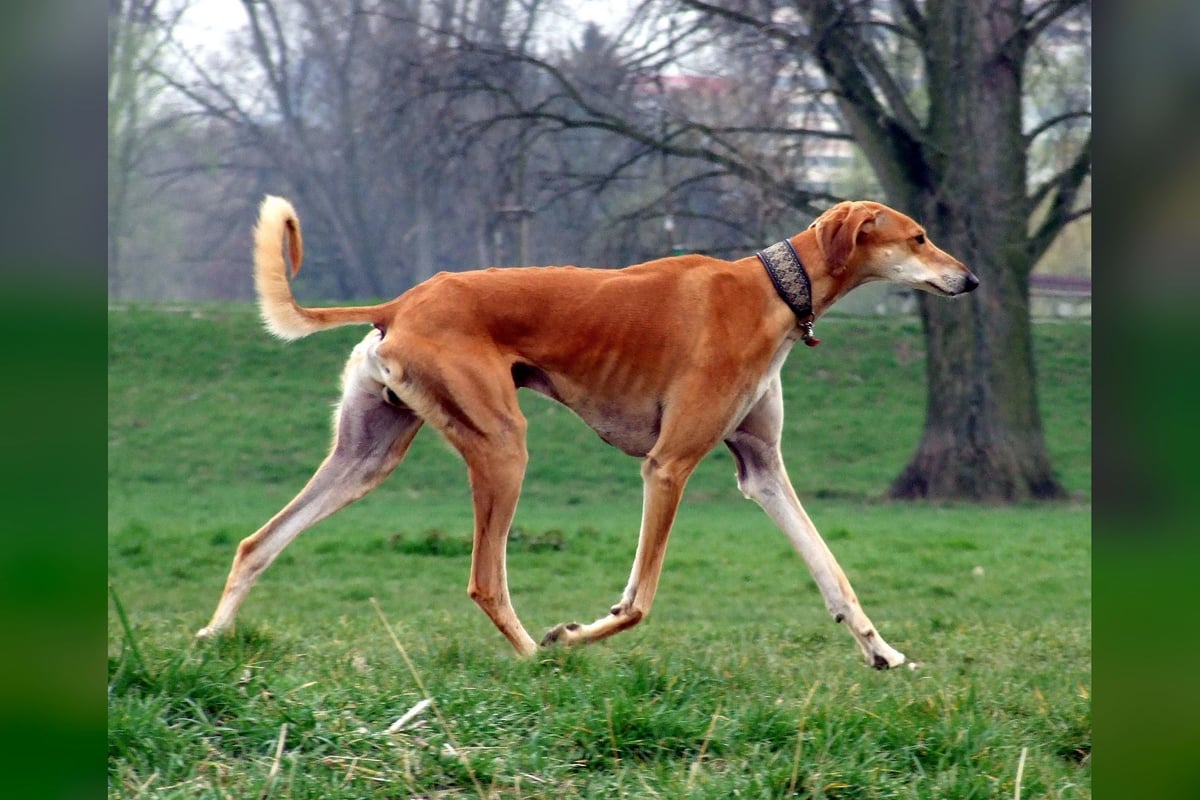
Saluki
The Saluki (FCI 269) weighs 13 to 30 kg for 58 to 71 cm at the withers, with a "feathered" variety (fringed ears and tail) and a "smooth" variety (entirely short coat). Attested as "Egypt's royal dog" through depictions dated to 4000 BC and identified in the tomb of Thutmose IV (1400 BC), it is the only animal Bedouin tradition allowed to sleep in the tent. Its ability to sustain 65-70 km/h over several kilometers sets it apart from the Greyhound, a pure sprinter, making it the ultimate long-distance sighthound.
- Weight
- 13 to 30kg
- Height
- 58 to 71cm
- Life expectancy
- 13years
- Monthly cost
- 70 to 120€
Personality profile
Energy 4/5
Independence 4/5
Trainability 2/5
Good with children 3/5
Barking 2/5
Space needed 4/5
Attachment to home 3/5
Good with strangers 2/5
Good with dogs 3/5
Good with cats 2/5
Coat care 2/5
Exercise needs 5/5
Scores given on measured axes, data confidence: high.
Living with a Saluki
Description
A slender but powerful sighthound body, deep and narrow chest, muscular and slightly arched loins, dense bone structure, with marked size differences between lines (Eastern lines lighter, European lines heavier). The feathered variety has long, silky drop ears, a tail with a silky fringe, and sometimes feathering on the legs. The smooth variety is entirely short-coated. The FCI standard admits a wide palette: fawn, cream, gold, red, grizzle, tricolor, black and tan — pure white is rare. A reserved expression, with a deep, aloof gaze characteristic of the breed.

Temperament
The Saluki shows marked behavioral independence inherited from millennia of autonomous hunting: it decides alone how much to engage with humans it doesn't know, adopting a cold reserve without aggression. Reserved with strangers to the point of appearing haughty — its prey drive is among the highest of all FCI breeds, and any moving prey can trigger a chase of 2 to 3 km with no return to recall. Within the family, it shows quiet, calm loyalty, without a Labrador's effusiveness.
Training
Training requires accepting a structural independence: this sighthound was selected for millennia to hunt at a distance without human instruction, work that rewards initiative over obedience. Positive reinforcement with short 10-minute sessions works better than repetitive submission exercises. The disciplines where it naturally excels are racing ones — FCI lure coursing and track racing. Reliable recall in unfenced open space is considered by breed specialists as nearly impossible to achieve at 100%.

Feeding
400 to 600 g of premium kibble a day for a 20 kg adult, in 2 meals spaced at least 4 hours apart. A high protein ratio (28-32%) is recommended to support the lean muscle mass of a distance athlete. Avoid intense exercise sessions within an hour of meals — the deep rib cage build theoretically predisposes it to gastric dilatation-volvulus (GDV), though the risk is lower than in the Great Dane. Fresh water at all times, especially after outings.
Affiliate links, no extra cost to you. Legal notice

Living conditions
A garden fenced to height (minimum 1.8 m, ideally 2 m) is essential: it clears a 1.5 m fence with a running start. An apartment is unsuitable without daily access to an open sprint space — 2 hours of exercise minimum per day, including at least two free-gallop sessions. Its cold tolerance is limited despite a denser coat than the Greyhound's: below 5 °C, extended outings should be avoided without protection. Its heat tolerance, on the other hand, is excellent, a millennia-old adaptation to the Arabian desert.

Grooming and coat care
The smooth variety only needs a weekly brushing with a grooming mitt. The feathered variety needs brushing 2 to 3 times a week with a soft brush to detangle the ear and leg fringes, areas where knots form quickly. Quarterly bath with a mild shampoo. No regular professional grooming required, but a spring trim of the interdigital hair makes movement on wet ground easier. Check the drop ears after every outing in vegetation.

Health
A robust breed with a life expectancy of 12 to 14 years (median 13 years). Osteosarcoma (bone cancer) is significantly less common in the breed than in the Greyhound or the Irish Wolfhound, which contributes to its relative longevity. Dilated cardiomyopathy is documented in some lines — annual cardiac auscultation recommended from age 5. Anesthetic sensitivity identical to other sighthounds: very low body fat mass and atypical barbiturate metabolism, any vet must be informed of the breed before surgery. Hypothyroidism reported occasionally in breed registries.
Breed history
The oldest depictions of Saluki-type dogs date back to 4000 BC on Sumerian pottery and Egyptian frescoes. Mummified specimens have been found in the tombs of pharaohs, including that of Thutmose IV (18th dynasty, around 1400 BC), attesting to the royal status granted to the breed. Among Bedouin peoples, it shared the living space of the tent — a unique privilege among animals, within an Islamic tradition that holds the dog to be impure, with an exception for hunting sighthounds. Introduced to Western Europe in the 19th century by British officers in the Middle East, recognized by the FCI under number 269, Group 10 Section 1 Long-haired or Fringed Sighthounds.
Getting ready for your Saluki
Five essentials to line up before day one.
Affiliate links, no extra cost to you. Legal notice
FAQ: Saluki
Sources
- FCI Standard No 269 — Saluki · FCI breed standard 269, Group 10 Sighthounds, Section 1 Long-haired or Fringed Sighthounds, country of origin UK (established from Middle-Eastern stock)
- AKC Breed Profile — Saluki · AKC Saluki breed profile, Hound Group, height 23-28 inches (58-71 cm)
- Société Centrale Canine — Standard Saluki · SCC LOF statistics Group 10, Saluki, annual registrations France
FCI, Fédération Cynologique Internationale, the world body that has codified breed standards since 1911. FCI number 269 is assigned to the Saluki.
Breeds similar to a Saluki

