


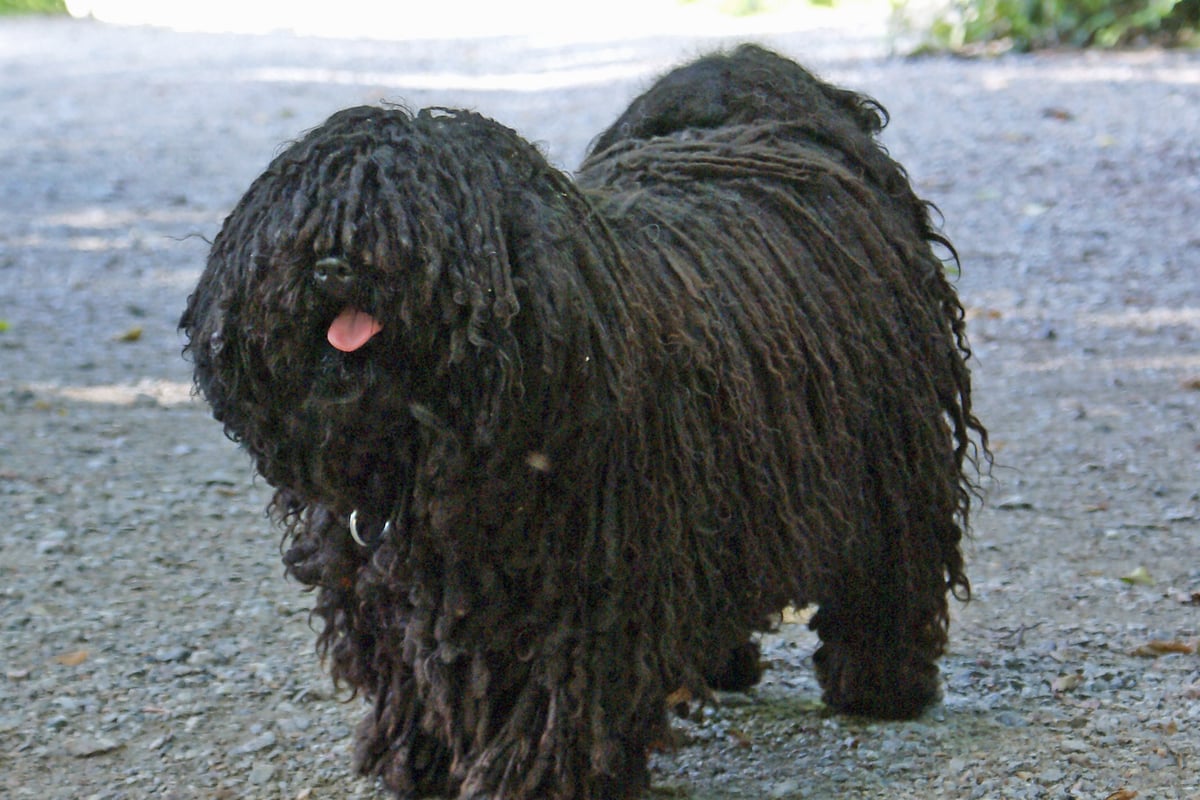
Puli
The Puli (FCI 55) is a Hungarian herding dog standing 36 to 45 cm at the withers for 10 to 15 kg, introduced to the Magyar plains in the 9th century by nomadic tribes migrating from Central Asia. Its naturally corded coat — the only canine dreadlocks to form without human intervention — makes it instantly recognizable among all the world's breeds. A breed related to the Tibetan Terrier and the Pumi, it shares the same ancient pastoral stock. Life expectancy of 12 to 16 years.
- Weight
- 10 to 15kg
- Height
- 36 to 45cm
- Life expectancy
- 14years
- Monthly cost
- 80 to 140€
Personality profile
Energy 5/5
Independence 3/5
Trainability 4/5
Good with children 4/5
Barking 5/5
Space needed 3/5
Attachment to home 4/5
Good with strangers 2/5
Good with dogs 3/5
Good with cats 3/5
Coat care 4/5
Exercise needs 5/5
Scores given on measured axes, data confidence: high.
Living with a Puli
Description
A medium-sized, compact and agile dog whose most striking physical feature is the corded coat, which begins forming at around 9 to 15 months. The cords — separated by hand, never brushed — grow to touch the ground in adulthood, forming a natural armor that historically protected against wolf bites and marsh moisture. The most typical color is solid black; white, fawn and gray are also admitted by the FCI standard. Its square silhouette and elastic gait betray a dog built for movement on rough terrain.

Temperament
Alert, attached to its family and wary of strangers — a structural wariness inherited from its role as an autonomous herder on the Hungarian pusztas. It is vocal and prone to barking: its guardian instinct drives it to insistently signal any unusual presence, which makes it an effective watchdog but poorly suited to environments where noise is a constraint. With children in the household, it is playful and engaged; its high energy, however, makes it less patient with very young children who don't respect its signals.
Training
Intelligent, it learns fast and handles short, varied sessions well — monotonous repetition breeds boredom and deviant behavior. Its high trainability score (4/5) does not mean blind obedience: it keeps a sense of judgment of its own, inherited from the autonomous herder. Dog sports like agility or frisbee suit its energy level and natural agility perfectly; plan for at least 1.5 to 2 hours of exercise and mental activity a day. Early socialization is decisive to temper its innate wariness of strangers.

Feeding
A daily ration of 180 to 250 g of premium small-to-medium breed kibble for a 12 kg adult, split into 2 meals. Growth is complete around 12 to 14 months; use the puppy formula until that age. Watch its weight: the cords make visually assessing body condition difficult — regularly palpate the ribs to ensure adequate fat coverage. During sustained activity, slightly increase the ration and ensure sufficient hydration, as the coat traps heat and promotes dehydration during exertion.
Affiliate links, no extra cost to you. Legal notice

Living conditions
Apartment living is feasible provided its exercise needs are met, but a house with an enclosed garden remains the best-suited environment for its energy level. Its dense corded coat protects it effectively from cold and frost, but traps body heat: in summer, intense exercise in hot weather should be avoided, and it needs constant access to shade and water. Its heat tolerance is low — particular vigilance is needed from 25 °C onward. Long daily walks over varied terrain are essential.

Grooming and coat care
Caring for the corded coat is unique and requires a specific technique: the cords must be separated by hand one by one to prevent them from fusing into a compact mass, an operation to perform every 3 to 6 months depending on density. There is no brushing or classic grooming — the whole coat is washed and drying takes several hours. Professional grooming familiar with the breed is strongly recommended for initial care. Ear, nail and teeth care follows a standard regular schedule. A poorly maintained dog develops painful mats that require a full clip.

Health
Life expectancy of 12 to 16 years, robust for an old breed with small numbers. The main genetic concern is progressive retinal atrophy (PRA-prcd): a DNA test is available, and serious breeders only mate individuals that test clear. Hip dysplasia is documented, to be checked radiographically before breeding. Congenital deafness has been reported in some white lines — BAER testing advised for puppies of this color. Degenerative myelopathy is a late-onset neurological condition to watch for. The dense corded coat can hide wounds or parasites — regularly inspect the skin under the cords.
Breed history
The breed was introduced to the Carpathian basin in the 9th century by the Magyars during their migration from the Asian steppes, with dogs from a stock shared with the Tibetan Terrier and the Pumi. On the pusztas (the great Hungarian plains), it worked as a driving herder: its role was not to guard the flock against predators (that fell to the Komondor) but to direct it, bounding and agile, able to jump across the sheep's backs to cross the flock at speed. The breed nearly disappeared during World War II and was reconstructed starting in the 1950s in Hungary. The FCI assigns it number 55; it has been recognized by the AKC since 1936.
Getting ready for your Puli
Five essentials to line up before day one.
Affiliate links, no extra cost to you. Legal notice
FAQ: Puli
Sources
- FCI Standard No 55 — Puli · FCI breed standard 55, Group 1 Sheepdogs and Cattledogs
- Société Centrale Canine — Puli · SCC official breed profile Puli, Group 1
- AKC Breed Profile — Puli · AKC Puli breed profile, Herding Group
FCI, Fédération Cynologique Internationale, the world body that has codified breed standards since 1911. FCI number 55 is assigned to the Puli.
Breeds similar to a Puli

