


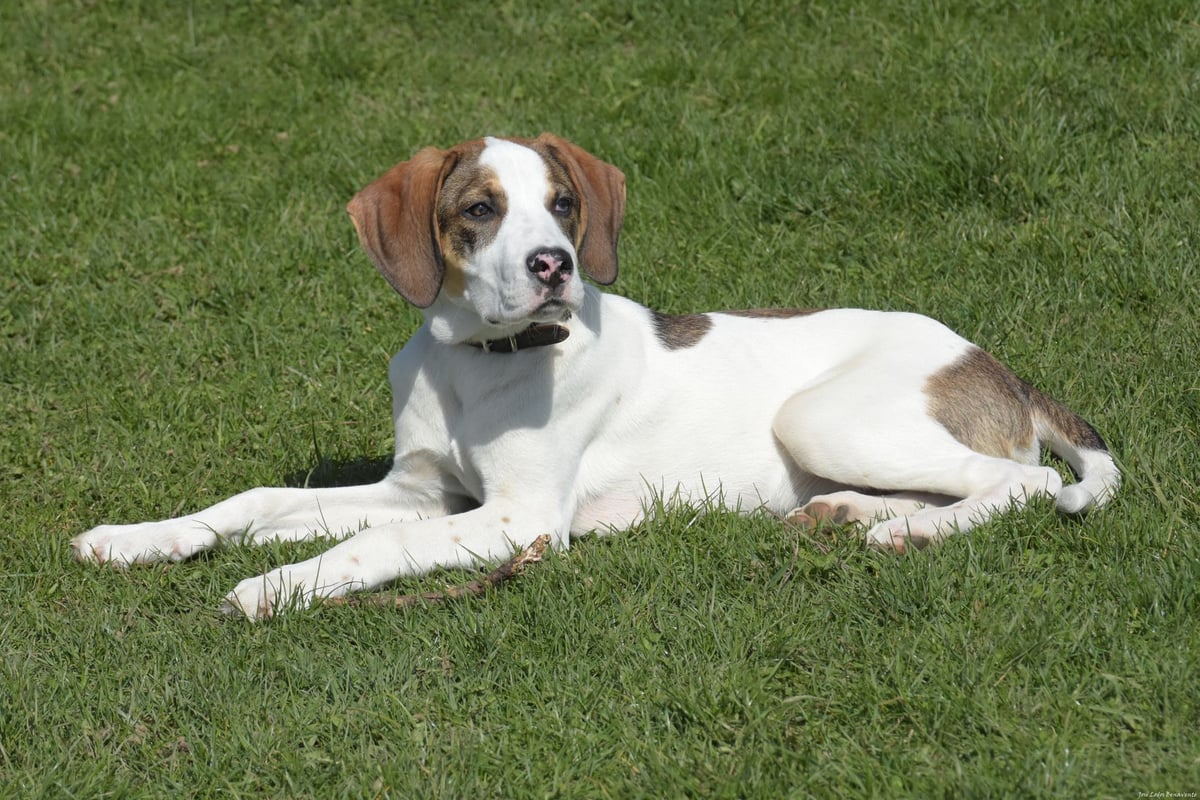
English Pointer
The English Pointer weighs 20 to 34 kg for 61 to 71 cm at the withers — a British pointing dog, FCI number 1, group 7. Bred for full days of hunting feathered game at a sustained gallop, it requires at least 2 hours of intense daily exercise. A relatively healthy breed for its size, with a life expectancy of 12 to 15 years. Its short, smooth coat makes it the least demanding of all large hunting breeds when it comes to grooming.
- Weight
- 20 to 34kg
- Height
- 61 to 71cm
- Life expectancy
- 13years
- Monthly cost
- 80 to 130€
Personality profile
Energy 5/5
Independence 3/5
Trainability 4/5
Good with children 4/5
Barking 2/5
Space needed 5/5
Attachment to home 4/5
Good with strangers 4/5
Good with dogs 4/5
Good with cats 2/5
Coat care 1/5
Exercise needs 5/5
Scores given on measured axes, data confidence: high.
Living with an English Pointer
Description
A large breed with a lean, muscular silhouette: a noble head with a pronounced stop and square muzzle, flat ears falling to the cheeks, round and expressive eyes. Short, fine, smooth coat, shining like satin — official colors: lemon and white, orange and white, liver and white, black and white. Body slightly longer than tall, deep chest for lung capacity, powerful hindquarters for drive at the gallop. Straight tail carried horizontally, without curl. Coat often patched or irregularly ticked. Marked sexual dimorphism: males 25-34 kg (66-71 cm), females 20-30 kg (61-66 cm).

Temperament
An even-tempered, affectionate family dog, without the disorganized hyperactivity of some hunting breeds. Indoors, the Pointer settles down readily after exercise — no systematic destruction if its physical needs are met. Sociable with strangers without being overly attached: capable of greeting a visitor calmly once trained. Good with children old enough (8+) to handle its size and exuberance during play. Strong hunting instinct: cohabiting with cats and small animals is risky without intensive early socialization. Its head lifts and freezes into a point the moment it picks up a game scent — an irrepressible reflex, the result of centuries of selection.
Training
Solid trainability (score 4/5): the Pointer picks up basic commands and obedience exercises quickly. Memorizes a new command in 15 to 25 repetitions with positive reinforcement. Its strong hunting instinct requires a thoroughly grounded recall before any off-leash outing — work in a secure enclosure for the first 6 months. Responsive to voice and contact; coercion produces inhibition without improving obedience. Excellent at field trials, agility and canicross — disciplines that channel its galloping endurance and intense need for exercise over long distances. Start socialization and training as early as 8 weeks.

Feeding
350 to 500 g of premium kibble (26-30% protein) a day for a 25-30 kg adult, adjusted to actual activity level. On days of intensive hunting or sport training, increase the ration by 20-25%. Two daily meals mandatory — a single meal increases the risk of gastric dilatation-volvulus at this size. Avoid intense exercise within 2 hours of a meal. BARF feeding is compatible with the breed but requires precise phosphocalcium monitoring for an active dog.
Affiliate links, no extra cost to you. Legal notice

Living conditions
Apartment living is unsuitable and strongly discouraged for this breed — even with regular outings, the lack of open running space generates chronic frustration. A house with a fenced garden is the minimum viable setup; the ideal remains the countryside or suburbs with access to open ground. In rural areas, it can be kept in a kennel with daily human socialization, though family contact remains beneficial. Handles heat well thanks to its smooth coat — best to avoid intense exercise above 30 °C. Sensitive to cold below 5 °C without shelter: coat too short for thermal insulation, a coat is useful in winter.

Grooming and coat care
Minimal upkeep: it is one of the easiest breeds of its size to groom. A weekly brushing with a grooming mitt or short-bristle brush is enough to remove dead hair and maintain coat shine. Monthly bath or after muddy outings. Systematic ear inspection after every outdoor session: flat ears reduce ventilation, favoring moisture. Bi-weekly ear cleaning. Nail trim every 4 to 6 weeks if the dog does not wear them down sufficiently on hard ground.

Health
A generally healthy breed for its size, with a life expectancy of 12 to 15 years, higher than that of many large-format dogs. Pathologies to watch: hip dysplasia (OFA/HD radiographic screening advised on breeding stock), progressive retinal atrophy (PRA — DNA test available, leads to progressive blindness), skin allergies and eczema (fine skin sensitive to grasses and parasites), congenital deafness (common in dogs with very white or heavily ticked coats — BAER testing recommended). Moderate ear infections (flat ears limiting ventilation). No major hereditary cardiac pathology documented at the breed-wide level.
Breed history
The English Pointer is one of the oldest and most iconic pointing breeds of Great Britain, mentioned in hunting texts as early as the 17th century. Its direct ancestor is thought to be the Spanish Pointer, introduced to England around 1713 and crossed with Foxhounds, Greyhounds and Bloodhounds to give it speed and stamina. It opens the international nomenclature: it is FCI breed number 1, group 7 (pointing dogs). Adopted in the 19th century by hunters of large feathered game in England, Scotland and Ireland. Imported to France in the 19th century by the hunting aristocracy; present in the LOF since the SCC's earliest statistics.
Getting ready for your English Pointer
Five essentials to line up before day one.
Affiliate links, no extra cost to you. Legal notice
FAQ: English Pointer
Sources
- FCI Standard No 1 — English Pointer · FCI breed standard 1, Group 7 Pointing Dogs, Section 2 British and Irish Pointers and Setters
- AKC Breed Profile — Pointer · AKC Pointer breed profile, Sporting Group — weight 45-75 lbs, height 23-28 inches, lifespan 12-17 years
FCI, Fédération Cynologique Internationale, the world body that has codified breed standards since 1911. FCI number 1 is assigned to the English Pointer.
Breeds similar to an English Pointer

