


Dobermann
Pinscher and Schnauzer - Molossoid and Swiss Mountain and Cattledogs
32 to 45 kg
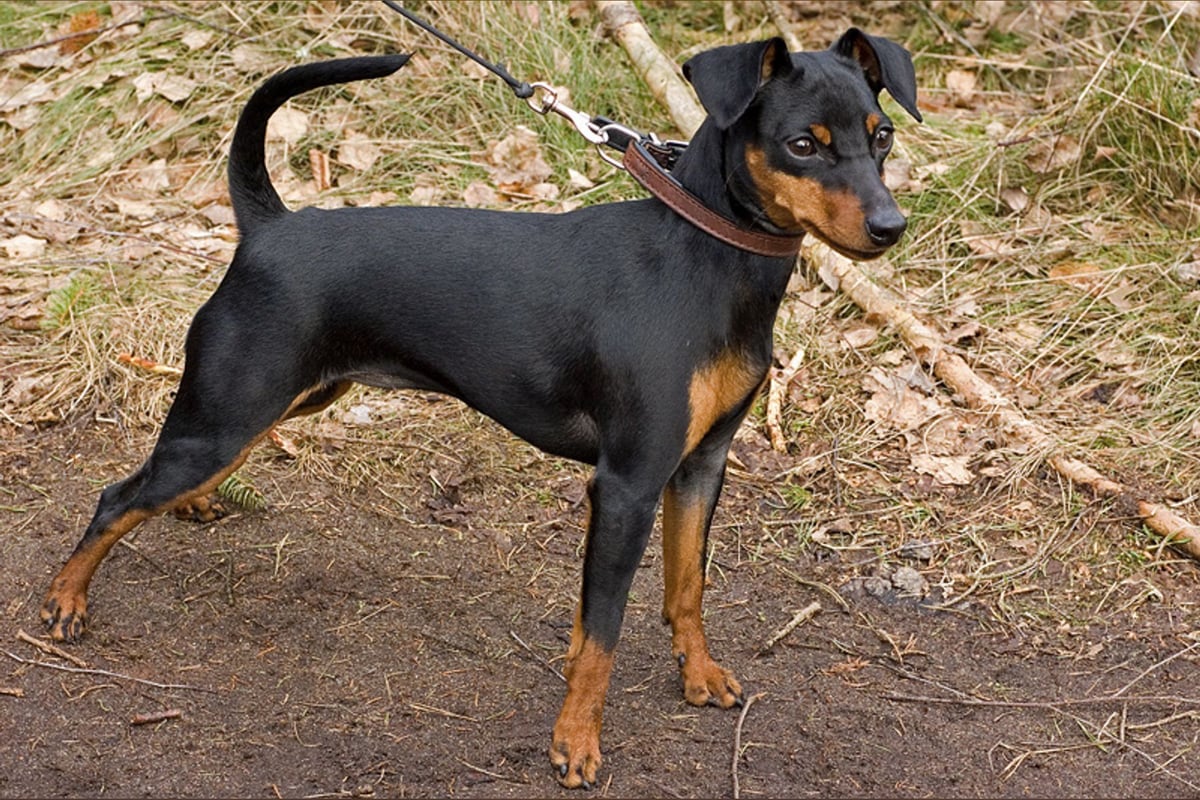
The Miniature Pinscher weighs 4 to 6 kg for 25 to 30 cm at the withers. Recognized as FCI number 185, group 2, section 1.1, native to Germany, where it was used as a rat hunter on farms and in stables. Life expectancy 12 to 16 years. Maximum energy (5/5) in a miniature format: without structured daily exercise, it quickly develops destructive behavior and compulsive barking. Genetic predispositions to watch for: mucopolysaccharidosis type VI (MPS VI, DNA test available), patellar luxation, and progressive retinal atrophy.
Scores given on measured axes, data confidence: high.
Living with a Miniature Pinscher
The Miniature Pinscher shows the square proportions typical of the Pinscher group: height at the withers equal to body length, dry bone structure, musculature visible under a short, glossy coat. Short coat with no undercoat, available in fawn-red, red-brown, black and tan, blue and tan. Sexual dimorphism is not pronounced. V-shaped ears, drooping or erect depending on the individual; ear cropping, once practiced to make them stand upright, is now banned in most European countries. Its build recalls a Dobermann reduced in scale, earning it the English nickname "King of Toys" or "min pin." Long, fine limbs relative to its mass: a fall from furniture can cause a fracture.

Lively, alert and vocal: it barks to signal any sound or visual intrusion into its territory, a barking behavior to work on from the first weeks through systematic desensitization. High energy and a need for continuous mental and physical stimulation — without suitable activity, it channels this energy into destruction or agitation. Wary of strangers and larger dogs, with a tendency to assert itself despite its size. Caution is required with young children: its 4 to 6 kg frame makes it vulnerable to uncontrolled handling, and a stressed or hurting Miniature Pinscher responds by snapping. Attached to its main handler, it tolerates long absences poorly.
Moderate trainability (3/5): intelligent and sharp, it picks up commands quickly, but its independent temperament leads it to weigh the cost-benefit before cooperating. Sessions of 5 to 10 minutes, very frequent (2 to 3 a day), based exclusively on positive reinforcement. Punishment breeds mistrust and reinforces stubbornness. Early socialization before 16 weeks is critical to ease reactive barking and wariness of strangers. Dog sport activities — agility, obedience, nose work — help channel its overflowing energy and improve cooperation over the long term.

100 to 150 g of premium kibble a day for a 5 kg adult, split into 2 meals. Small-breed kibble (8-10 mm diameter) suited to its teeth. Rigorous monitoring of body condition: documented tendency toward obesity, especially after spaying/neutering. A weight gain of 500 g represents 10% of body weight and mechanically worsens patellar luxation. No fatty treats: prioritize low-calorie-density rewards.
Affiliate links, no extra cost to you. Legal notice

Suited to apartment living if activity needs are met: a minimum of 45 to 60 minutes of sustained exercise per day, splittable into 2 to 3 outings with running or fetch games. Its sensitivity to cold below 5 °C (short coat with no insulating undercoat) requires a coat in winter; it must sleep indoors, never in an outdoor kennel. A fence is mandatory in any outdoor space: instinct to roam and hunt small animals. Avoid a standard collar for walks — a chest harness is preferable to protect the trachea during sudden pulls.

Among the simplest grooming needs of any breed: the short coat only needs a weekly pass with a grooming mitt to remove dead hair and maintain shine. Monthly bath with a mild shampoo. Moderate shedding in spring and fall. Weekly ear check (prone to wax buildup in drop ears). Monthly nail trim — the fine limbs mean natural wear is insufficient for dogs living exclusively indoors.

Three priority genetic predispositions to know before adopting. Mucopolysaccharidosis type VI (MPS VI) is a lysosomal storage disease with autosomal recessive inheritance: progressive accumulation of glycosaminoglycans in tissue, leading to bone issues, corneal clouding and neurological damage — a DNA test is available and should be required from both parents. Patellar luxation (grade I to IV) is documented in the breed: watch for any limping or hopping during outings. Progressive retinal atrophy (PRA) leads to progressive night blindness and eventual total blindness — an annual ophthalmological exam is recommended from age 3. Tendency to gain weight after spaying/neutering: adjust the ration immediately. Fine limbs: any fall from a height over 50 cm carries a fracture risk.
The Miniature Pinscher (Zwergpinscher in German) descends from the medium-sized German Pinscher, selected over several centuries on farms and in stables to eliminate rodents. The first traces of a miniature variant appear in the German Stud Book (Deutsches Hundestammbuch) as early as 1879. Recognized as separate from the medium Pinscher by the FCI under number 185, group 2 (Pinscher and Schnauzer type dogs, Molossoid breeds, Swiss Mountain and Cattledogs), section 1.1. Introduced to the United States in the early 20th century, it entered the AKC registry in 1925 in the Toy Group under the name Miniature Pinscher. Its resemblance to a miniaturized Dobermann is often mentioned, but it predates it: the two breeds share common ancestors without a direct line of descent.
Five essentials to line up before day one.
Affiliate links, no extra cost to you. Legal notice
FCI, Fédération Cynologique Internationale, the world body that has codified breed standards since 1911. FCI number 185 is assigned to the Miniature Pinscher.
Pinscher and Schnauzer - Molossoid and Swiss Mountain and Cattledogs
32 to 45 kg

Pinscher and Schnauzer - Molossoid and Swiss Mountain and Cattledogs
4 to 8 kg
