


Miniature Pinscher
Pinscher and Schnauzer - Molossoid and Swiss Mountain and Cattledogs
4 to 6 kg
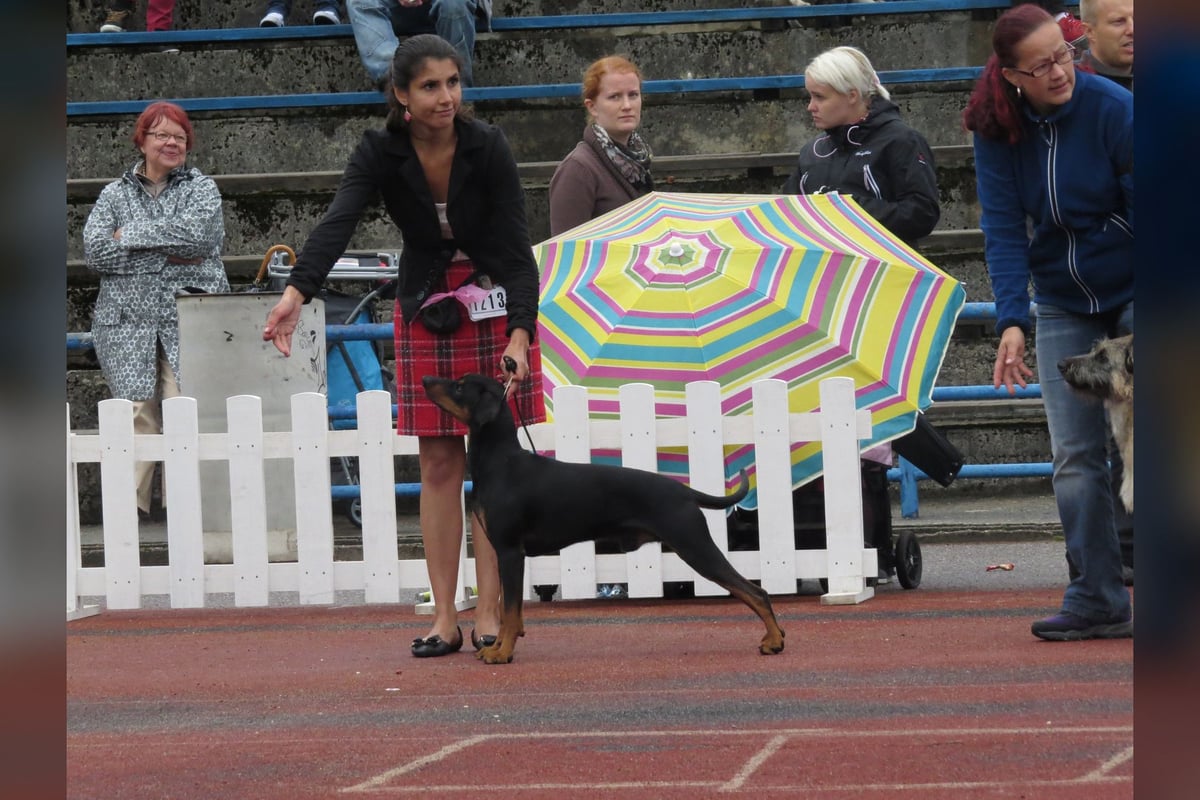
The German Pinscher weighs 14 to 20 kg for 45 to 50 cm at the withers. Recognized as FCI number 184, group 2, section 1.1, native to Germany. It is the standard variant of the Pinscher group, the documented ancestor of the Dobermann (developed from 1880 onward) and an intermediate version between the Miniature Pinscher (~5 kg, FCI 185) and these larger descendants. A rare breed in France (~150 annual LOF registrations) after near-extinction during World War II — a single breeding dog recorded in West Germany in 1949 (Werner Jung, Franconia). Life expectancy 12 to 14 years.
Scores given on measured axes, data confidence: high.
Living with a German Pinscher
The German Pinscher shows the canonical square proportions of the group: height at the withers equal to body length, dry bone structure, musculature clearly visible under a short, dense coat with no undercoat. Intermediate build: at 45 to 50 cm at the withers for 14 to 20 kg, it sits between its miniature descendant (Miniature Pinscher, 25-30 cm) and the Dobermann (63-72 cm). Short coat available in fawn-red, red-brown, and black-and-tan under FCI standard 184. V-shaped ears, naturally carried drooping — ear cropping, once practiced, is now banned in most European countries. The tail was traditionally docked; this practice is likewise prohibited under the European Convention for the Protection of Pet Animals (1987).

Alert and energetic without reaching the maximum level of the Miniature Pinscher: its 4/5 energy is that of an active working dog, not an uncontrollable sprinter. Wary of strangers — an alert and watchful reaction — with a functional guarding instinct rooted in its origins as a farm ratter. Attached to its main handler, it develops strong loyalty. Its predisposition for vermin hunting and searching remains active: interactions with small animals (rodents, rabbits) require supervision and solid recall training.
Trainability of 3/5: intelligent, sharp and capable of quick learning, but its independent temperament leads it to weigh the usefulness of commands before systematically cooperating. Sessions of 10 to 15 minutes, regular, based on positive reinforcement with high-value food rewards. Early socialization before 16 weeks is decisive: exposure to unfamiliar people, children, other dogs, and varied environments to soften its structural wariness of the unknown. Dog sports suited to its build and instincts: obedience, agility, mantrailing, nose work.

250 to 350 g of premium kibble a day for a 17 kg adult, split into 2 meals. Medium-size kibble is suitable. Monitor body condition: keep ribs palpable without excess fat tissue. An uncontrolled waistline mechanically worsens the joint load on the hips — particularly relevant in a breed with a moderate predisposition to dysplasia. No fatty treats as a routine; prioritize low-calorie-density rewards during training sessions.
Affiliate links, no extra cost to you. Legal notice

A house with secure outdoor access is recommended, though apartment living remains workable if activity needs are met: a minimum of 60 minutes of sustained exercise per day, splittable into 2 outings with running or dynamic play. Its short coat with no undercoat gives it moderate cold tolerance (3/5) — a coat is recommended below 5 °C for extended outings. A fence of at least 1.50 m is required in any outdoor space: active tendency to roam and explore. A confirmed indoor dog, it does not tolerate permanent outdoor kenneling.

Grooming is among the simplest in the group: a short coat with no undercoat needs only a weekly pass with a rubber grooming mitt to remove dead hair and maintain shine. Moderate shedding twice a year (spring, fall). Monthly bath with a mild shampoo. Bi-weekly ear check and monthly nail trim. No stripping, no clipping — a notable advantage over the Schnauzer variants, which require technical grooming twice a year.

A favorable health profile for a breed of this size: few genetic pathologies documented at high prevalence, in contrast with breeds reconstructed from a narrow base. Hip dysplasia is documented at a moderate rate — x-rays of breeding stock are recommended at serious kennels. Hereditary cataracts (annual ophthalmological exam) and dilated cardiomyopathy (cardiac workup from age 5) round out the health points to monitor. The narrow genetic base after reconstruction (a single breeding dog alive in 1949) makes it essential to choose a breeder who traces pedigrees back at least 5 generations.
The German Pinscher (Deutscher Pinscher) is documented in the German Stud Book (Deutsches Hundestammbuch) as early as 1880 as a farm and stable breed, used for hunting rodents and guarding property. It is the direct ancestor of the Dobermann: Karl Friedrich Louis Dobermann, a tax collector in Thuringia, developed his personal breed from 1880 onward using the German Pinscher, the Rottweiler and the Beauceron. The breed nearly disappeared during World War II: Werner Jung, a breeder from Franconia (West Germany), recorded a single living breeding dog in the country in 1949. Genetic reconstruction, including crosses with the Miniature Schnauzer to broaden the base, allowed the breed to be reestablished. Recognized by the FCI under number 184, group 2, section 1.1.
Five essentials to line up before day one.
Affiliate links, no extra cost to you. Legal notice
FCI, Fédération Cynologique Internationale, the world body that has codified breed standards since 1911. FCI number 184 is assigned to the German Pinscher.
Pinscher and Schnauzer - Molossoid and Swiss Mountain and Cattledogs
4 to 6 kg

Pinscher and Schnauzer - Molossoid and Swiss Mountain and Cattledogs
32 to 45 kg

Pinscher and Schnauzer - Molossoid and Swiss Mountain and Cattledogs
14 to 20 kg