


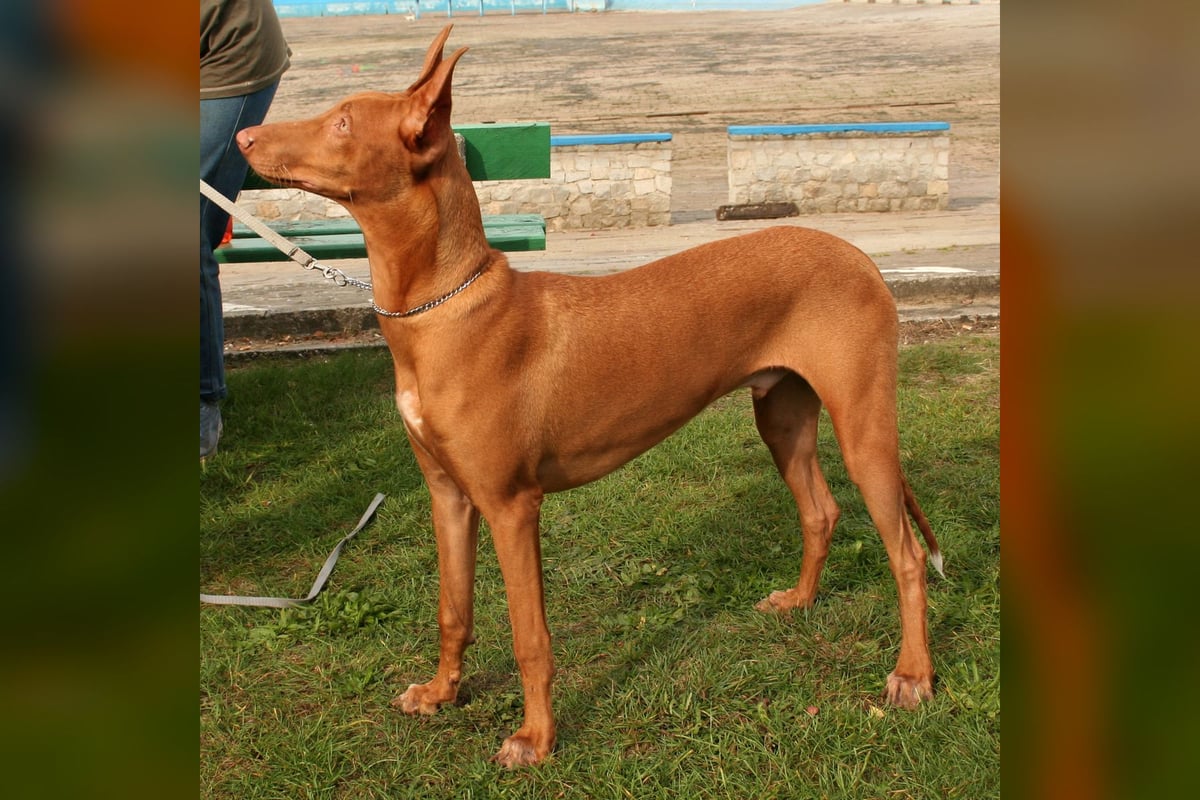
Pharaoh Hound
The Pharaoh Hound (FCI 248), called Kelb tal-Fenek ("rabbit dog") in Malta, weighs 18 to 25 kg for 53 to 63 cm at the withers — Malta's national dog since 1974. Despite its striking resemblance to the canine effigies of Anubis, the DNA study by Parker et al. (2017) places its origins in the Phoenician Mediterranean basin, not Egypt: parallel evolution on Malta's karst terrain shaped a convergent sighthound morphotype. Its rarest trait among canids: "blushing" — a visible reddening of the nose and ears through vasodilation when excited, observable on the breed's thin skin.
- Weight
- 18 to 25kg
- Height
- 53 to 63cm
- Life expectancy
- 12years
- Monthly cost
- 80 to 140€
Personality profile
Energy 5/5
Independence 4/5
Trainability 3/5
Good with children 4/5
Barking 3/5
Space needed 4/5
Attachment to home 4/5
Good with strangers 3/5
Good with dogs 3/5
Good with cats 2/5
Coat care 1/5
Exercise needs 5/5
Scores given on measured axes, data confidence: high.
Living with a Pharaoh Hound
Description
A slender sighthound body, dry musculature clearly visible under a short reddish-gold to tan coat, with a nose, ears and pads in flesh-pink tones. The ears are large, wide at the base and held rigid in alert position — a distinctive feature that sets it apart from other drop-eared sighthounds. The thin skin, pink-colored on depigmented areas, makes vasodilation visible to the naked eye. Amber eyes leaning toward ochre, expressive. A long, fine, whip-like tail. Two standard FCI coat variants: tan and red, with white admitted on the tail tip and an optional white blaze.

Temperament
An action dog that goes from couch-sighthound to 65 km/h in under a second: at rest in the house, it can sprawl for hours; the moment a visual stimulus (bird, bicycle, small animal) triggers its prey drive, it vanishes with no reliable recall in open space. Its family attachment is sincere and demonstrative — it initiates physical contact, unlike the Saluki or the Borzoi. The blushing also serves as a daily emotional barometer: it signals excitement or intense joy, never distress.
Training
It picks up basic routines quickly, but its independence as a self-reliant hunter creates selective obedience: it responds readily when the command interests it, less so when an outside stimulus grabs its attention. Positive reinforcement with high-value treats, sessions of 10 to 15 minutes, varied exercises to avoid saturation. Recall in unfenced open space should be considered unreliable at 100% — even well-trained individuals can switch over to chase instinct. Suitable sports: lure coursing, racing.

Feeding
550 to 800 g of premium kibble a day for a 20 kg adult, in 2 meals spaced at least 4 hours apart. A protein ratio of 26-30% is recommended to support the muscle mass of an agile athlete. The sighthound build (deep, narrow chest) carries a theoretical risk of gastric dilatation-volvulus (GDV) if the dog runs within the hour after eating — do not allow access to sprint space within 90 minutes after a meal. Fresh water at all times.
Affiliate links, no extra cost to you. Legal notice

Living conditions
A house with a garden fenced to at least 1.8 m is mandatory: its speed and agility on uneven ground — in Malta it hunts by leaping from rock to rock on volcanic karst — make a standard 1.2 m fence easy to clear. A minimum of two hours of daily activity is needed, including free sprints in a secure enclosure. Its cold tolerance is among the lowest of all sighthounds: thin skin, no undercoat, a metabolism suited to the Mediterranean climate — below 10 °C, a waterproof coat is essential. Summer heat, on the other hand, does not bother it.

Grooming and coat care
Near-zero upkeep: the short coat only needs a weekly brushing with a rubber grooming mitt to remove dead hair. Bathe every 6 to 8 weeks with a mild shampoo suited to thin skin. Depigmented areas (nose, ear edges) can be sensitive to intense summer sun — some Maltese breeders use veterinary sun protection during extreme heat periods. Nails to trim every 3 to 4 weeks if the dog does not wear them down naturally.

Health
A breed with low genetic disease prevalence: the geographic bottleneck of the island of Malta paradoxically selected for a healthy population with few known hereditary defects. Life expectancy of 11 to 14 years, with a median of 12 years. Anesthetic sensitivity common to sighthounds (low body fat mass, atypical barbiturate metabolism) — any vet performing surgery must be informed of the breed beforehand. No genetic test is mandatory under FCI standard 248, but an annual ophthalmological exam is advised from age 7.
Breed history
The Kelb tal-Fenek has been documented in Malta for at least two millennia in Arabic writings and the accounts of Mediterranean sailors. The theory of a direct Egyptian origin, long supported by its morphological resemblance to depictions of Anubis, was formally revised by the DNA study of Parker et al. (Cell Reports, 2017): the breed is genetically a Mediterranean dog of Phoenician type, whose sighthound morphology results from convergent adaptation to Malta's karst terrain. Declared Malta's national dog by official act in 1974, recognized by the FCI under number 248, Group 10 Section 3 Sighthounds. Introduced to Great Britain in the 1960s-1970s, the breed remains rare outside Malta with fewer than 50 annual LOF births in France.
Getting ready for your Pharaoh Hound
Five essentials to line up before day one.
Affiliate links, no extra cost to you. Legal notice
FAQ: Pharaoh Hound
Sources
- FCI Standard No 248 — Pharaoh Hound · FCI breed standard 248, Group 10 Sighthounds, Section 3 Short-haired Sighthounds, country of origin Malta
- AKC Breed Profile — Pharaoh Hound · AKC Pharaoh Hound breed profile, Hound Group, height 21-25 inches (53-63 cm), weight 45-55 lbs (20-25 kg)
- Société Centrale Canine — Standard Pharaoh Hound · SCC LOF statistics Group 10 Section 3, Pharaoh Hound FCI 248, annual registrations France
- Parker et al. (2017) — Genomic analysis of the dog breeds · Parker HG et al., Genomic Analyses Reveal the Influence of Geographic Origin, Migration, and Hybridization on Modern Dog Breed Development, Cell Reports 2017 — demonstration of the Pharaoh Hound's non-Egyptian Mediterranean origin
FCI, Fédération Cynologique Internationale, the world body that has codified breed standards since 1911. FCI number 248 is assigned to the Pharaoh Hound.

