


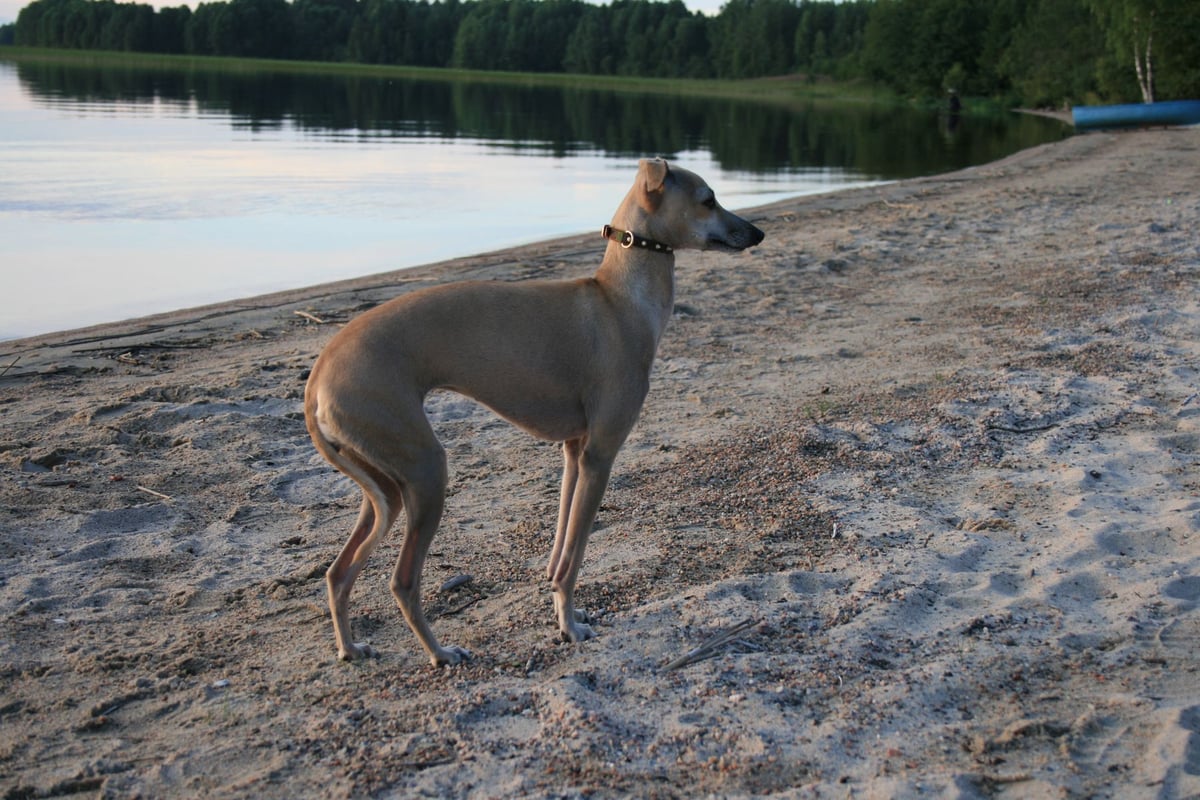
Italian Greyhound
The Italian Greyhound (FCI 200) weighs 3 to 5 kg for 32 to 38 cm at the withers — the lightest sighthound recognized by the FCI. Depicted on Egyptian figurines from 2000 BC, it became the favorite sighthound of the courts of the Italian peninsula, starting with that of Frederick II Hohenstaufen. Its thin, undercoat-free skin and slender long bones demand constant vigilance against fractures and hypothermia.
- Weight
- 3 to 5kg
- Height
- 32 to 38cm
- Life expectancy
- 14years
- Monthly cost
- 60 to 100€
Personality profile
Energy 4/5
Independence 3/5
Trainability 3/5
Good with children 3/5
Barking 3/5
Space needed 2/5
Attachment to home 5/5
Good with strangers 2/5
Good with dogs 4/5
Good with cats 3/5
Coat care 1/5
Exercise needs 3/5
Scores given on measured axes, data confidence: high.
Living with an Italian Greyhound
Description
A miniaturized sighthound silhouette: arched loin, deep chest, long, slender limbs with no excess muscle mass. The skin is so thin that the subcutaneous veins are visible on the flanks. Two coat varieties: solid (fawn, slate gray, black) or bicolor with white. FCI standard: long, narrow head, flat skull, tapered muzzle, large, bright eyes. The fragility of the long bones — the tibia and radius in particular — produces a spontaneous fracture rate well above the average for breeds this size, often from a simple landing after jumping off a couch.

Temperament
Deeply attached to its key people, to the point of following their every move around the house, the Italian Greyhound frequently develops severe separation anxiety if it is not accustomed to solitude as a puppy. Its explosive sprint speed (a recorded top speed of 40 km/h for a 5 kg dog) contrasts with intense couch-dwelling behavior indoors. Reserved, even fearful, with strangers, it is socially selective rather than distrustful — early socialization before 12 weeks reduces residual shyness in adulthood.
Training
Intelligent but distracted by the slightest outdoor movement — its courser's instinct triggers an instant chase at any moving stimulus. Positive reinforcement exclusively, short 5-to-10-minute sessions indoors: beyond that, attention drops off sharply. Recall in open settings is very hard to make reliable — never let it off leash without a fence at least 1.8 m high. Suited sports: miniature lure coursing, light-version agility (reduced jump heights to protect the long bones before 18 months).

Feeding
150 to 200 g of premium kibble a day for a 4 kg adult, in 2 meals. Prefer mini-size kibble (7 to 9 mm diameter) suited to the small jaw. Monitor body condition: palpable but not visible ribs is the standard morphological norm for sighthounds — do not overfeed, as obesity increases fracture risk on already slender limbs. Calcium and vitamin D supplementation is not recommended without a veterinary prescription.
Affiliate links, no extra cost to you. Legal notice

Living conditions
An apartment works, provided fall risks are eliminated: high couches and beds, stairs without a low guard rail, and unprotected balconies are documented fracture sites. Its sensitivity to cold is extreme — thin skin, a complete absence of undercoat and almost no subcutaneous fat lead to rapid hypothermia from as little as 8 °C outdoors: a waterproof coat is mandatory in fall and winter. Access to a fenced area for sprints remains necessary 3 to 4 times a week.

Grooming and coat care
Minimal upkeep: weekly brushing with a rubber grooming mitt removes the few dead hairs from a short coat. A bath every 6 to 8 weeks with a mild shampoo formulated for sensitive skin — thin skin is more prone to irritation than a thicker coat would allow. Regular checks of the ears and nails, which grow quickly on a dog not very active on hard ground. No professional grooming required.

Health
Four priority points of vigilance. Long bone fractures (tibia, radius): a risk up to 18 months during bone growth, but also in adulthood from landing a jump of more than 60 cm — prevalence estimated at 26% over a lifetime according to British registry studies. Primary hereditary epilepsy: present in some lines, appearing between 1 and 3 years — a genetic assessment of breeding stock is recommended before any purchase. Patellar luxation (grade I-III) documented in around 8% of dogs seen in consultation. Anesthesia: atypical barbiturate metabolism, the same as in other sighthounds — inform any veterinarian of the breed before any procedure.
Breed history
The earliest depictions of dogs of the miniaturized sighthound type appear in Egyptian figurines dated to 2000 BC. The breed spread through the courts of the Italian peninsula, where Frederick II Hohenstaufen was among its first patrons; from the 14th century on, it became the companion sighthound of many Venetian doges — the portraits of Pisanello and Ghirlandaio attest to this. After a 19th-century decline that threatened the breed's survival, crosses with Chihuahuas and Bichons allowed a partial reconstruction but introduced bone weaknesses that are managed today through selective breeding. Recognized by the FCI under number 200, Group 10 Section 3 Short-haired Sighthounds.
Getting ready for your Italian Greyhound
Five essentials to line up before day one.
Affiliate links, no extra cost to you. Legal notice
FAQ: Italian Greyhound
Sources
- FCI Standard No 200 — Italian Greyhound · FCI breed standard 200, Group 10 Sighthounds, Section 3 Short-haired Sighthounds, country of origin Italy
- AKC Breed Profile — Italian Greyhound · AKC Italian Greyhound breed profile, Toy Group, weight 7-14 lbs (3.2-6.4 kg)
- Société Centrale Canine — Italian Greyhound Standard · SCC LOF statistics, Group 10, Italian Greyhound, annual registrations
FCI, Fédération Cynologique Internationale, the world body that has codified breed standards since 1911. FCI number 200 is assigned to the Italian Greyhound.
Breeds similar to an Italian Greyhound

