


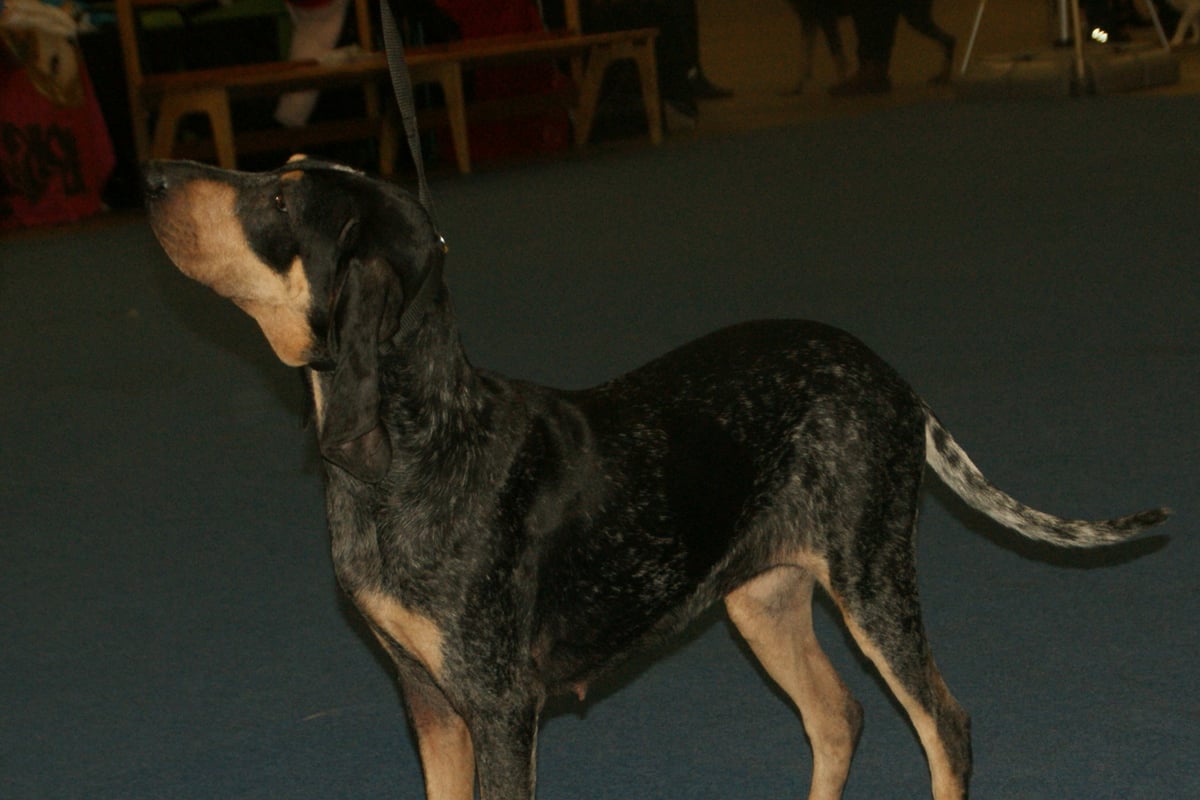
Petit Bleu de Gascogne
The Petit Bleu de Gascogne (FCI 31) is a medium-sized French scent hound weighing 17 to 22 kg for 50 to 58 cm at the withers, produced by the selective downsizing of the Grand Bleu de Gascogne for hunting rabbit and hare on the hillsides of Béarn and Gascony from the 14th century on. Its white coat flecked with black — giving a characteristic "slate-blue" sheen — and its deep hunting voice, carrying for several kilometers, make it an instantly recognizable breed. Little known outside French hunting circles, it accounts for only around 200 LOF registrations a year, mostly among hunters.
- Weight
- 17 to 22kg
- Height
- 50 to 58cm
- Life expectancy
- 12years
- Monthly cost
- 70 to 130€
Personality profile
Energy 4/5
Independence 3/5
Trainability 3/5
Good with children 5/5
Barking 5/5
Space needed 4/5
Attachment to home 4/5
Good with strangers 4/5
Good with dogs 5/5
Good with cats 1/5
Coat care 1/5
Exercise needs 5/5
Scores given on measured axes, data confidence: medium.
Living with a Petit Bleu de Gascogne
Description
A silhouette balanced between a bloodhound-type and a light scent hound: solid bone without bulk, an athletic gait, a well-supported back. The coat is white flecked with irregular black spots creating the characteristic blue-slate effect, with large black patches on the head and body, and tan markings above the eyes, on the cheeks and under the tail. The ears are long, drooping, curled inward, set low — a distinctive mark of the Gascon type. The short, dense coat is easy to maintain. A trait rare in a scent hound: a low body odor often mentioned by owners.

Temperament
Gentle and sociable by nature, the Petit Bleu was bred to work in a pack — so its tolerance for other dogs is excellent and its pack instinct strong. With children in the household it is patient and affectionate, though its hunting energy can make it boisterous. Its chase instinct, on the other hand, is intense and primal: cats, rabbits and small animals are perceived as potential prey — unsupervised cohabitation is risky. It is vocal and barks abundantly, whether on a hunting trail or when left alone too long.
Training
Curious and motivated by interaction, the Petit Bleu responds well to positive methods as long as sessions stay short (10-15 min) and varied — its focus scatters quickly the moment an interesting scent appears. Recall is the critical point: in the presence of a fresh trail, it goes deaf to commands, even well-learned ones. Long daily outings (at least 1.5 hours, ideally including sport or running) are needed to channel its energy and prevent destructive behaviors at home. Its hunting instinct toward small animals cannot be trained away by education alone.

Feeding
200 to 300 g of premium medium-breed kibble a day for an active 20 kg adult, split into two meals. For a dog hunting several days a week, the ration can be increased by 20 to 30% on working days. Avoid feeding before an intensive hunting session to limit digestive risk. Glucosamine is recommended for joint prevention from age 6-7 in very active dogs.
Affiliate links, no extra cost to you. Legal notice

Living conditions
An enclosed garden is essential — the breed follows scent trails with total determination and will escape without hesitation if the grounds are not secured (fence ≥ 1.5 m, no gaps underneath). Apartment life is not recommended: its high energy level and intense barking make it a poor fit for urban living without long, daily outings. It adapts to the four French seasons thanks to its dense coat, but very hot days call for early-morning or evening outings.

Grooming and coat care
Minimal upkeep thanks to the short, dense coat: weekly brushing with a firm brush is enough outside of seasonal shedding. Spring shedding is moderate and lasts two to three weeks. Brushing the long ears matters more than the body: plant matter and ticks catch there easily after outings in natural terrain. A bath every 6 to 8 weeks or after muddy outings keeps the white coat clean. Nails grow quickly without natural hard ground to wear them down — monthly trimming recommended.

Health
A rustic working breed with few serious documented genetic diseases. Ear infections are the most common condition, favored by its long drop ears which trap moisture after outings in undergrowth — weekly cleaning is a basic precaution. Eye problems (entropion, ectropion) are reported in some bloodlines and warrant an ophthalmological exam before acquisition. Hip dysplasia is reported sporadically — poorly documented due to a lack of systematic radiographs in hunting kennels. Life expectancy of 11 to 13 years.
Breed history
The Petit Bleu de Gascogne descends directly from the Grand Bleu de Gascogne, one of France's oldest bloodhound-type breeds, whose origins some cynologists trace to Phoenician dogs introduced into Gaul. From the 14th century on, in Béarn and Gascony, breeders reduced the Grand Bleu's size to produce a more agile dog suited to hunting rabbit and hare on steep hillsides — terrain unsuited to large hunting packs. The "slate-blue" coat and the characteristic deep voice remained intact through the downsizing. Recognized by the FCI under number 31, it remains mostly found in the departments of southwestern France and within hunting circles, which places it among the low-population French breeds.
Getting ready for your Petit Bleu de Gascogne
Five essentials to line up before day one.
Affiliate links, no extra cost to you. Legal notice
FAQ: Petit Bleu de Gascogne
Sources
- FCI Standard No 31 — Small Blue Gascony Hound · FCI breed standard 31, Group 6 Scent hounds and related breeds, Section 1.2 Medium-sized hounds
- Société Centrale Canine — Petit Bleu de Gascogne · SCC official breed profile, Petit Bleu de Gascogne, Group 6
- Wikipedia FR — Petit Bleu de Gascogne · Wikipedia FR article, Petit Bleu de Gascogne — history, standard and distribution
FCI, Fédération Cynologique Internationale, the world body that has codified breed standards since 1911. FCI number 31 is assigned to the Petit Bleu de Gascogne.
Breeds similar to a Petit Bleu de Gascogne

