


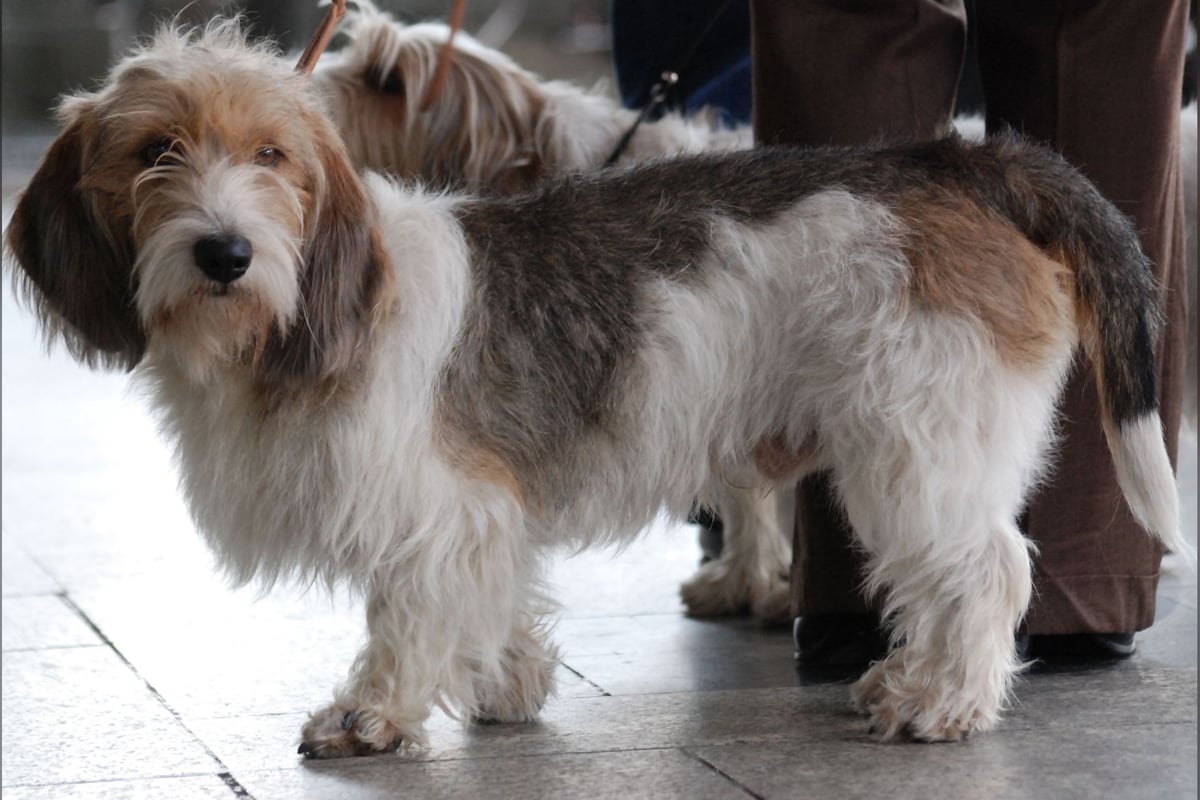
Petit Basset Griffon Vendéen
The Petit Basset Griffon Vendéen (FCI 67, Group 6) is a French scent hound from the Vendée bocage, bred from the Grand Basset Griffon Vendéen for hunting rabbit and hare over rough terrain. The official split of the two varieties was formalized by Paul Dezamy in 1947 — before that date, they coexisted under a single name. Standing 34 to 38 cm at the withers for 14 to 19 kg, it is the most compact of the Vendéen griffons, with a rough, shaggy coat and characteristic mustache and eyebrows. Its powerful hunting voice and stamina make it a ground hound feared in rabbit warrens.
- Weight
- 14 to 19kg
- Height
- 34 to 38cm
- Life expectancy
- 14years
- Monthly cost
- 70 to 130€
Personality profile
Energy 4/5
Independence 3/5
Trainability 3/5
Good with children 5/5
Barking 5/5
Space needed 3/5
Attachment to home 5/5
Good with strangers 4/5
Good with dogs 5/5
Good with cats 2/5
Coat care 3/5
Exercise needs 4/5
Scores given on measured axes, data confidence: high.
Living with a Petit Basset Griffon Vendéen
Description
The PBGV has an elongated, muscular silhouette on short legs, suited to moving through undergrowth and the burrows of the bocage. The coat is rough, shaggy, never silky — typically Vendéen — with a bushy mustache and eyebrows giving it an expressive look. Accepted colors are white-tricolor, white-orange, white-black and tan, and charcoal fawn (fauve charbonné). The long, drooping ears, covered in curly hair, add to the breed's recognizable profile. The tail is carried flag-like while working, a signal that the dog is active on a trail.

Temperament
Cheerful, sociable and lively, the PBGV is a pack dog at heart: it gets along remarkably well with other dogs and genuinely enjoys company. With children, it is patient and playful, handling boisterous interactions without losing its composure. Toward strangers, its welcome is warm — it has neither a terrier's reserve nor a sighthound's cold independence. On the other hand, it is a natural barker: vocalizing is part of its working toolkit and shows up outside hunting outings as well. Its hunting instinct is very present — faced with a cat or a small animal, the chase kicks in instinctively, which calls for caution and supervision.
Training
The PBGV is a scent hound: its autonomy on a trail and its breeding for working without constant human commands both show up in how it responds to training. Recall is the critical point — it needs to be worked on from a very young age with short, varied, heavily rewarded exercises. Long, repetitive training sessions bore it; short 5-to-10-minute sessions built around play give better results. It needs long daily scent walks to channel its energy and tracking instinct — at least 45 to 60 minutes of sport or work a day.

Feeding
200 to 280 g of premium kibble a day for a 17 kg adult, split into two meals. The breed tends to gain weight if activity drops — check body condition every season. Medium-breed kibble with good animal protein content, without excess fast carbohydrates. Dogs working actively during the hunting season may need a temporary switch to a higher energy-density formula.
Affiliate links, no extra cost to you. Legal notice

Living conditions
An enclosed garden is essential: the PBGV follows trails without regard for low fences, and unsecured grounds invariably end in an escape. A house with an enclosed outdoor space suits it better than a strict apartment, but it can adapt to apartment life with outings sufficient in both number and length. Its intense barking is incompatible with a dense urban setting without a garden — nearby neighbors will be affected. Pack life with other dogs comes naturally to it and reduces solitary stress.

Grooming and coat care
The PBGV's shaggy coat needs weekly brushing to avoid tangles and the buildup of plant debris after outings in undergrowth. The key areas to watch are the ears, armpits and belly. Professional grooming two to three times a year is recommended to balance the coat and avoid excess length that would trap bramble thorns. No close scissor cuts — the rough Vendéen coat is worked by hand-stripping the tips, never with clippers.

Health
Life expectancy of 13 to 15 years, robust for a scent hound. The long drop ears favor chronic ear infections: regular ear cleaning is an essential care routine. Eye problems (entropion, ectropion) are reported in the breed — an annual ophthalmological exam is advised. Idiopathic epilepsy and hypothyroidism are documented conditions. Steroid-Responsive Meningitis-Arteritis (SRMA) is specific to the breed with an estimated prevalence of 5-10%; it treats effectively with corticosteroids if diagnosed early.
Breed history
The Griffon Vendéen is a family of scent hounds from Poitou and Vendée, whose history goes back to the 16th century and which tradition links to the gray dogs known as "Gris de Saint-Louis." The Vendéen strain stands out for its rough, shaggy coat, suited to moving through the brambles and hedgerows of the western bocage. For centuries, Vendéen griffons existed in several sizes (Grand, Briquet, Petit), often bred together. It was Paul Dezamy, president of the Club du Griffon Vendéen, who in 1947 officially settled the split of the Petit and the Grand Basset Griffon Vendéen into two distinct breeds with their own standards. The PBGV is recognized by the FCI under number 67 within Group 6, Section 1.3 Bassets.
Getting ready for your Petit Basset Griffon Vendéen
Five essentials to line up before day one.
Affiliate links, no extra cost to you. Legal notice
FAQ: Petit Basset Griffon Vendéen
Sources
- FCI Standard No 67 — Petit Basset Griffon Vendéen · FCI breed standard 67, Group 6 Scent hounds and related breeds, Section 1.3 Small-sized hounds
- Société Centrale Canine — Petit Basset Griffon Vendéen · SCC official breed profile, Petit Basset Griffon Vendéen, Group 6
- AKC Breed Profile — Petit Basset Griffon Vendéen · AKC Petit Basset Griffon Vendéen breed profile, Hound Group
FCI, Fédération Cynologique Internationale, the world body that has codified breed standards since 1911. FCI number 67 is assigned to the Petit Basset Griffon Vendéen.
Breeds similar to a Petit Basset Griffon Vendéen

