


Norwich Terrier
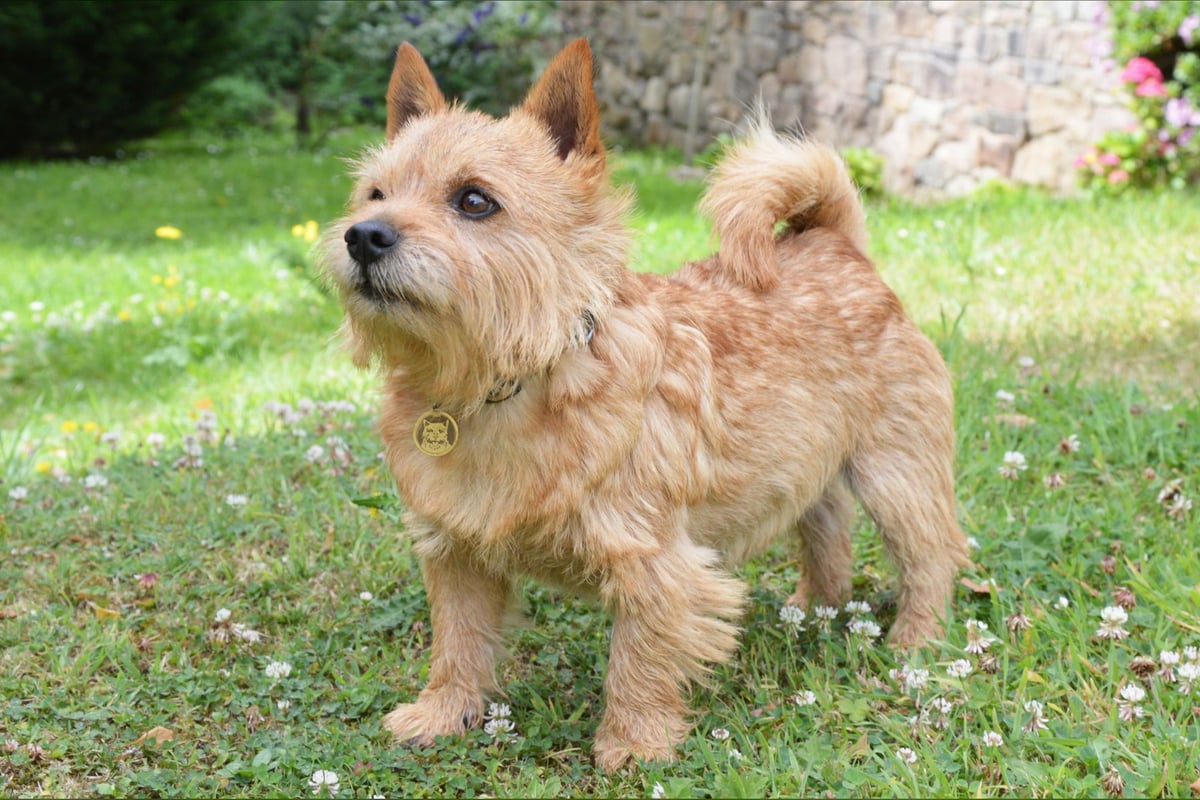
The Norwich Terrier (FCI 72) is a 5 to 6 kg British terrier from East Anglia, recognizable by its pointed, erect ears — the sole morphological trait that sets it apart from the Norfolk Terrier, its near-identical sibling with drop ears. Before the official split by the UK Kennel Club in 1964, the two types had cohabited under the name "Norwich Terrier" since the late 19th century. A lively, courageous breed, the Norwich was used at Trinity College Cambridge for ratting, and in the countryside for fox control and clearing burrows.
- Weight
- 5 to 6kg
- Height
- 24 to 26cm
- Life expectancy
- 13years
- Monthly cost
- 70 to 130€
Personality profile
Energy 4/5
Independence 3/5
Trainability 3/5
Good with children 4/5
Barking 3/5
Space needed 2/5
Attachment to home 4/5
Good with strangers 3/5
Good with dogs 4/5
Good with cats 2/5
Coat care 4/5
Exercise needs 3/5
Scores given on measured axes, data confidence: high.
Living with a Norwich Terrier
Description
Small, stocky, compact build: 24 to 26 cm at the withers for 5 to 6 kg, solid bone for the size. Hard, rough-textured coat — colors ranging from red-fawn to wheaten, with black and tan and grizzle variants. Erect, triangular ears, set well apart on the skull: this is the breed's visual signature and its only difference from the Norfolk. Tail traditionally docked in countries that still allow it — a practice now banned or strictly regulated in most European countries. The double coat (warm undercoat, rough top coat) gives effective protection in wet weather.

Temperament
Bold and determined like all terriers, the Norwich stands out for being more sociable than average for its group: it tolerates other dogs well and generally gets along with children, provided interactions are supervised. Its hunting instinct is intact — any small animal (rodent, rabbit, even a cat) can trigger an impulsive chase. It is active and curious, likes exploring its surroundings and regularly seeks stimulation. Boredom shows up as unwanted behaviors (repeated barking, digging).
Training
Receptive to positive training, it keeps the stubborn independence typical of the terrier group. It quickly learns the basics — sit, down, recall — but won't hesitate to "forget" them if a more interesting distraction comes along. Short sessions (10 to 12 minutes), varied and rewarded, work better than long, repetitive training. Its energy and curiosity make it a good candidate for agility, rally obedience or search games. Its natural sociability with other dogs makes learning in group classes easier.

Feeding
Daily ration of premium small-breed kibble sized for a 5.5 kg adult, split into two meals — follow the manufacturer's chart and adjust for body condition. At this size, a daily surplus of 50 g already represents a significant drift. Monitor weight monthly, particularly from age 7 on as metabolism slows. As a supplement, glucosamine from age 5 helps prevent the patella problems documented in the breed.
Affiliate links, no extra cost to you. Legal notice

Living conditions
Despite its small size, it needs real daily walks and sustained physical activity — its high energy is not satisfied by a simple turn around the garden. Count on 45 to 60 minutes of exercise a day, ideally active walking supplemented with scent games or light agility. It adapts to apartment life if its exercise needs are met. A leash remains recommended in open areas: its hunting instinct can make it ignore recall in the presence of prey.

Grooming and coat care
The rough coat needs hand-stripping twice a year to maintain its characteristic texture and bold color — using clippers softens the hair and dulls the shade. Stripping is a technique best learned from a professional groomer specialized in wire-haired terriers; some owners learn to do it themselves with practice. Between strippings, regular weekly brushing with a natural-bristle brush is enough to maintain the coat and remove loose dead hair. Erect ears are less prone to ear infections than the Norfolk's, but still need regular cleaning.

Health
Life expectancy of 12 to 15 years. Upper Airway Syndrome (UAS) is the most closely monitored condition in the breed — prevalence and screening methods are detailed in the FAQ. Patellar luxation is common at this size — orthopedic tests are recommended on breeding stock. Heart problems (mitral valve murmur) can appear with age, as in many small terriers. A rare breed in France: around 30 to 50 LOF registrations a year according to SCC figures.
Breed history
The origin is shared with the Norfolk Terrier: both types emerged in the East Anglia region (the counties of Norfolk and Cambridgeshire) in the late 19th century, used by farmers to control rodents and track foxes. In Cambridge, these sturdy terriers gained popularity under the nickname "Trumpington Terrier" among Trinity College students, who used them to keep the rat population down. For decades, the two types — erect ears and drop ears — cohabited within the same official breed. In 1964, the British Kennel Club made the split official: the erect-eared variant took the name Norwich Terrier, the drop-eared one became the Norfolk Terrier. The AKC recognized the split in 1979. It is the only codified morphological difference between the two breeds.
Getting ready for your Norwich Terrier
Five essentials to line up before day one.
Affiliate links, no extra cost to you. Legal notice
FAQ: Norwich Terrier
Sources
- FCI Standard No 72 — Norwich Terrier · FCI breed standard 72, Group 3 Terriers, Section 2 Small-sized Terriers
- Société Centrale Canine — Norwich Terrier · SCC official breed profile, Norwich Terrier, Group 3
- AKC Breed Profile — Norwich Terrier · AKC Norwich Terrier breed profile, Terrier Group
FCI, Fédération Cynologique Internationale, the world body that has codified breed standards since 1911. FCI number 72 is assigned to the Norwich Terrier.
Breeds similar to a Norwich Terrier

