


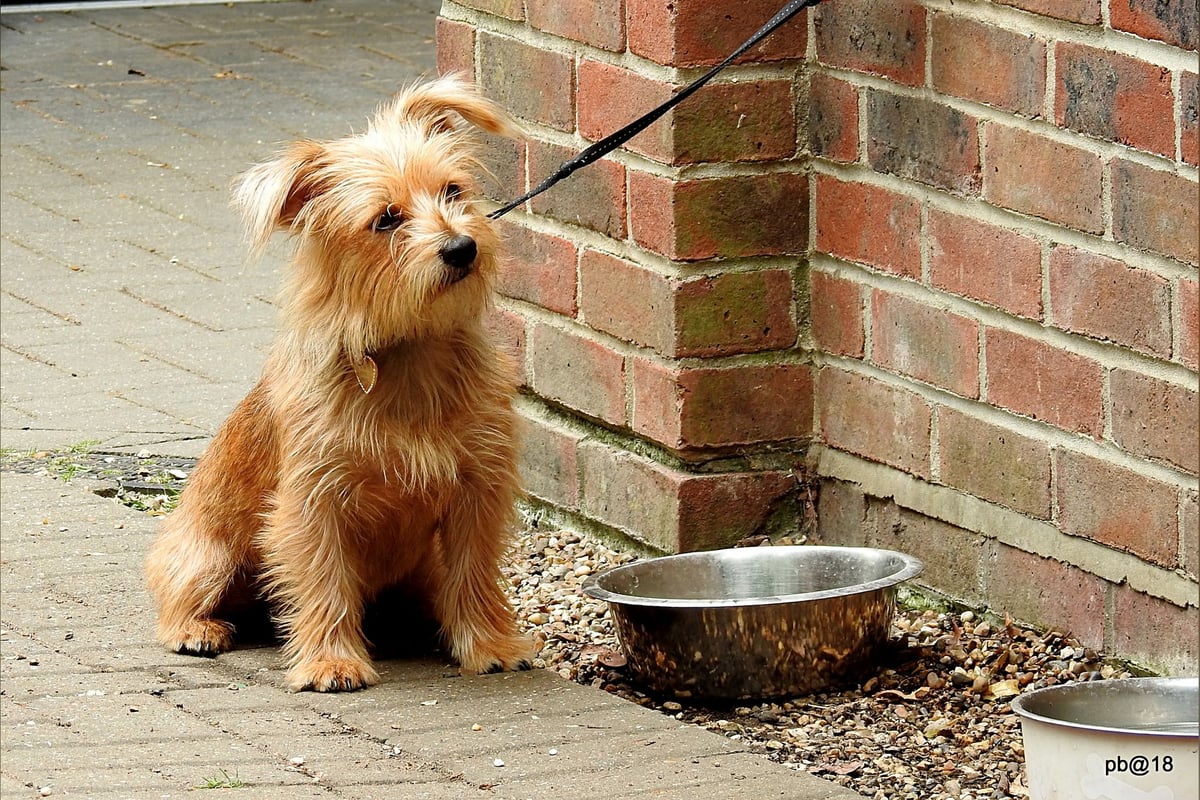
Norfolk Terrier
The Norfolk Terrier (FCI 272, Group 3, Section 2) is one of the smallest recognized working dogs: 24 to 26 cm at the withers for 5 to 6 kg, with a life expectancy of 12 to 15 years. Bred in the Norfolk and Cambridgeshire regions in the late 19th century to hunt rats and foxes on English farms, it also circulated around Cambridge, where it was nicknamed the "Trumpington Terrier" and later the "Cantab Terrier." It is distinguished from the Norwich Terrier — with which it was a single breed until 1964 — solely by its drop ears, where the Norwich has prick ears. A rare breed in France, with around 30 to 50 LOF registrations a year.
- Weight
- 5 to 6kg
- Height
- 24 to 26cm
- Life expectancy
- 13years
- Monthly cost
- 70 to 130€
Personality profile
Energy 4/5
Independence 3/5
Trainability 3/5
Good with children 4/5
Barking 3/5
Space needed 2/5
Attachment to home 4/5
Good with strangers 3/5
Good with dogs 4/5
Good with cats 2/5
Coat care 4/5
Exercise needs 3/5
Scores given on measured axes, data confidence: high.
Living with a Norfolk Terrier
Description
A stocky, compact build for a working dog: short back, solid bone, straight legs and muscled limbs suited to working underground in dens. The coat is rough — a defining feature of the standard: hard, close-lying hair, denser on the neck and shoulders. Accepted colors are wheaten, red, black and tan, and grizzle. The small, V-shaped drop ears are the sole official morphological difference from the Norwich Terrier. Strong jaw with a tight scissor bite, expressive dark oval eyes, tail traditionally docked — a practice now banned or strictly regulated in most European countries.

Temperament
Bold and lively despite its size, it is noticeably more sociable than most British terriers: it gets along well with other dogs in the household and copes well with children it sees regularly. Its strong hunting instinct, selected for decades to track rats, rabbits and foxes, makes it unreliable around rodents, small rabbits and sometimes cats. Curious and alert, it expresses its character with confidence, without the pronounced aggressiveness of some other terriers its size.
Training
Decent trainability for a terrier: it responds well to short, varied positive methods, but its hunter's independence shows up as soon as the environment gets stimulating. Recall is the critical point: without firm, early training, it will ignore any scent it has picked up. Training sessions of 10 to 15 minutes twice a day give better results than long sessions. Daily activity (exercise, tracking games, light agility) channels its energy and prevents unwanted behaviors linked to boredom.

Feeding
80 to 120 g of premium small-breed kibble a day for a 5 to 6 kg adult, split into two meals. Small-format kibble is preferable for this size: it encourages proper chewing and reduces the risk of eating too fast. A glucosamine supplement is recommended from age 7 to help prevent patellar luxation. Avoid overly caloric treats — the breed gains weight easily from adulthood on, which worsens the risk of joint problems.
Affiliate links, no extra cost to you. Legal notice

Living conditions
Its small size (24-26 cm) lets it adapt to apartment life, provided it gets 2 to 3 activity outings a day — walking, play, exploring. Its high energy level calls for at least 45 minutes of daily walking, split across the day. In a house with a garden, the fence must be buried at least 30 cm deep: it digs with determination to escape and follow a scent.

Grooming and coat care
The rough coat requires regular grooming by hand-stripping (pulling out dead hair by hand or with a stripping knife) twice a year. This professional technique is essential: regular clipping destroys the coat's rough texture and washes out its color, leaving it woolly and dull. The cost of a stripping session at a specialized salon runs between 80 and 120 euros. Between sessions, weekly brushing keeps the coat clean and aerated. Drop ears must be cleaned regularly to prevent ear infections.

Health
A robust, long-lived breed: life expectancy of 12 to 15 years, well above the terrier average. Patellar luxation affects 5 to 10% of individuals, and should be watched for if the dog limps or favors a hind leg. Heart conditions, notably mitral valve disease, can appear from age 8-10. Upper Airway Syndrome (UAS / Norfolk-Norwich Upper Airway Syndrome), estimated at up to 65% prevalence in a 2018 study by the Royal Veterinary College of London, shows up as exercise intolerance and snoring; its causes are partly hereditary.
Breed history
The breed descends from terriers used on East Anglia farms (Norfolk, Cambridgeshire) in the late 19th century to flush rats and foxes out of barns and burrows. Popularized by Frank Jones, a Norwich breeder, it was first called the "Trumpington Terrier" after a Cambridge street, then the "Cantab Terrier," a reference to Trinity College Cambridge where students kept them. For decades, Norfolk and Norwich Terriers coexisted as a single breed combining drop ears and prick ears. It was in 1964 that the British Kennel Club officially split the two breeds on this single morphological difference: drop ears for the Norfolk, prick ears for the Norwich. The AKC and the FCI ratified the distinction in 1979.
Getting ready for your Norfolk Terrier
Five essentials to line up before day one.
Affiliate links, no extra cost to you. Legal notice
FAQ: Norfolk Terrier
Sources
- FCI Standard No 272 — Norfolk Terrier · FCI breed standard 272, Group 3 Terriers, Section 2 Small-sized Terriers
- Société Centrale Canine — Norfolk Terrier · SCC official breed profile, Norfolk Terrier, Group 3, Section 2
- AKC Breed Profile — Norfolk Terrier · AKC Norfolk Terrier breed profile, Terrier Group
FCI, Fédération Cynologique Internationale, the world body that has codified breed standards since 1911. FCI number 272 is assigned to the Norfolk Terrier.
Breeds similar to a Norfolk Terrier

