


St. Bernard
Pinscher and Schnauzer - Molossoid and Swiss Mountain and Cattledogs
65 to 90 kg
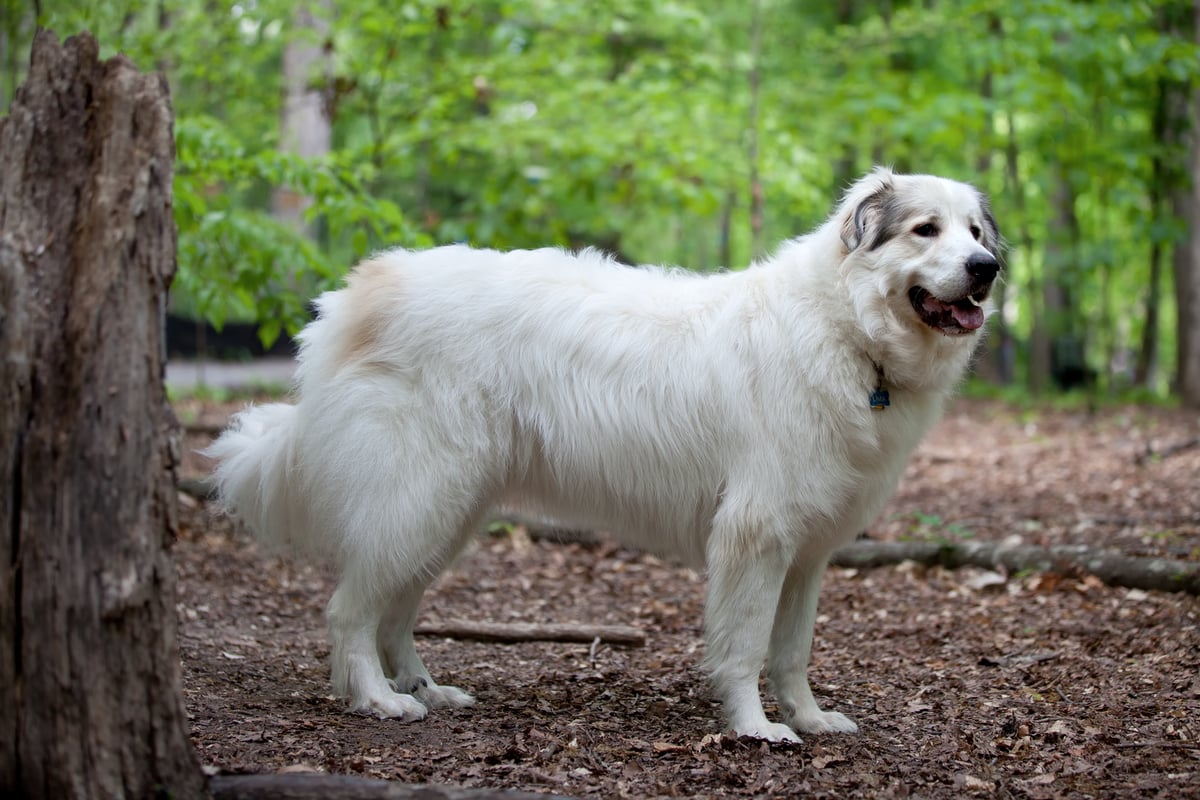
The Pyrenean Mountain Dog (or Patou) is a livestock guardian dog (LGD) classified FCI number 137, weighing 40 to 60 kg for 65 to 82 cm at the withers. Present in the Pyrenees since the 17th century, it was given to the Dauphin of France by Louis XIV in 1675. It is not a herding dog but an autonomous guardian: it lives with the flock, decides on its own when to intervene, and barks at night to deter predators.
Scores given on measured axes, data confidence: high.
Living with a Pyrenean Mountain Dog
Entirely white coat, or white with badger, pale fawn, or gray markings on the ears and head according to FCI standard 137. Dense double coat: thick woolly undercoat, long, flat topcoat slightly wavy at the withers. Marked sexual dimorphism: males 72-82 cm and 50-60 kg, females 65-74 cm and 40-50 kg. Double dewclaws on the hind legs — a distinctive morphological trait written into the standard. Massive build, slow but powerful gait.

An autonomous guardian dog par excellence: it decides on its own about the threat and the response to give it, without waiting for an order. Very wary of strangers — a functional behavior in high-mountain summer pasture but a burden in urban or suburban settings. It barks abundantly at night (an innate predator-deterrence behavior), which regularly creates conflicts with hikers and local residents. Affectionate and patient with its core family.
Moderate trainability: the Patou is not selected to obey commands but to decide autonomously. Learning basic commands (recall, sit, leash walking) requires repetition and consistency — novice owners are often overwhelmed. Coercive methods are counterproductive and risky given this build. Daily exercise remains moderate relative to its size: 45 to 60 minutes of walking is enough for a healthy adult; long runs are not recommended because of the joints.

400 to 600 g of premium large-breed kibble a day for a 50 kg adult, in 2 strict meals. 1h of mandatory digestive rest before and after each meal to limit the risk of gastric torsion. Giant-breed kibble up to 24 months — the slow growth of giant breeds should not be forced. Glucosamine and chondroitin recommended from age 5 to prevent early joint degeneration.
Affiliate links, no extra cost to you. Legal notice

A house with a large fenced plot of land is mandatory — a 55 kg Patou cannot live in an apartment or a city garden. Not recommended in dense urban or suburban settings: its intense nighttime barking and territorial instinct are incompatible with close-packed housing. In high-mountain summer pasture or a rural setting with a flock, it thrives fully; in a purely family context, it needs enough space to patrol its territory.

Weekly brushing is enough outside of shedding season — the dense white coat picks up vegetation (grass, burrs) outdoors. During the spring shed, daily brushing is essential for 3 to 4 weeks to prevent deep tangles in the woolly undercoat. Quarterly bath recommended given the surface area to cover; long drying time. Regular cleaning of the ear flaps (drop ears trap moisture) — a source of recurring ear infections if left untreated.

Life expectancy 10 to 12 years, decent for a dog of this build. Hip dysplasia: high prevalence — serious breeders provide official radiographs of the breeding dogs (SCC reading, grade A or B, or OFA equivalent). Gastric dilatation-volvulus (GDV): a real risk for a deep-chested breed of this build — 2 meals a day, 1h of digestive rest after meals, mandatory. Osteosarcoma reported in large-sized lines. Heat sensitivity: above 25 °C, outings only early morning or evening.
The Pyrenean Mountain Dog is documented in the French Pyrenees as early as the 17th century as a flock-guarding dog against bear and wolf. In 1675, Louis XIV received several specimens for the Château de Versailles and gave a Patou to the Dauphin — the first official royal mention of the breed. FCI standard number 137 classifies it in Group 2 (Molossoids). Since the 2000s, the return of the wolf to the Alps and the Pyrenees has led the French state to subsidize the acquisition of Patous for livestock farmers, boosting the breed's numbers in pastoral settings.
Five essentials to line up before day one.
Affiliate links, no extra cost to you. Legal notice
FCI, Fédération Cynologique Internationale, the world body that has codified breed standards since 1911. FCI number 137 is assigned to the Pyrenean Mountain Dog.
Pinscher and Schnauzer - Molossoid and Swiss Mountain and Cattledogs
65 to 90 kg

Sheepdogs and Cattledogs (except Swiss Cattledogs)
7 to 15 kg

Pinscher and Schnauzer - Molossoid and Swiss Mountain and Cattledogs
45 to 77 kg