


Miniature Pinscher
Pinscher and Schnauzer - Molossoid and Swiss Mountain and Cattledogs
4 to 6 kg
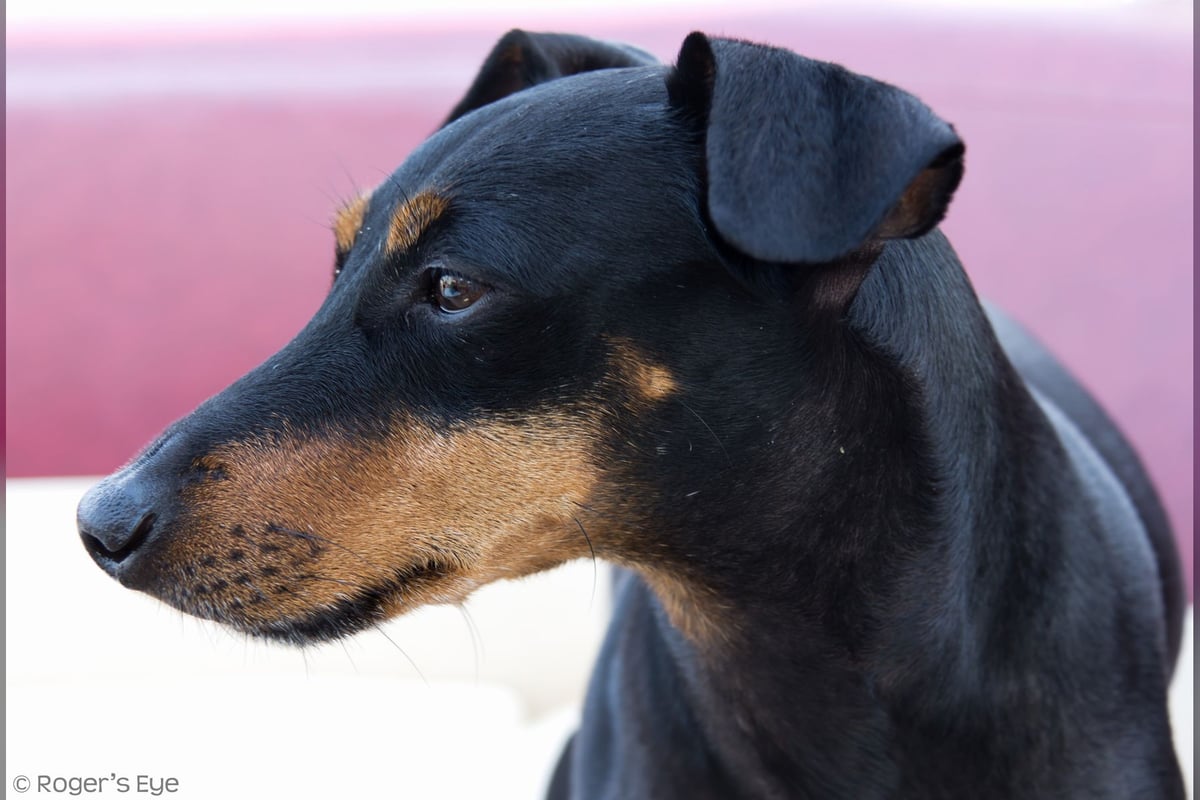
The Manchester Terrier weighs 5 to 10 kg for 38 to 41 cm at the withers, recognized by the FCI under number 71 (Group 3, Section 1). Born in industrial Lancashire in the 19th century, it was selected by crossing a Greyhound and a Black and Tan Terrier to exterminate rats in the textile mills of Manchester. Its coat is black-and-tan, short, smooth, and tight — a minimal maintenance profile. About 50 puppies registered with the LOF annually in France.
Scores given on measured axes, data confidence: medium.
Living with a Manchester Terrier
Mistakenly confused with a miniature Dobermann: same short black-and-tan coat, same slender silhouette, but it is a self-standing terrier breed, with semi-erect button ears, predating the Dobermann by several decades. There is a Toy variant (< 4 kg) recognized by the AKC as a distinct breed and kept in the United States, but not recognized by the FCI — in France, only the standard variety (FCI 71) is registrable. The silhouette is that of an athletic dog: long-legged, muscular, with a slightly arched back and a tucked-up belly — a legacy of the crossed-in Greyhound.

Sharp, observant, and very attached to its owner — more affectionately demonstrative than the average working terrier. Its wariness of strangers is marked: it is reserved at first meetings and signals strangers with an alert posture rather than repeated barking. Very high predatory instinct toward small animals (rodents, rabbits, cats) — ratting selection does not fade in a few generations. Cohabitation with cats or rodents is not recommended without intensive early socialization.
Good trainability for a terrier (4/5): more cooperative than average, it learns quickly and seeks to interact with its owner. Short sessions (10-15 minutes), play-oriented and based on positive reinforcement, give the best results. Its quick learning can mask latent frustration if sessions are too repetitive — varying exercises and incorporating dog sports (agility, lure coursing, rally obedience) fully taps its potential. Recall remains unreliable in the presence of prey.

130 to 200 g of premium kibble a day for a 7-8 kg adult, split into 2 meals. Its slender silhouette reflects real energy expenditure: kibble with a high protein density (28-32%) suits it better than "sedentary small breed" formulas. Watch for weight gain after neutering — its lean build makes excess weight show quickly and burden the joints.
Affiliate links, no extra cost to you. Legal notice

Tolerates apartment living provided its exercise needs are met — 45 minutes to 1 hour a day of sustained activity. Its compact build and moderate barking level make it compatible with urban life, but its short coat without an undercoat makes it sensitive to cold: it shivers below 5 °C and needs a coat in winter for extended outings. Avoid prolonged exposure to cold weather. A garden is appreciated but not essential if outings are regular.

Minimal upkeep — one of the least grooming-demanding terriers. A grooming glove or rubber brush once a week to remove dead hair and stimulate the skin. No stripping, no clipping, no professional grooming required for everyday use. The short coat holds neither water nor mud; a quick wipe-down after a rainy outing is enough.

Life expectancy 14 to 16 years — among the best of all terrier breeds, driven by selection on ratting robustness criteria. Documented hereditary congenital deafness: prevalence estimated at ~5% in some lines, detectable only through the BAER test (Brainstem Auditory Evoked Response) — should be requested from both parents before acquisition. Type I von Willebrand disease reported in the breed: hereditary coagulation disorder (autosomal recessive transmission), DNA test available at serious breeders. Cataracts reported in some lines: an ophthalmologic exam is a useful addition.
Born in industrial Lancashire in the 19th century, at the heart of the British textile revolution. John Hulme (Manchester) is credited with the first documented cross between a Greyhound and a local Black and Tan Terrier around 1860 — the goal being a sprint-capable ratter to cover large warehouse and mill floors. Recognized by the British Kennel Club under the name Manchester Terrier in the late 19th century. The FCI assigned it number 71 (definitive standard 1954). In France, the breed is confidential (~50 LOF registrations/year) but has been steady since the 1980s.
Five essentials to line up before day one.
Affiliate links, no extra cost to you. Legal notice
FCI, Fédération Cynologique Internationale, the world body that has codified breed standards since 1911. FCI number 71 is assigned to the Manchester Terrier.
Pinscher and Schnauzer - Molossoid and Swiss Mountain and Cattledogs
4 to 6 kg

