


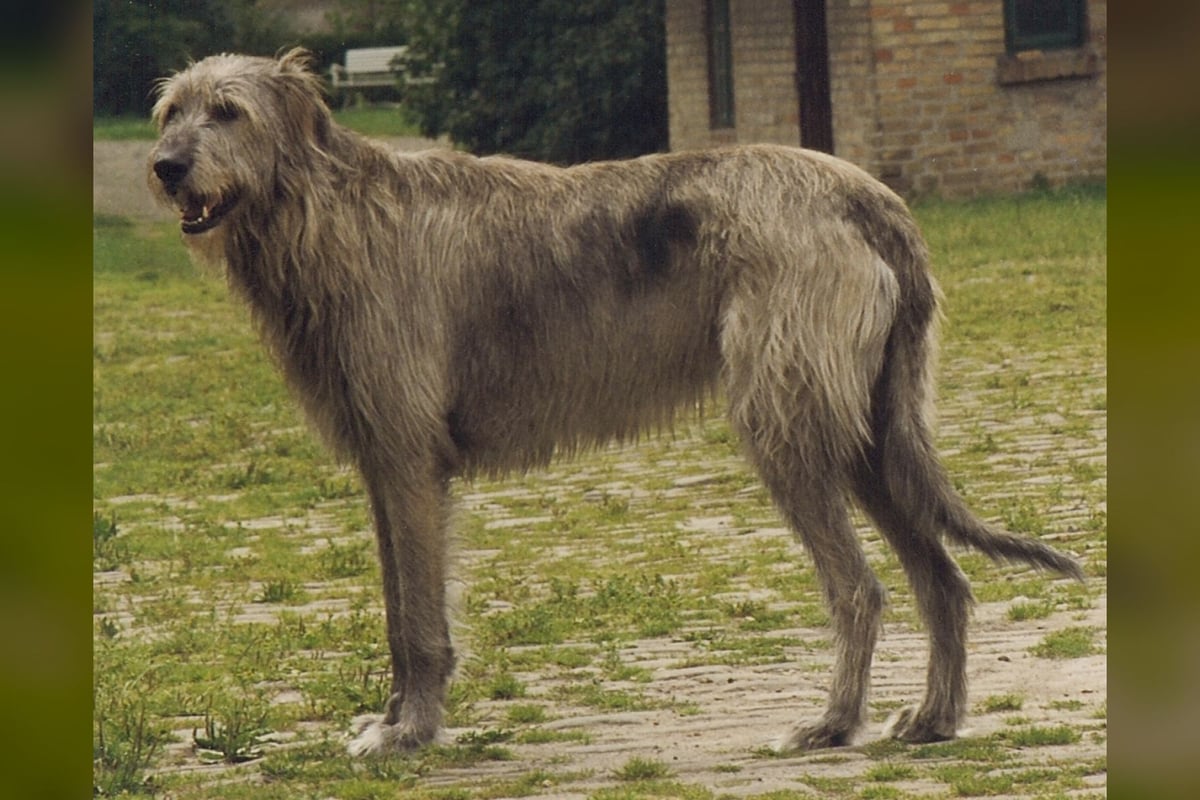
Irish Wolfhound
The Irish Wolfhound (FCI 160, Group 10) is the largest dog officially recognized by the FCI: 86 cm minimum at the withers for males, 79 cm for females, typical weight 48 to 70 kg. Selected since Celtic antiquity to hunt wolf and Irish elk, it nearly disappeared in the 19th century before being reconstructed by Captain George Augustus Graham starting in 1862. Its life expectancy is among the shortest of all breeds: median 6.4 years according to the Adams 2010 study on 172 059 dogs in the United Kingdom.
- Weight
- 48 to 70kg
- Height
- 79 to 90cm
- Life expectancy
- 7years
- Monthly cost
- 150 to 250€
Personality profile
Energy 3/5
Independence 4/5
Trainability 2/5
Good with children 4/5
Barking 1/5
Space needed 5/5
Attachment to home 4/5
Good with strangers 3/5
Good with dogs 3/5
Good with cats 2/5
Coat care 2/5
Exercise needs 4/5
Scores given on measured axes, data confidence: high.
Living with an Irish Wolfhound
Description
Imposing silhouette with a muscular profile and a loin slightly arched over the back, long and fairly broad head, dark eyes with a calm, deep expression. The coat is rough, hard, and shaggy on the body — longer above the eyes and under the jaw in a characteristic small beard. Accepted colors: gray, brindle, red, black, pure white, fawn. Males ≥ 86 cm (FCI standard, absolute threshold) for a minimum weight of 54.4 kg; females ≥ 79 cm for 40.9 kg. The rib cage is deep and narrow, characteristic of the giant sighthound morphology predisposed to gastric dilatation-volvulus.

Temperament
The FCI standard describes the Irish Wolfhound as "dignified and calm" — a giant with a stable, low-reactivity temperament, with no tendency toward aggression or fear. Deeply attached to its family, it tolerates children well thanks to its natural gentleness, but supervision remains necessary given its mass (an unintentional collision at 60 kg can knock down a young child). Its sighthound chase instinct remains present: any small fleeing animal can trigger a chase that recall would not always stop.
Training
The Irish Wolfhound responds to positive reinforcement with high-value rewards, in short 8 to 12 minute sessions — its gentle nature makes the approach easier, but its sighthound independence limits obedience to practical exercises. FCI lure coursing sports tap into its sighthound chase instinct. Early socialization (3 to 12 weeks) is critical to accustom this giant to urban environments and situations of intense stimulation. Coercive methods are contraindicated: they produce an inhibited dog without improving obedience.

Feeding
Daily ration of premium kibble sized for a 55-60 kg adult — manufacturer's chart followed by adjustment to body condition — mandatorily split into 2 meals to limit the risk of stomach torsion. During growth (8 to 18 months), the ration should be calculated on a "large breed" food with moderate protein content (25-28%) to slow growth speed and reduce joint load — excessively fast growth in this breed is documented as a factor in osteochondrosis. Monthly weighing up to 18 months to adjust rations.
Affiliate links, no extra cost to you. Legal notice

Living conditions
A garden fenced at least 1.5 m high and large enough for its runs is essential — an apartment is not recommended. Despite its colossal build, the Irish Wolfhound is calm indoors and does not become destructive if its exercise needs are met: 1 hour to 1h30 of daily activity is enough as an adult, in two sessions. While growing (up to 18-24 months), intense exercise on hard surfaces should be avoided — a 30 kg puppy's joints bear disproportionate strain. Heat is poorly tolerated: avoid outings in full sun above 25 °C.

Grooming and coat care
The rough coat needs weekly brushing with a hard-bristle brush to remove dead hair — it does not mat but can lose its luster without regular upkeep. Manual stripping (pulling out dead hair by hand or with a stripping knife) twice a year maintains the rough texture and natural weather protection. Brushing the beard and eyebrows, areas where food debris accumulates, should be done twice a week. Quarterly bath; weekly check of the semi-drop ears.

Health
Median life expectancy 6.4 years (Adams 2010 study, UK Kennel Club, 172 059 dogs). Dilated cardiomyopathy (DCM) is the leading cause of death, with an estimated cumulative prevalence of 25% in the breed; annual cardiac auscultation and echocardiography from age 3 recommended. Osteosarcoma (bone cancer) affects about 20% of individuals — persistent lameness in one limb after age 5 requires an immediate radiograph. Gastric dilatation-volvulus (GDV) is a frequent surgical emergency given this chest morphology. Anesthetic sensitivity to barbiturates common to all sighthounds: must be systematically reported to the veterinarian.
Breed history
The oldest written record of the "great Irish dog" dates back to Quintus Aurelius Symmachus in 391 AD, who describes sending seven Irish hunting dogs to Rome as an imperial gift. In Celtic tradition, these dogs were used to hunt wolf and Irish elk (Megaloceros, now extinct, then Cervus elaphus, hunted to local extinction in the 17th century). The Irish wolf was definitively eradicated in 1786 — with no prey left, the Irish Wolfhound nearly disappeared entirely. Captain George Augustus Graham undertook its reconstruction between 1862 and 1885 by crossing the rare surviving specimens with the Scottish Deerhound, the Russian Borzoi, and the Tibetan Mastiff. Recognized by the FCI under number 160, Group 10, Section 2 Rough-haired Sighthounds.
Getting ready for your Irish Wolfhound
Five essentials to line up before day one.
Affiliate links, no extra cost to you. Legal notice
FAQ: Irish Wolfhound
Sources
- FCI Standard No 160 — Irish Wolfhound · FCI breed standard 160, Group 10 Sighthounds, Section 2 Rough-haired Sighthounds, country of origin Ireland. Minimum height males 86 cm, minimum weight 54.4 kg.
- Adams VJ et al. (2010) — UK Kennel Club Health Survey · Adams VJ, Evans KM, Sampson J, Wood JLN. Methods and mortality results of a health survey of purebred dogs in the UK. J Small Anim Pract. 2010;51(10):512-524. Median longevity Irish Wolfhound: 6.4 years (n=172 059 dogs total study).
- AKC Breed Profile — Irish Wolfhound · AKC Irish Wolfhound breed profile, Hound Group. Minimum height 32 inches (81 cm) males, minimum weight 120 lbs (54 kg).
- Société Centrale Canine — Irish Wolfhound Standard · SCC, Irish Wolfhound breed standard, Group 10, section 2, Irish wolfdog.
FCI, Fédération Cynologique Internationale, the world body that has codified breed standards since 1911. FCI number 160 is assigned to the Irish Wolfhound.
Breeds similar to an Irish Wolfhound

Great Dane
Pinscher and Schnauzer - Molossoid and Swiss Mountain and Cattledogs
50 to 90 kg

St. Bernard
Pinscher and Schnauzer - Molossoid and Swiss Mountain and Cattledogs
65 to 90 kg