


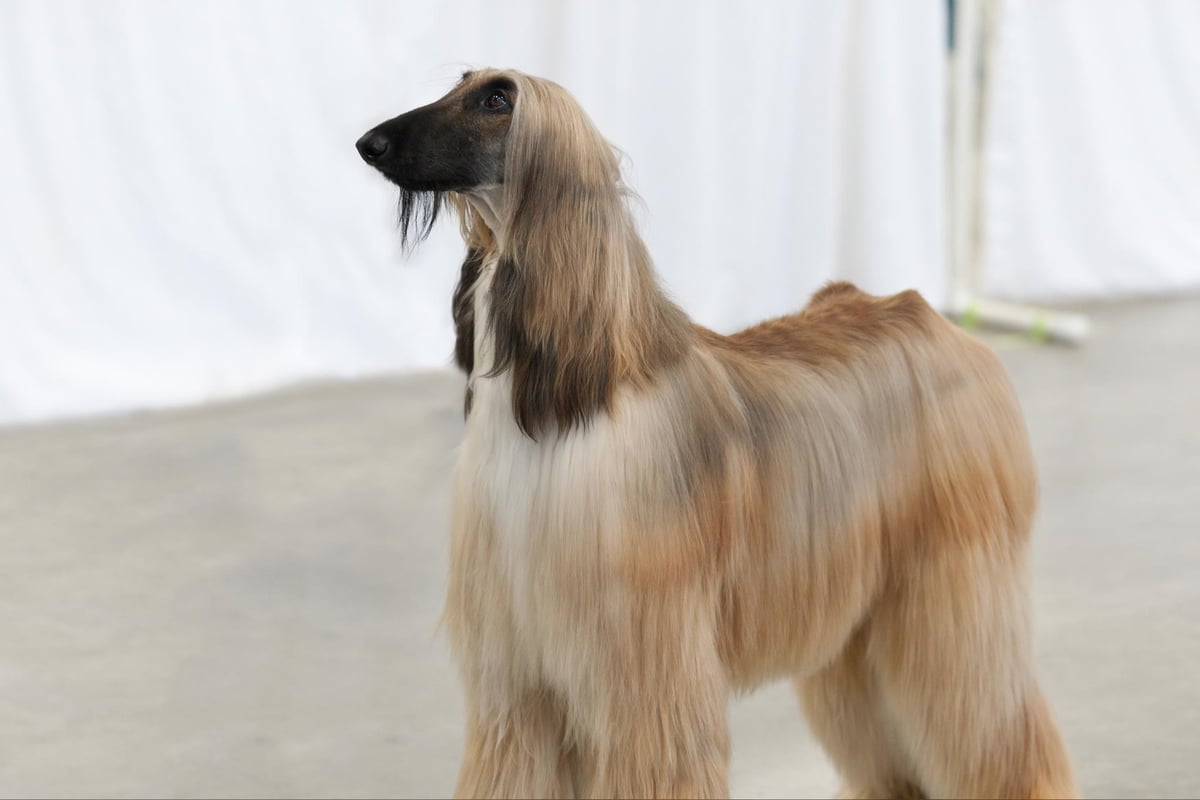
Afghan Hound
The Afghan Hound, classified FCI number 228 in Group 10, comes from the Afghan Hindu Kush mountains where it hunted snow leopard and gazelle for millennia. It weighs 23 to 27 kg for 63 to 74 cm at the withers, with a long, silky coat unique among sighthounds. The breed became known in the West starting in 1907 with the male King Zardin, exhibited at Crufts, before being standardized by the FCI. Life expectancy 12 to 14 years.
- Weight
- 23 to 27kg
- Height
- 63 to 74cm
- Life expectancy
- 13years
- Monthly cost
- 90 to 150€
Personality profile
Energy 4/5
Independence 5/5
Trainability 2/5
Good with children 3/5
Barking 2/5
Space needed 4/5
Attachment to home 3/5
Good with strangers 2/5
Good with dogs 3/5
Good with cats 2/5
Coat care 5/5
Exercise needs 4/5
Scores given on measured axes, data confidence: high.
Living with an Afghan Hound
Description
Tall, slender silhouette, fine but solid bone structure, long and slightly arched loin. The head is long and narrow, adorned with a topknot of long hair on top of the skull. The adult coat is dense, fine, and silky on the flanks, legs, and ears — the back saddle remaining shorter and smooth. Slanted almond-shaped eyes with a distant expression. The prominent hip joints are a morphological trait of the breed (FCI standard), not an anomaly. Males 68-74 cm for 26-27 kg, females 63-69 cm for 23-25 kg.

Temperament
Selected to decide on its own in the terrain of the Hindu Kush, it acts according to its own judgment rather than out of deference to its owner. Hence its last place in Coren's obedience ranking, which has nothing to do with a lack of intelligence (see FAQ). Reserved with strangers, it is not a guard dog: it ignores rather than watches. Its instinct for coursing prey is extreme; any fleeing animal triggers an irreversible chase.
Training
Training requires an approach centered exclusively on positive reinforcement with high-value rewards (fresh meat, coursing games). Sessions must stay short (8-10 minutes maximum): beyond that, the dog loses interest. Its sport of choice is FCI lure coursing (mechanical lure pursuit), at which the breed excels naturally. Achieving 100% reliable recall in unfenced open space is practically impossible — never let it off-leash without a secure enclosure of at least 2 m.

Feeding
Daily ration of premium kibble sized for a 25 kg adult, split into 2 meals — follow the manufacturer's chart and adjust to actual body condition. The low fat mass makes body condition tricky to assess: protruding ribs and hips are normal for the breed's morphology, do not overfeed to "correct" what is a standard trait. Glucosamine recommended from age 6 for the hind leg joints, heavily stressed during sprinting.
Affiliate links, no extra cost to you. Legal notice

Living conditions
A house with a garden fenced high (2 m minimum) is mandatory: it reaches 60 km/h and clears low fences effortlessly. Apartments are not recommended unless daily access to a significantly sized secure open space is guaranteed. Two intense exercise sessions a day (30-45 min each) are needed to channel its energy. Sensitive to extreme cold below 5 °C, its dense coat protects it well from moderate heat.

Grooming and coat care
Brushing 4 to 5 times a week is essential to prevent matting in the long, fine coat — the ears and legs are the areas most prone to tangling. Professional grooming recommended every 6 to 8 weeks. Some owners opt for the "puppy clip" (short trim on the body), which reduces brushing to 2 times a week and makes practical management easier for an active family. Bath at least monthly with a mild, hydrating shampoo to preserve the silky texture.

Health
Life expectancy 12 to 14 years (median 13 years). Like all sighthounds, an atypical metabolism for barbiturates: systematically inform the veterinarian of the breed before any anesthesia (risk of overdose with standard protocols). Documented predispositions: hereditary cataracts, muscle necrosis (hereditary myopathy in some lines), and hypothyroidism. Very low subcutaneous fat mass makes the breed sensitive to physical shock and prolonged cold.
Breed history
One of the genetically oldest breeds, originating in the Hindu Kush mountains and the plains of Afghanistan, where nomadic tribes selected it to hunt snow leopard, wolf, and gazelle at altitudes above 3 000 meters. Its presence in Europe was concretely established in 1907 when Captain John Barff brought the male King Zardin back from Afghanistan — this dog was exhibited at Crufts and inspired the first British standard. The FCI recognized the breed under number 228 in Group 10, Section 1 (Long-haired or fringed Sighthounds).
Getting ready for your Afghan Hound
Five essentials to line up before day one.
Affiliate links, no extra cost to you. Legal notice
FAQ: Afghan Hound
Sources
- FCI Standard No 228 — Afghan Hound · FCI breed standard 228, Group 10 Sighthounds, Section 1 Long-haired or fringed Sighthounds
- AKC Breed Profile — Afghan Hound · AKC Afghan Hound breed profile, Hound Group
- Société Centrale Canine — Afghan Hound Standard · SCC, Afghan Hound breed standard, Group 10, section 1
FCI, Fédération Cynologique Internationale, the world body that has codified breed standards since 1911. FCI number 228 is assigned to the Afghan Hound.

