


St. Bernard
Pinscher and Schnauzer - Molossoid and Swiss Mountain and Cattledogs
65 to 90 kg
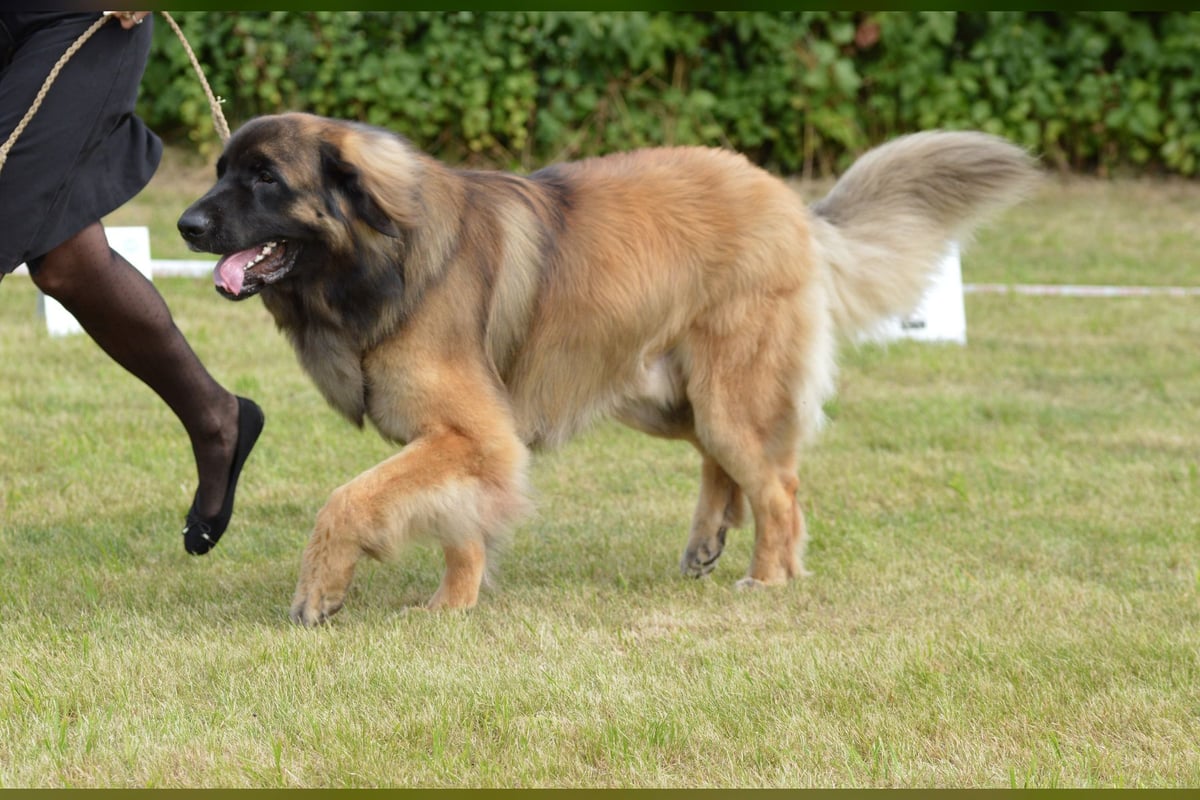
The Leonberger is a German giant created in Leonberg (Baden-Württemberg) in 1846 by Heinrich Essig, a cattle merchant, with the aim of producing a dog resembling the lion on the town's coat of arms. Recognized by the FCI under number 145 (Group 2), it weighs 45 to 77 kg for 65 to 80 cm. Its life expectancy of 8 to 9 years remains among the shortest of the large breeds.
Scores given on measured axes, data confidence: high.
Living with a Leonberger
A mountain-type breed with a massive but balanced frame. Males 72-80 cm for 60-77 kg, females 65-74 cm for 45-61 kg. Semi-long coat, thick double layer, water-resistant, with a pronounced mane on the chest of adult males. Golden lion to red-brown coat with a black mask. Its robust build is the product of a documented cross: St. Bernard × Newfoundland, then the addition of a mountain dog — sources differ on the exact breed — to stabilize the coat.

Calm, measured temperament for a dog of this mass: neither dominant nor excessively fearful according to the FCI standard. Intense family attachment, natural tolerance of children — its placidity remains conditioned on well-conducted early socialization before 4 months. Moderate wariness of strangers; not an aggressive guard dog, but its mere presence deters. Tolerates prolonged solitude beyond 4 hours poorly.
Good learning ability with positive reinforcement, but a high sensitivity to coercive methods — excessive pressure triggers shutdown or withdrawal. Early training is decisive: before 6 months, the size remains manageable for working on leash walking, essential for a 70 kg adult dog. Suited to obedience, water rescue (its natural swimming ability is documented from the earliest Newfoundland crosses), and carting. Not compatible with protection disciplines.

450 to 650 g of premium giant-breed kibble a day for a 60 kg adult, in 2 strict meals (gastric torsion prevention). Giant-breed kibble maintained up to 24 months to support the slow bone growth characteristic of giant breeds. Glucosamine and chondroitin supplementation from age 3 to protect the joints under the strain of body mass. Strict weight control: every excess kilo significantly worsens dysplasia.
Affiliate links, no extra cost to you. Legal notice

A house with a large fenced garden is the only suitable setting — an apartment is unsuited to a build of 77 kg. 1 hour to 1h30 of daily activity is enough: the Leonberger is not an intensely sporty breed, but its energy must be channeled regularly. Excellent cold resistance thanks to its double coat, but heat is poorly tolerated: exercise should be avoided above 25 °C, with permanent access to shade and fresh water essential.

Brushing 3 times a week under normal conditions to detangle the semi-long coat and prevent knots behind the ears and on the hind legs. During the two annual shedding seasons (spring and fall), daily brushing becomes essential: undercoat loss is significant, equivalent to several bags of hair per shed. A metal anti-tangle comb is recommended alongside the brush. Bath at most quarterly with a mild shampoo for long hair.

Life expectancy 8 to 9 years, among the shortest of the giant breeds. Two predominant genetic diseases: Leonberger hereditary polyneuropathy (LPN1 and LPN2, mandatory DNA tests on breeding dogs) and hip/elbow dysplasia (LOF radiographs). Predisposition to osteosarcoma and bone tumors comparable to those of the Rottweiler. Gastric dilatation-volvulus syndrome (veterinary emergency <2h): 2 meals mandatory, 1 hour of rest before/after exertion. Semi-annual heart checks from age 5.
Heinrich Essig began his crosses between 1837 and 1846 in Leonberg (Baden-Württemberg). His stated goal was to recreate the town's heraldic lion. After near-extinction during the two world wars (population reduced to a few dozen individuals in 1945), reconstruction began in 1945 from the rare surviving Belgian and German dogs. Recognized by the FCI in 1955 under number 145. A breed little known to the general public despite a temperament profile sought after for canine therapy and water rescue.
Five essentials to line up before day one.
Affiliate links, no extra cost to you. Legal notice
FCI, Fédération Cynologique Internationale, the world body that has codified breed standards since 1911. FCI number 145 is assigned to the Leonberger.
Pinscher and Schnauzer - Molossoid and Swiss Mountain and Cattledogs
65 to 90 kg

Pinscher and Schnauzer - Molossoid and Swiss Mountain and Cattledogs
45 to 70 kg

Pinscher and Schnauzer - Molossoid and Swiss Mountain and Cattledogs
42 to 60 kg