


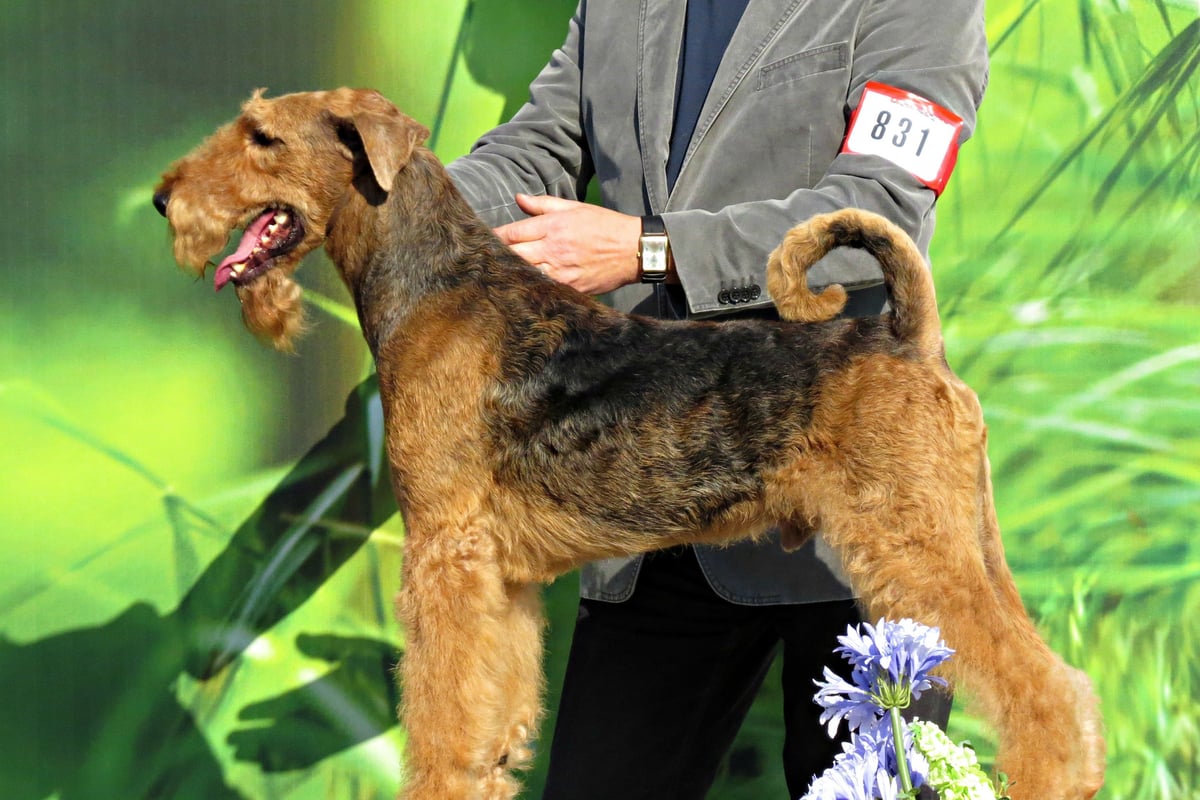
Lakeland Terrier
The Lakeland Terrier weighs 7 to 8 kg for 33 to 37 cm at the withers — a small working terrier from the Lake District (Cumbria, UK), recognized by the FCI under number 70, Group 3, Section 1. Developed in the 18th-19th century by local sheep farmers to destroy foxes and badgers in the rocky mountain terrain. Recognized as a distinct breed in 1921. About 50 LOF-registered puppies a year in France — one of the most confidential terrier breeds in the country. Life expectancy 12 to 15 years.
- Weight
- 7 to 8kg
- Height
- 33 to 37cm
- Life expectancy
- 13years
- Monthly cost
- 60 to 90€
Personality profile
Energy 4/5
Independence 4/5
Trainability 3/5
Good with children 3/5
Barking 4/5
Space needed 2/5
Attachment to home 3/5
Good with strangers 2/5
Good with dogs 2/5
Good with cats 2/5
Coat care 4/5
Exercise needs 4/5
Scores given on measured axes, data confidence: high.
Living with a Lakeland Terrier
Description
Square, compact silhouette, legs relatively long for a small terrier — a distinctive trait compared to the similar-looking Welsh Terrier, which it differs from through this taller-on-leg build. Rectangular head, flat skull, moderate stop. Dense, hard (wiry) topcoat, soft undercoat. Colors accepted by the FCI: black and tan, blue and tan, red, wheaten, liver, blue, or black — a wide palette absent in the Welsh Terrier, which only allows black and tan, or blue and tan. Narrow chest — a functional trait allowing it to go down into the rocky fissures of the Lake District.

Temperament
A mountain hunting terrier with a strong-willed character: courageous out of proportion to its weight, tenacious in effort, a barker to signal any intrusion or detected prey. Barking is a deeply rooted working behavior — the breed was selected to give voice underground so hunters could locate it in rocky crevices. Its relationship with other dogs shows classic terrier dominance; early socialization reduces friction but does not eliminate it entirely. Caution is advised with young children: the Lakeland tolerates handling but reacts sharply if roughly treated.
Training
Moderate trainability (3/5): the Lakeland picks up new tasks quickly but resists mechanical repetition — a universal terrier trait amplified by its independence as a solitary mountain hunter. Short sessions (10-12 minutes), varied and based on food rewards, give the best results. Suitable sports: earthdog trials, agility, recreational obedience. Recall is unreliable outside a secured area in the presence of prey — a long lead is recommended in unfenced spaces.

Feeding
140 to 200 g of premium kibble a day for a 7-8 kg adult, in 2 meals. An active breed with a brisk metabolism — watch for weight gain in winter if activity drops. Regular outings naturally limit weight gain; adjust the ration if weekly activity decreases significantly.
Affiliate links, no extra cost to you. Legal notice

Living conditions
Suited to apartment life thanks to its compact build (7-8 kg), provided 1h to 1h15 of daily activity is ensured — long walks and scent stimulation. Its tendency to bark can be an issue in dense urban settings without early desensitization work. A garden is appreciated but not essential; a solid fence is required — digging under fences is an instinctive behavior of the breed. High cold resistance thanks to its dense coat, consistent with its origin in the lake-district mountains of northern England.

Grooming and coat care
Mandatory stripping 2 to 3 times a year — manual plucking or stripping-knife plucking is the only method that maintains the hardness and density of the topcoat. Clipper trimming softens the coat over 2 to 3 growth cycles, fades the characteristic coloring, and reduces its waterproofing properties. Weekly brushing between stripping sessions. The facial hair (eyebrows, beard) needs regular upkeep with a hard brush to prevent matting. Grooming budget: 50 to 70 € per full stripping session.

Health
A remarkably healthy profile for a terrier of this age: few hereditary pathologies documented at a high prevalence rate. Progressive retinal atrophy (PRA) is reported sporadically — DNA testing recommended on breeding dogs in some countries. Watch for dermatoses associated with an unmaintained wiry coat: irregular stripping encourages undercoat buildup and skin irritation.
Breed history
Developed in the 18th and 19th centuries in the Lake District (Cumbria) by sheep farmers who needed a terrier able to follow the hounds on foot in the mountains, go down into steep rocky fissures to flush out foxes and badgers, and climb back out alone if the hunter could not reach the spot. Unlike the terriers of Wales or central England, it did not work on loose ground but in stone scree and crevices — hence its taller-on-leg build and sturdy frame. Recognized as a distinct breed by the British Kennel Club in 1921. Recognized by the FCI under number 70 (standard published March 25, 1991).
Getting ready for your Lakeland Terrier
Five essentials to line up before day one.
Affiliate links, no extra cost to you. Legal notice
FAQ: Lakeland Terrier
Sources
- FCI Standard No 70 — Lakeland Terrier · FCI breed standard 70, Group 3 Terriers, Section 1 Large and medium sized Terriers, recognized definitively March 25, 1991
- AKC Breed Profile — Lakeland Terrier · AKC Lakeland Terrier breed profile, Terrier Group, recognized 1934
- SCC Standard — Lakeland Terrier · Société Centrale Canine, official Lakeland Terrier standard, Group 3
FCI, Fédération Cynologique Internationale, the world body that has codified breed standards since 1911. FCI number 70 is assigned to the Lakeland Terrier.
Breeds similar to a Lakeland Terrier

