


Pyrenean Mountain Dog
Pinscher and Schnauzer - Molossoid and Swiss Mountain and Cattledogs
40 to 60 kg
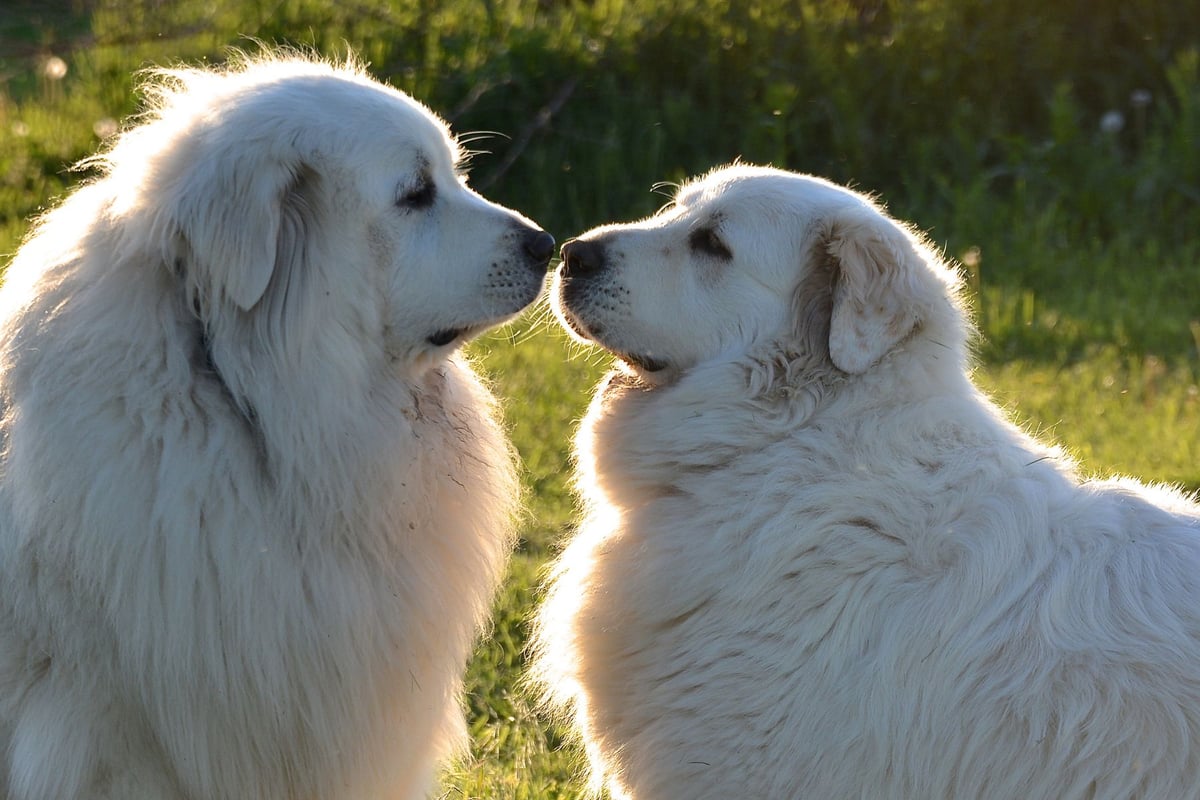
The Kuvasz (FCI 54) is a Hungarian flock guardian weighing 37 to 52 kg for 66 to 76 cm at the withers, recognizable by its pure white coat, with not the slightest marking allowed by the standard. Brought to Hungary by the Magyar tribes in the 9th century from probably Turkic stock — its name derives from the Turkish term "kawasz", meaning guard — it was raised to the rank of royal dog by Matthias I in the 15th century. The breed nearly disappeared after the Second World War: the German and then Soviet armies deliberately killed it because it attacked soldiers, leaving only around thirty individuals in 1945. Its full reconstruction from a handful of survivors is now part of its history.
Scores given on measured axes, data confidence: high.
Living with a Kuvasz
A powerful, well-proportioned silhouette, without excessive bulk despite its size: males 71-76 cm for 40-52 kg, females 66-70 cm for 37-45 kg. The coat is pure white with no exceptions allowed by the standard — this trait historically let shepherds working at night tell the dog apart from the wolf in the dark. The coat is double, medium-to-long, wavy on the back and legs, with a dense, woolly undercoat. The head is elongated with a slight stop, the eyes almond-shaped and dark brown, the ears drop-set and V-shaped. Its build favors endurance over top speed.

A typical autonomous guardian among livestock guardian dogs (LGDs): it assesses threats on its own and decides its response without seeking human validation. Its wariness of strangers is structural and deep — it isn't resolved by simple socialization and forms the very foundation of its usefulness. It is vocal and barks at night by nature, an innate behavior that training does not remove. Toward its reference family, its loyalty is quiet and constant; with children of the household it shows tolerance, but its size demands strict supervision of interactions with unfamiliar children.
Training demands absolute consistency and prior experience with independent breeds — novice owners are quickly overwhelmed by a 50 kg dog that makes its own decisions. Coercive methods are counterproductive: they reinforce mistrust rather than cooperation. Early socialization before 12-14 weeks is decisive for a manageable adult, but it does not erase the guardian instinct. Daily exercise of 45 to 60 minutes is enough to maintain physical balance — this isn't a sport or agility dog, but a patrolling guardian.

300 to 500 g of premium large-breed kibble a day for a 45 kg adult, split into two meals. During growth (up to 18-24 months), giant-breed kibble with moderate calcium content prevents the overly rapid bone ossification responsible for OCD. Glucosamine and chondroitin are recommended as a supplement from age 5-6 for joint prevention. Strictly avoid any intense exercise within an hour of meals to reduce the risk of gastric dilatation-volvulus — a documented risk at this size.
Affiliate links, no extra cost to you. Legal notice

A large fenced yard is the absolute minimum — apartment life is unsuited to a 50 kg dog that instinctively patrols its territory. A house with rural or semi-rural land is its natural environment; its intense nighttime barking makes cohabitation in an urban area or shared-wall housing very difficult. Its exceptional cold tolerance (dense double coat, a millennia-old adaptation to Hungarian and Carpathian winters) contrasts with poor heat tolerance: in summer, constant access to shade and fresh water is essential to avoid heatstroke.

The double coat needs brushing twice a week outside shedding season, and daily during the spring and fall seasonal molts, which last three to five weeks. The white coat shows dirt visibly — mud and plant matter cling to it more than to a dark coat, which calls for regular baths (every 6 to 8 weeks). Unlike the Komondor, whose coat cords spontaneously, the Kuvasz's coat stays workable without mandatory professional grooming. The drop ears trap moisture and need weekly cleaning to prevent ear infections.

Life expectancy of 10 to 12 years, typical for a dog of this size. Hip dysplasia is the most documented condition: serious breeders provide radiograph results (FCI/OFA) for their breeding stock. Osteochondritis dissecans (OCD) affects the shoulder and hock joints during growth — giant-breed nutrition and controlled growth reduce the risk. Gastric dilatation-volvulus (GDV) is a real risk at this size: two strict meals a day and one hour of rest after each meal are non-negotiable precautions. Hypothyroidism is reported in some lines and can appear in young adults: thyroid testing built into the annual check-up once growth is finished beats a late diagnosis triggered by symptoms.
The breed arrived in Hungary with the Magyar tribes during their 9th-century migration — its name is a corruption of the Turkish term "kawasz" (armed guard), which suggests an origin in the Central Asian steppes. In the 15th century, King Matthias I of Hungary made it a royal symbol: Kuvasz dogs slept in the royal chambers, ate at the king's table, and served as his bodyguards — a favor denied to the nobility. Two centuries later, the breed moved back down to the sheepfolds and flocks, its role as livestock guardian becoming firmly established. The Second World War nearly proved fatal: German and Soviet soldiers systematically shot any Kuvasz they encountered, since the dogs attacked unfamiliar uniforms without hesitation. By 1945, fewer than thirty individuals survived in Hungary. The breed's reconstruction was built on this tiny base, which explains the relative genetic uniformity of today's population.
Five essentials to line up before day one.
Affiliate links, no extra cost to you. Legal notice
FCI, Fédération Cynologique Internationale, the world body that has codified breed standards since 1911. FCI number 54 is assigned to the Kuvasz.
Pinscher and Schnauzer - Molossoid and Swiss Mountain and Cattledogs
40 to 60 kg

Pinscher and Schnauzer - Molossoid and Swiss Mountain and Cattledogs
40 to 65 kg
