


Pyrenean Mountain Dog
Pinscher and Schnauzer - Molossoid and Swiss Mountain and Cattledogs
40 to 60 kg
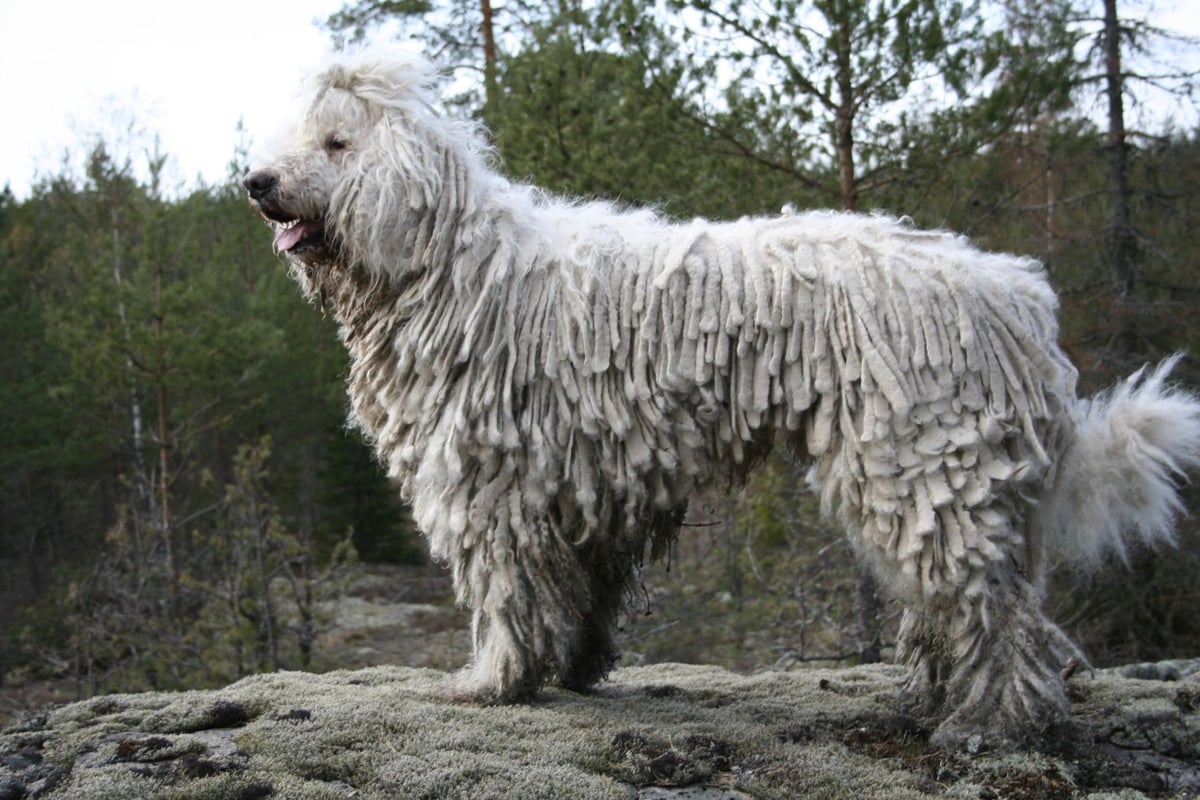
The Komondor is the Hungarian flock guardian with a white corded coat, nicknamed "the king of sheepdogs" in Hungary and classed FCI number 53 (Group 1). Introduced to the Puszta plains by the Cumans (a nomadic people from Central Asia) in the 12th-13th centuries, it guards the large flocks of merino sheep on the Hungarian plain by blending visually into the flock. As an adult, it weighs 40 to 60 kg for 65 to 80 cm.
Scores given on measured axes, data confidence: high.
Living with a Komondor
A sturdy, muscular build under an entirely white corded coat. Males 70-80 cm for 50-60 kg, females 65-70 cm for 40-50 kg. The coat — a characteristic unique to the breed — forms natural cords (dreadlocks) that begin developing around 9 months and reach full maturity at 2 years. These cords result from the fusion of the woolly undercoat and the coarse outer coat — a spontaneous process that cannot be reversed without a full clip-down. The white coat provides perfect camouflage within the flock against predators approaching at night.

An autonomous guardian with economical patrol behavior: it doesn't run, doesn't play during working hours, but watches and steps in on demand. Its wariness of strangers is structural and total — non-negotiable even with well-conducted early socialization. The alert bark is powerful (4/5) and triggers at a low threshold. With its reference family, it shows a quiet loyalty without being demonstrative. Cohabitation with other male dogs requires boundaries set from a very young age.
Low trainability by functional design: the breed has been selected for centuries to make autonomous decisions in the face of predators without waiting for the shepherd's order. The basics (recall, sit, walking on leash) are learned through positive reinforcement but require prolonged repetition and calm mastery — coercive methods produce shutdowns or increased mistrust. Training before 16 weeks is decisive. Not recommended for first-time owners without experience with an independent breed.

380 to 550 g of premium large-breed kibble a day for a 50 kg adult, in 2 strict meals. Large-breed kibble maintained until 24 months to support bone growth. This isn't a breed prone to obesity, but excess weight worsens hip dysplasia and GDV risk: a monthly check of body condition is essential under the coat, since it's imperceptible to the eye. Glucosamine and chondroitin recommended from age 5.
Affiliate links, no extra cost to you. Legal notice

A house with a large fenced property and room to patrol is mandatory — its functional calling is perimeter surveillance, not couch life. Apartments are unsuited and urban settings are discouraged: its unconditional wariness of strangers and powerful alert bark make it unmanageable in close residential quarters. Exceptional cold tolerance: its cords form natural thermal insulation effective down to -25 °C. In summer, sensitive to heat above 25 °C — exercise limited to cool hours, access to shade essential. After rain or a swim, it stays wet at the core of its cords for a day or two: plan ahead before letting it back inside.

Grooming among the most demanding of any breed: the forming cords (9 to 24 months) must be separated by hand, one by one, to keep the coat from matting into a single felted slab. This work recurs regularly throughout the year and runs into hours once the coat has gone a few weeks unattended. No brushing: brushes destroy formed cords, only hand-separation works. Bathing must be followed by active drying down to the core of the cords — a corded coat left to air-dry on its own stays wet deep down for 24 to 48 hours and eventually develops internal mold.

Life expectancy of 10 to 12 years, in the upper range for breeds of this size. Hip and elbow dysplasia: prevalent, radiographs from both parents (grade A/B OFA or SCC) should be required before acquisition. Gastric dilatation-volvulus (GDV): a real risk given the deep chest — 2 meals mandatory, 1 hour of digestive rest, no intense exercise after meals. Entropion (turned-in eyelids) reported in some lines — check that there's no history of eye surgery in the parents. The density of the corded coat can hide wounds or parasites: a systematic weekly inspection of the skin beneath the cords is needed.
The breed is documented in Hungary since the 16th century, but its origins trace back to the Cumans (Kuns in Hungarian), a Turkic-speaking nomadic people who migrated from the Central Asian steppe to Hungary in the 12th-13th centuries. The word "Komondor" likely derives from "Kumandur" (dog of the Kuns). It guarded the vast merino sheep flocks of the Hungarian Puszta plains, often alone over territories of several square kilometers. Nearly wiped out during the Second World War (soldiers killed farm dogs to eliminate defenders of properties), the breed was rebuilt from a few dozen dogs starting in 1945. Recognized by the FCI under number 53, it remains the largest Hungarian shepherd breed.
Five essentials to line up before day one.
Affiliate links, no extra cost to you. Legal notice
FCI, Fédération Cynologique Internationale, the world body that has codified breed standards since 1911. FCI number 53 is assigned to the Komondor.
Pinscher and Schnauzer - Molossoid and Swiss Mountain and Cattledogs
40 to 60 kg

