


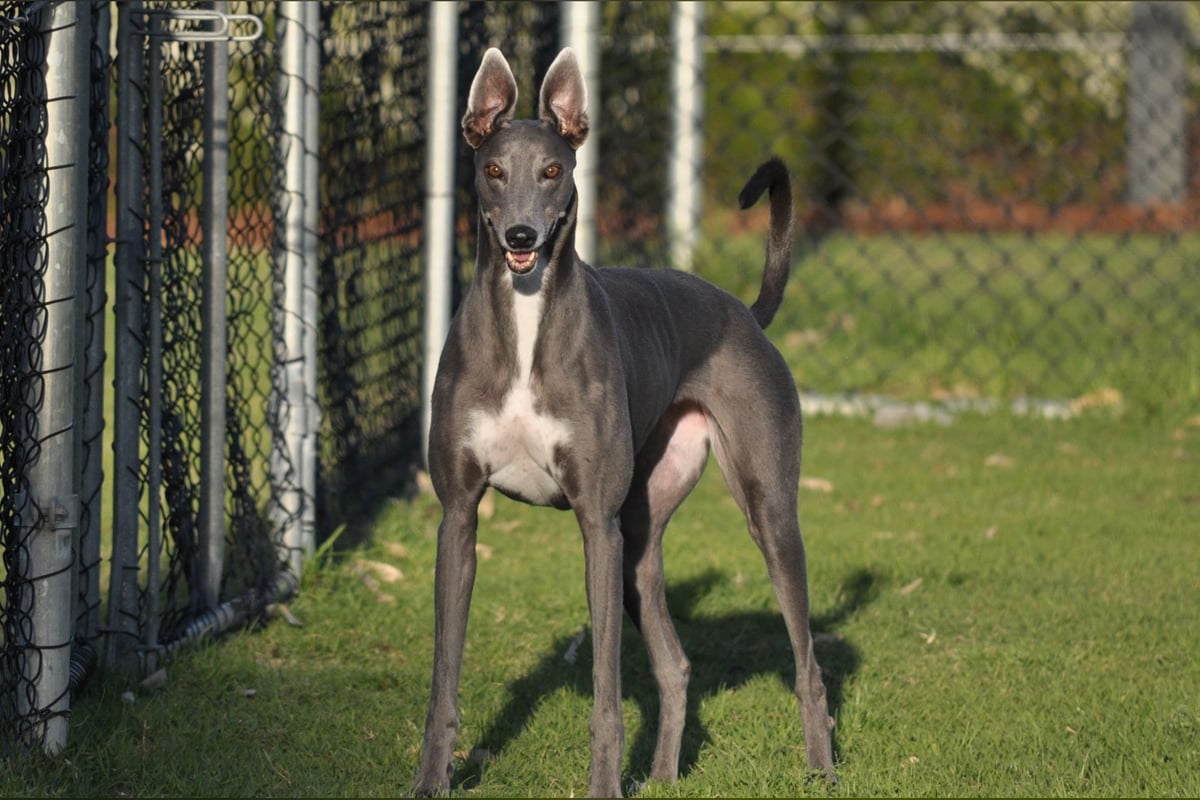
Greyhound
The Greyhound is the fastest racing dog in the world, able to reach 70 km/h within six strides. Recognized by the FCI under number 158, it weighs 25 to 32 kg for 68 to 76 cm. Paradoxically, it is a calm dog at home that sleeps 18 hours a day — nicknamed the "45 mph couch potato" by retired-racer adoption associations.
- Weight
- 25 to 32kg
- Height
- 68 to 76cm
- Life expectancy
- 12years
- Monthly cost
- 80 to 140€
Personality profile
Energy 3/5
Independence 3/5
Trainability 3/5
Good with children 4/5
Barking 1/5
Space needed 3/5
Attachment to home 4/5
Good with strangers 3/5
Good with dogs 3/5
Good with cats 2/5
Coat care 1/5
Exercise needs 3/5
Scores given on measured axes, data confidence: high.
Living with a Greyhound
Description
Extreme dolichocephalic silhouette: long, tapered head, deep keeled chest, tucked-up waist, heavily muscled thighs, back arched like a sabre blade. Body fat proportion is among the lowest of all dog breeds, to the point that bloodwork doesn't read the same way as in other breeds: hematocrit and several reference values fall outside standard canine norms. Short, hard coat, available in a great many variants — brindle, fawn, black, white, blue, and their combinations.

Temperament
Gentle, reserved with strangers, non-aggressive. Rooted in 6 000 years of selection for sight and speed, it carries a coursing instinct that triggers at any small moving animal — caution with cats and rabbits. Affectionate with its family without being clingy; tolerates solitude better than most working breeds. Not much of a barker, a calm temperament that contrasts with its athletic build.
Training
Moderate trainability: selection focused on visual independence, not obedience — instinct comes before command. Recall is unreliable without intensive training; must be exercised in an enclosed space or on a long lead. Responds well to short sessions (10-15 minutes) with food rewards. Retired racers need a 4- to 8-week decompression phase to adjust to family life.

Feeding
Daily ration of 350 to 500 g of premium kibble for a 30 kg adult, split into 2 meals. Because of the deep chest morphology, the risk of gastric dilatation-volvulus exists: 45 minutes of rest before and after feeding is mandatory. Joint supplements recommended after age 6 to prevent pain linked to wear from a racing career.
Affiliate links, no extra cost to you. Legal notice

Living conditions
Suited to apartment living despite its size: two 30-minute outings a day are enough, one of which should be in a secure space for free sprints. A fenced yard (fence ≥ 1.80 m mandatory — it can clear obstacles at high speed) is ideal but not essential. Sensitive to cold due to its near-total lack of undercoat and subcutaneous fat: a coat is mandatory below 5 °C. Never let it off leash without a fence — its top speed puts it out of vocal range within seconds.

Grooming and coat care
Minimal upkeep: weekly brushing with a rubber grooming glove is enough for the short coat. No professional grooming needed. Regular checks of the drop ears and the paw pads, which get worn down by hard track surfaces. Quarterly bath with a gentle shampoo for sensitive skin.

Health
Life expectancy 10 to 14 years, median 12 years according to British studies. Rate of osteosarcoma (bone cancer) significantly higher than the canine average, especially in dogs that raced, retired around age 4-5 — though the risk itself materializes later in the dog's life (see FAQ). Specific anesthesia risk: the very low fat level and a slower liver metabolism alter the response to barbiturates (a sighthound anesthesia protocol is required from any vet). Skin sensitivity due to the close coat. No major structural heart problems — natural selection through performance.
Breed history
Sighthound-type dogs appear on Egyptian depictions dating back to around 4 000 BC, and some Bible translations mention them (Proverbs 30:31). Julius Caesar describes sighthounds in Britain during his expedition of 55 BC. A pure coursing breed — used to hunt hare and deer by sight up until the 19th century. The era of industrial Greyhound racing begins in 1926 with the opening of the first tracks in England; several tens of thousands of dogs are retired each year through rescue associations (Retired Greyhound Trust in the UK, Lévriers en Détresse in France).
Getting ready for your Greyhound
Five essentials to line up before day one.
Affiliate links, no extra cost to you. Legal notice
FAQ: Greyhound
Sources
- FCI Standard No 158 · FCI breed standard 158, Group 10 Sighthounds
- AKC Breed Profile — Greyhound · AKC Greyhound breed profile, Hound Group
- Retired Greyhound Trust UK · Retired Greyhound Trust, adoption guide and health data, UK
FCI, Fédération Cynologique Internationale, the world body that has codified breed standards since 1911. FCI number 158 is assigned to the Greyhound.
Breeds similar to a Greyhound

