


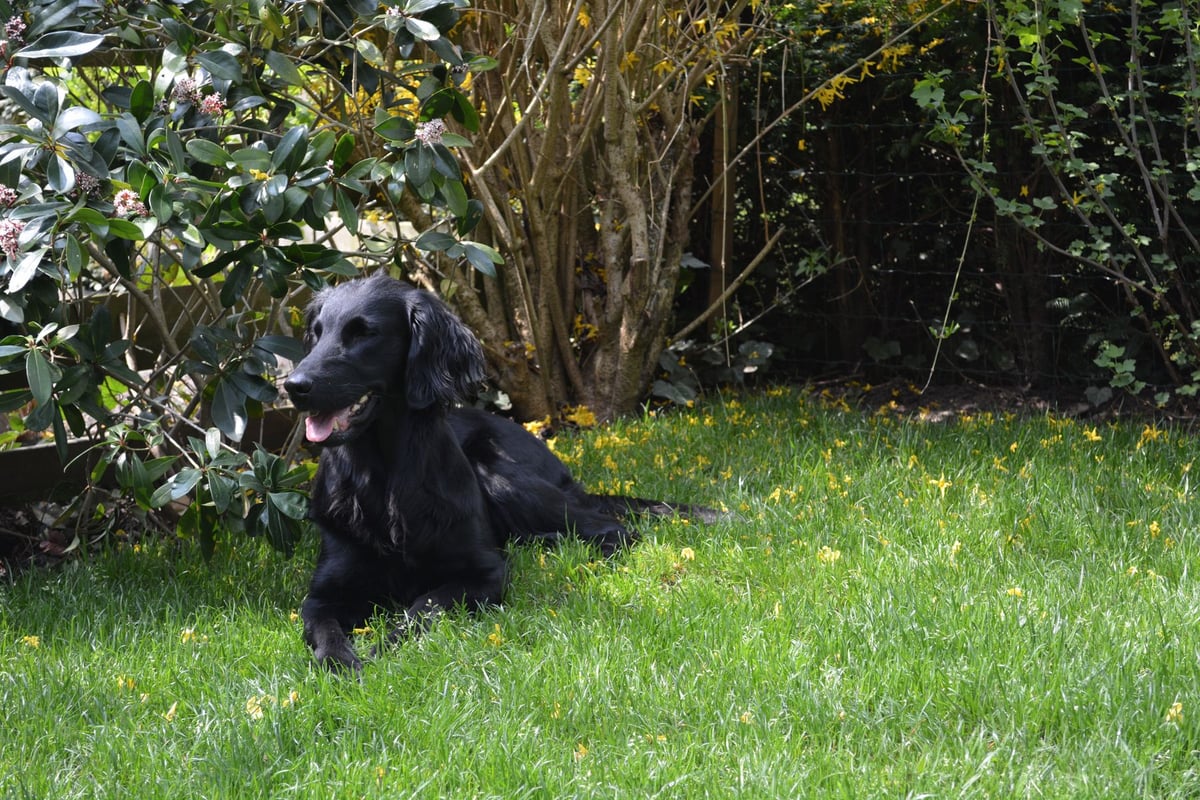
Flat-Coated Retriever
The Flat-Coated Retriever, nicknamed 'Flatty', is a British retriever weighing 25 to 36 kg, standardized in the 19th century (Hutchinson, 1864) by crossing the Newfoundland, Setter and Sheepdog. Recognized by the FCI under number 121, it is known for its so-called 'perpetual puppy' temperament (late maturity at 3-4 years) and for one of the highest cancer rates recorded in any dog breed — on the order of 60% of dogs die of a neoplasm according to mortality surveys conducted on the breed.
- Weight
- 25 to 36kg
- Height
- 56 to 62cm
- Life expectancy
- 9years
- Monthly cost
- 110 to 170€
Personality profile
Energy 5/5
Independence 2/5
Trainability 4/5
Good with children 5/5
Barking 2/5
Space needed 4/5
Attachment to home 5/5
Good with strangers 5/5
Good with dogs 5/5
Good with cats 4/5
Coat care 3/5
Exercise needs 5/5
Scores given on measured axes, data confidence: high.
Living with a Flat-Coated Retriever
Description
A large, lean retriever breed with a flat, silky coat (black or liver), distinct from the Golden's wavy coat. Males 59-62 cm for 28-36 kg, females 56-59 cm for 25-32 kg. A long, fine head, a gentle, lively expression, tail carried cheerfully. A more athletic, less compact silhouette than the Labrador. Life expectancy 8-10 years, among the shortest of the large retrievers.

Temperament
Sociable with everyone without distinction — children, strangers, other dogs — just like the Golden. Enthusiastic, playful and exuberant well into adulthood: 3-4 years before adolescent behavior truly gives way to more calm, and even then. This late maturity is an accepted trait of the breed, not a training failure. A breed attached to people (independence score 2/5), it copes poorly with prolonged isolation.
Training
Solid trainability — well-ranked on Coren's working intelligence test — with strong motivation for retrieving objects. It picks up a new command in 5-15 repetitions with positive reinforcement. Its energy (5/5) and exercise needs (5/5) demand long, varied training sessions to stay engaged — repetitive drills quickly bore the Flatty. Excellent results in agility, advanced obedience, mantrailing and hunt tests, provided training starts as early as 3-4 months.

Feeding
350 to 450 g of premium kibble a day for a 30 kg adult, in 2 meals. An athletic, lean breed with no marked predisposition to obesity, but the ration should be adjusted to age and activity: a less active Flatty aged 7+ needs a 15-20% reduction. Large-breed kibble up to 18-24 months (slow bone growth). Avoid intense exercise within 2 hours after a meal (predisposition to gastric torsion).
Affiliate links, no extra cost to you. Legal notice

Living conditions
Unsuited to a small apartment: its energy level (5/5) and size demand a garden and 1.5 to 2 hours of daily activity including retrieving sports or swimming. In a large apartment, it is livable only at the cost of long, regular outings (conditions detailed in the FAQ). It tolerates British cold well thanks to its double coat, but not prolonged heat waves.

Grooming and coat care
Brush twice a week under normal conditions to maintain the flat, silky coat and remove leaves and twigs after forest outings. Moderate seasonal sheds (spring/fall) requiring daily brushing for 2-3 weeks. Optional professional grooming every 3-4 months to even out the feathering on the legs and tail. Quarterly bath with a mild shampoo.

Health
A breed with a major health risk: on the order of 60% of dogs die of cancer — malignant histiocytosis and osteosarcoma lead the list, at a rate well above other retrievers. Since cancer is the leading cause of death in a breed that rarely lives past 10, vigilance cannot wait for the senior years: any subcutaneous mass, persistent lameness or unexplained weight loss warrants a visit from adulthood onward. Life expectancy 8-10 years (vs. 11-12 years for the Labrador). Hereditary hip dysplasia (official screening X-rays required). It is essential to choose a breeder who tests breeding stock, with certified hip scoring and documented longevity in the lines.
Breed history
Developed in England starting in 1864 by S.E. Hutchinson, by crossing a Newfoundland (water work), a Setter (scenting) and a Sheepdog (agility). A dominant breed in British shows from 1875 to 1905, before being overtaken by the Labrador. Nearly wiped out after the First World War: Stanley O'Neill led a reconstruction effort in the 1920s from a small core of surviving breeding stock. Modest popularity since, which partly explains the narrow genetic base associated with the breed's cancer prevalence.
Getting ready for your Flat-Coated Retriever
Five essentials to line up before day one.
Affiliate links, no extra cost to you. Legal notice
FAQ: Flat-Coated Retriever
Sources
- FCI Standard No 121 · FCI breed standard 121, Group 8 Section 1 Retrievers
- AKC Breed Profile — Flat-Coated Retriever · AKC Flat-Coated Retriever breed profile, Sporting Group
- Morris Animal Foundation — Canine Cancer Studies · Morris Animal Foundation — Golden Retriever Lifetime Study, a canine cancer research program
FCI, Fédération Cynologique Internationale, the world body that has codified breed standards since 1911. FCI number 121 is assigned to the Flat-Coated Retriever.
Breeds similar to a Flat-Coated Retriever

