


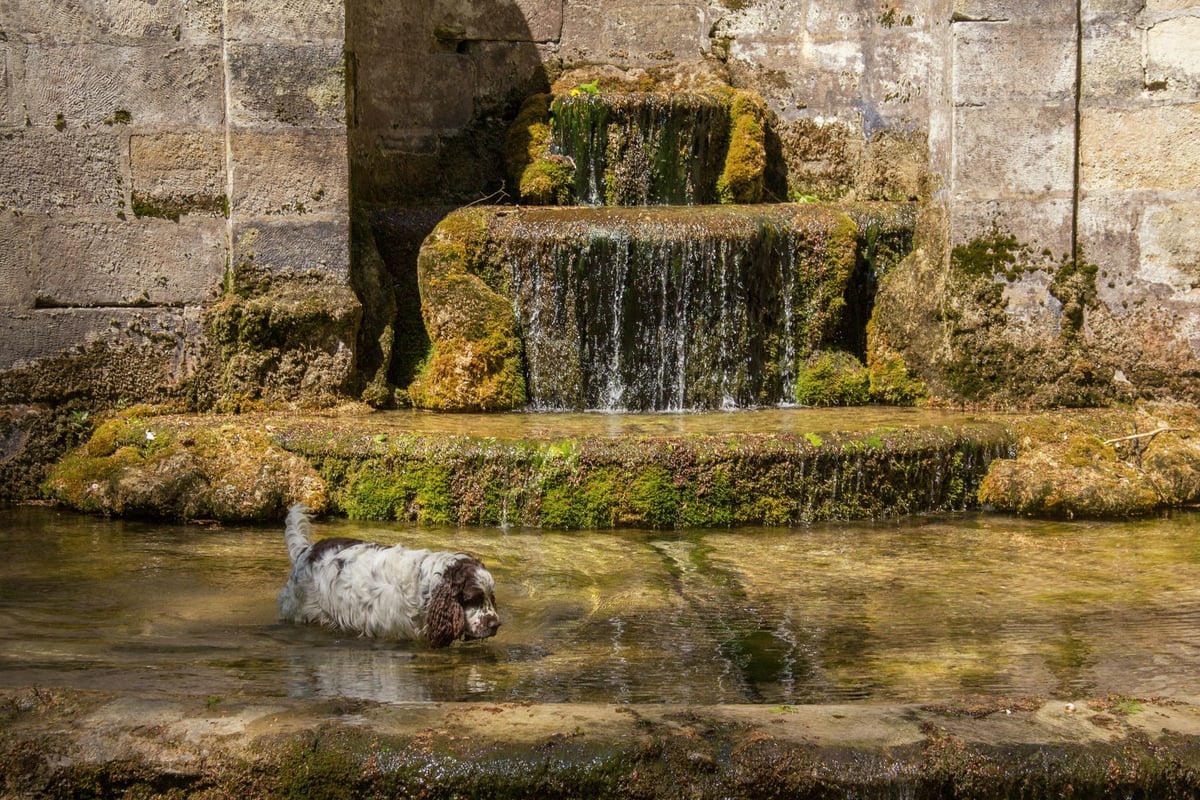
English Springer Spaniel
The English Springer Spaniel weighs 18 to 25 kg for 46 to 51 cm at the withers — one of the largest British hunting spaniels recognized by the FCI (number 125, group 8). The name 'springer' refers to its hunting action: springing the game out of cover to put it within gun range. Cockers and English Springers were judged together within the same litters until 1902, separated by weight alone. Life expectancy 12 to 14 years.
- Weight
- 18 to 25kg
- Height
- 46 to 51cm
- Life expectancy
- 13years
- Monthly cost
- 80 to 130€
Personality profile
Energy 5/5
Independence 2/5
Trainability 4/5
Good with children 4/5
Barking 3/5
Space needed 4/5
Attachment to home 4/5
Good with strangers 3/5
Good with dogs 4/5
Good with cats 3/5
Coat care 3/5
Exercise needs 5/5
Scores given on measured axes, data confidence: high.
Living with an English Springer Spaniel
Description
A medium-to-large breed with a compact, muscular profile: a balanced head with a pronounced stop, long, flat ears hanging well below the jaw, oval eyes ranging from hazel to dark brown. The coat is medium-length, flat or slightly wavy, with feathering on the ears, chest, legs and belly. Two dominant FCI-recognized colors: liver and white, black and white (with or without tan). Two modern lines exist side by side — 'field' type (working) and 'show' type (exhibition) — so different morphologically and behaviorally that some breeders push for their official separation into two distinct breeds.

Temperament
An expressive working dog, deeply attached to its handler, it copes poorly with more than 4 to 5 hours alone and can develop separation anxiety with destructive behavior. Playful, sociable with children and other dogs when well socialized. A minority of dogs is affected by 'Springer Rage Syndrome', a hereditary neurological disorder detailed below. The 'show' line has a calmer temperament than the 'field' line, whose working intensity can overwhelm an insufficiently active household.
Training
Excellent trainability: a breed selected for centuries to work in close partnership with the hunter, with a strong need for communication with its handler. It picks up commands in 5 to 15 repetitions with positive reinforcement and scent work. Suitable sports include field trials, obedience, mantrailing, agility and long structured walks. The 'field' line needs intense, regular training to channel its energy — without enough stimulation, compulsive behaviors (repeated jumping, destruction) can set in.

Feeding
350 to 450 g of premium kibble a day for a 20 to 22 kg adult, split into 2 meals. An active breed whose caloric needs vary significantly depending on whether the dog is in hunting activity or companion mode: adjust the ration to the season. Watch the body condition score in winter — a tendency to gain weight as soon as activity drops.
Affiliate links, no extra cost to you. Legal notice

Living conditions
A house with a secured garden is the reference environment for this breed: its tracking instinct and high energy level make apartment living unsuitable without 1.5 to 2 hours of physical and scent-based activity guaranteed every day. The 'field' line needs more stimulation than the 'show' line. An outdoor space to relax in is essential between outings. Its strong hunting instinct requires a fence of at least 1.80 m — the Springer will follow a scent trail regardless of recall.

Grooming and coat care
Moderate upkeep compared to other spaniels: brush 2 to 3 times a week to detangle the feathering on the ears, legs and belly, more often after an outing in vegetation. Professional grooming recommended every 8 to 10 weeks to even out the coat and thin the ears. Weekly ear cleaning is essential to prevent recurring infections. Working dogs are often clipped shorter on the body than show dogs.

Health
Chronic ear infections are the most frequent condition: the long, drooping ears reduce ventilation in the ear canal, creating an environment prone to bacterial and fungal infections — weekly cleaning is mandatory. Hip dysplasia is present in the breed (official screening X-rays recommended for breeding stock). Progressive retinal atrophy (PRA) requires a PRA DNA test for both parents. Springer Rage Syndrome, described as a heritable focal epilepsy, shows up as sudden episodes of aggression with no prior warning, followed by an apparent return to calm; it affects only a fraction of lines but warrants asking for the behavioral history over three generations. Entropion and ectropion (eyelid malformations) are also described in the breed.
Breed history
English hunting spaniels have been documented in Great Britain since the 16th century. Until 1902, Cockers and Springers were not separate breeds: within the same litter, dogs under 11.3 kg were classed as Cockers, those over 11.3 kg as Springers. It was in 1902 that the British Kennel Club formalized the split and recognized the breed as its own. The specialization between working dogs and show dogs took hold over the 20th century and produced today's two 'field' and 'show' lines. Recognized by the FCI under number 125.
Getting ready for your English Springer Spaniel
Five essentials to line up before day one.
Affiliate links, no extra cost to you. Legal notice
FAQ: English Springer Spaniel
Sources
- FCI Standard No 125 — English Springer Spaniel · FCI breed standard 125, Group 8 Flushing Dogs, Section 2 Spaniels
- AKC Breed Profile — English Springer Spaniel · AKC English Springer Spaniel breed profile, Sporting Group
- SCC Standard — English Springer Spaniel · Société Centrale Canine, official English Springer Spaniel standard, Group 8
FCI, Fédération Cynologique Internationale, the world body that has codified breed standards since 1911. FCI number 125 is assigned to the English Springer Spaniel.
Breeds similar to an English Springer Spaniel

