


Pyrenean Mountain Dog
Pinscher and Schnauzer - Molossoid and Swiss Mountain and Cattledogs
40 to 60 kg
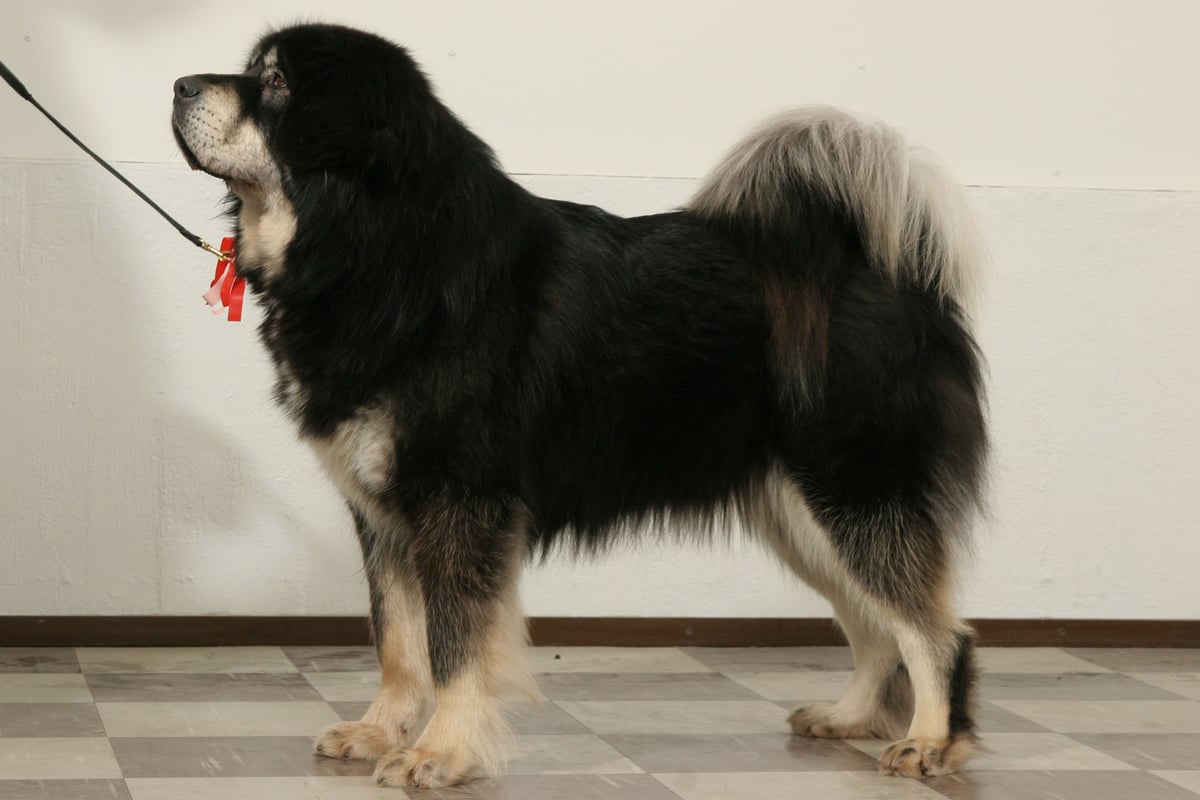
The Tibetan Mastiff (Do-Khyi in Tibetan, 'tied dog') is a Himalayan guardian classified as FCI number 230 (Group 2), weighing 50 to 90 kg for 61 to 76 cm at the withers. Marco Polo described it in the 13th century as being the size of a donkey. Used for millennia around Buddhist monasteries and nomadic dwellings on the Tibetan plateau, it works in a nocturnal pack to deter predators at altitudes where the air grows thin.
Scores given on measured axes, data confidence: high.
Living with a Tibetan Mastiff
A powerful, massive build with very heavy bone structure. Males 66-76 cm for 65-90 kg, females 61-71 cm for 50-75 kg. A thick double coat: a dense woolly undercoat and a harsh outer coat, providing protection down to -40 °C. Coat colors black, black and tan, blue and tan, or golden fawn under FCI standard 230. A pronounced mane in the adult male, reminiscent of a lion. The EPAS1 gene, a mutation shared with Himalayan human populations, gives it a remarkable tolerance to altitude hypoxia.

The quintessential autonomous guardian, selected to decide on its own without human orders. Its independence is total: it distinguishes household members from strangers with formidable precision, but its wariness of strangers is structural and cannot be neutralized by socialization alone. The deep, powerful nighttime barking is an innate deterrent behavior — it cannot be suppressed and lasts several hours a night. Its loyalty to its reference family is intense but does not show itself through obedience.
Trainability among the lowest of breeds this size: the Do-Khyi is not selected to execute orders, but to make autonomous decisions in a hostile environment. The basics (recall, leash walking, sit) are attainable but require constant repetition and absolute consistency, with no coercive methods — an 80 kg adult that refuses to come back is a real danger. Training should start before 16 weeks, while the puppy is still physically manageable.

450 to 700 g of premium giant-breed kibble a day for a 70 kg adult, in 2 strict meals. Growth is slow and does not finish until between 3 and 4 years — giant-breed kibble formulated for slow growth is essential until the end of this period. Glucosamine and chondroitin from age 4 to prevent joint degeneration under body mass. Strict weight control: an overweight dog compounds dysplasia and hypothyroidism.
Affiliate links, no extra cost to you. Legal notice

A rural house with a large, tall fenced property (minimum 2 m) is mandatory — a garden alone without an adjoining home is not suitable. Apartments are unsuited and urban settings are not recommended, for three combined reasons: its size (50-90 kg), its intense nighttime barking, which is bound to create conflict with neighbors, and its territorial instinct, which makes it hard to manage in crowded public spaces. Its Himalayan coat tolerates heat poorly: above 25 °C, exercise should be avoided during hot hours, and permanent access to shade and fresh water is essential.

Weekly brushing is enough outside of shedding season — the dense undercoat does not tangle as fast as finer-coated breeds. The annual shed (spring) is heavy and concentrated over 3 to 6 weeks: daily brushing becomes essential to prevent deep mats in the undercoat. A professional grooming session with a blow-dryer, at least once during shedding season, is strongly recommended. Clean the facial folds twice a week to prevent skin irritation.

Life expectancy of 11 to 14 years, long for a giant breed. Hip and elbow dysplasia: high prevalence — OFA or SCC X-rays of both parents are essential before acquiring a puppy. Hypothyroidism: frequently reported in the breed, watch for lethargy, unexplained weight gain and dandruff. Hereditary CIDN-type neuropathy (ARHGEF10 gene): a progressive neurodegenerative condition documented in the breed, DNA test available from some specialized breeders. Gastric dilatation-volvulus is possible at this size: 2 strict meals, 1 hour of digestive rest.
The Do-Khyi is among the oldest dog breeds in the world, present on the Tibetan plateau for millennia. Marco Polo, who set out for Asia in 1271, described it in his travel accounts as being 'the size of a donkey' — the first documented Western mention. A guardian of Buddhist monasteries and nomadic camps on the Tibetan plateau (4 000-5 000 m altitude), it worked in packs at night while short-coated Tibetan dogs (Lhasa Apso, Tibetan Terrier) guarded the inside. In 2014, a speculative bubble in China drove the price of a puppy up to 1.6 million dollars, leading to a catastrophic collapse and mass abandonment after the 2015 crash.
Five essentials to line up before day one.
Affiliate links, no extra cost to you. Legal notice
FCI, Fédération Cynologique Internationale, the world body that has codified breed standards since 1911. FCI number 230 is assigned to the Tibetan Mastiff.
Pinscher and Schnauzer - Molossoid and Swiss Mountain and Cattledogs
40 to 60 kg

Pinscher and Schnauzer - Molossoid and Swiss Mountain and Cattledogs
45 to 77 kg

Pinscher and Schnauzer - Molossoid and Swiss Mountain and Cattledogs
65 to 90 kg