


Bullmastiff
Pinscher and Schnauzer - Molossoid and Swiss Mountain and Cattledogs
41 to 59 kg
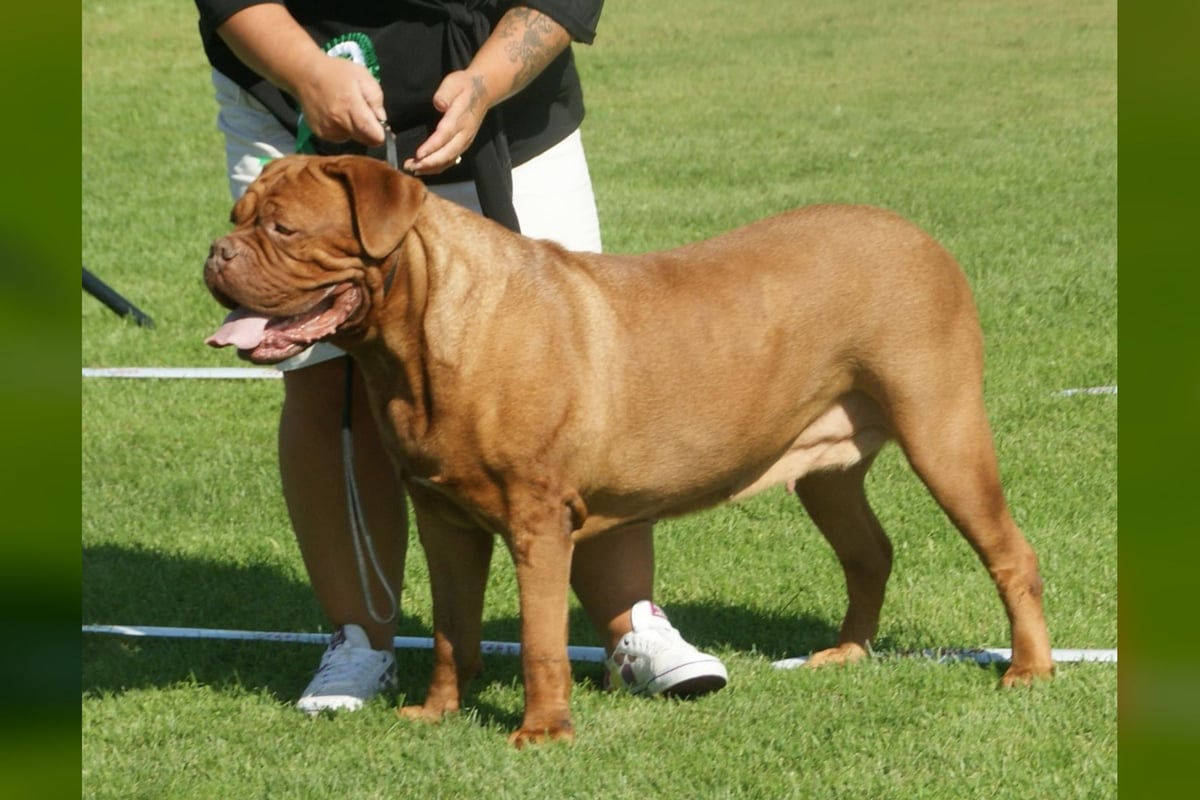
The Dogue de Bordeaux (FCI 116) is the oldest French molosser, traced back to the 14th century in Aquitaine — whether its birthplace was Bordeaux or Toulouse remains debated. Popularized worldwide by the American film 'Turner & Hooch' (1989), it holds one of the shortest life expectancies of any breed: 5 to 8 years. Males ≥ 50 kg for 60-68 cm — heavy drooling and costly health care call for a carefully considered adoption.
Scores given on measured axes, data confidence: high.
Living with a Dogue de Bordeaux
A massive, stocky breed: a short, muscular body, a broad, deep chest, and an extraordinarily large head — the largest in proportion to the body among FCI-recognized breeds. Males 60-68 cm for 50 kg minimum; females 58-66 cm for 45 kg minimum. Very loose skin forming deep folds on the skull and face — the breed's trademark. Short coat, fawn to mahogany, with a red or black mask depending on the variety. Pronounced brachycephaly: a short muzzle and upturned nose severely limiting breathing capacity. Constant, heavy drooling — not correctable, a structural trait.

A balanced, affectionate temperament with its close family — one of the highest levels of human attachment among molossers. Calm and not very active indoors, it can spend hours lying near its owner. Wary without being aggressive toward strangers: its guarding instinct shows through presence and vigilance rather than aggression. Caution is required with children outside the family because of its size (55 kg) and strength. Cohabitation between males is difficult without structured early socialization.
Decent trainability for a massive molosser: it picks up basic commands with positive reinforcement if training starts early. Training is mandatory from 8 weeks — by 12 months, the puppy already weighs 35-40 kg, and any leash pulling becomes physically difficult to manage. Mastering 'sit', 'down' and loose-leash walking are the absolute priorities. Socialization from 8 weeks to strangers, children, urban noise and other dogs — without it, natural wariness turns to fear or defensiveness. An experienced owner is recommended; first-time owners are discouraged.

500 to 800 g of premium large-breed kibble a day for a 55 kg adult, split into 2 mandatory meals (never a single one — gastric dilatation-volvulus risk). Giant-breed kibble up to 24 months for controlled bone growth. 60 minutes of digestive rest before and after any exercise. An elevated bowl at sternum height. Never overfeed: the Dogue de Bordeaux tends toward weight gain, which worsens dysplasia and BOAS. Glucosamine/chondroitin as a supplement from age 3.
Affiliate links, no extra cost to you. Legal notice

A house with a fenced garden is mandatory — a garden of at least 80 m² for a 55 kg adult to move around in. Unsuited to an apartment, even a large one. Intolerant of extreme heat due to severe brachycephaly: outings are off-limits above 22 °C during the day, permanent shade and fresh water are needed, and the risk of rapid, severe hyperthermia is real. Prefer early morning (before 9am) and late evening outings in summer. Acceptable tolerance of mild cold — the short coat is insufficient under prolonged temperatures below -5 °C. Tile or a cool surface is appreciated for lying down in hot weather.

A short coat with moderate upkeep: weekly brushing with a rubber grooming glove, with a more intense seasonal shed in spring. Daily cleaning of the deep folds on the skull and muzzle is essential — without this cleaning, moist dermatitis sets in within 48 hours. Dry thoroughly after each fold cleaning. Wipe away drool after meals and drinking. Monthly bath with a mild shampoo — non-trivial logistics for 55 kg. Monthly claw trimming; thick claws that grow fast.

Life expectancy among the shortest of all large breeds: 5 to 8 years, median 5.5 years according to the Leroy (2019) epidemiological study. Dilated cardiomyopathy (DCM): documented predisposition, annual echocardiographic screening recommended from age 4. Hip dysplasia is highly prevalent — X-rays mandatory for breeding stock. Gastric dilatation-volvulus (GDV): risk favored by the deep chest, surgical emergency within 2 hours. Severe brachycephaly causes Brachycephalic Obstructive Airway Syndrome (BOAS) — corrective surgery sometimes necessary. Dermatitis in the deep facial folds without rigorous care.
Documented presence in Aquitaine as early as the 14th century under the names 'dogue de France' or 'dogue d'Aquitaine' — precisely linking it to Bordeaux rather than Toulouse remains debated among dog experts. Historically used to hunt big game (boar, bear), guard livestock, and fight bulls until this was banned in the 19th century. Explosive worldwide popularity after the release of the American film 'Turner & Hooch' (1989) with Tom Hanks, which drove a surge of imports to the United States and Europe. Recognized by the FCI under number 116, group 2, current standard revised in 1995.
Five essentials to line up before day one.
Affiliate links, no extra cost to you. Legal notice
FCI, Fédération Cynologique Internationale, the world body that has codified breed standards since 1911. FCI number 116 is assigned to the Dogue de Bordeaux.
Pinscher and Schnauzer - Molossoid and Swiss Mountain and Cattledogs
41 to 59 kg

Pinscher and Schnauzer - Molossoid and Swiss Mountain and Cattledogs
68 to 100 kg

Pinscher and Schnauzer - Molossoid and Swiss Mountain and Cattledogs
40 to 50 kg