


Dogue de Bordeaux
Pinscher and Schnauzer - Molossoid and Swiss Mountain and Cattledogs
45 to 68 kg
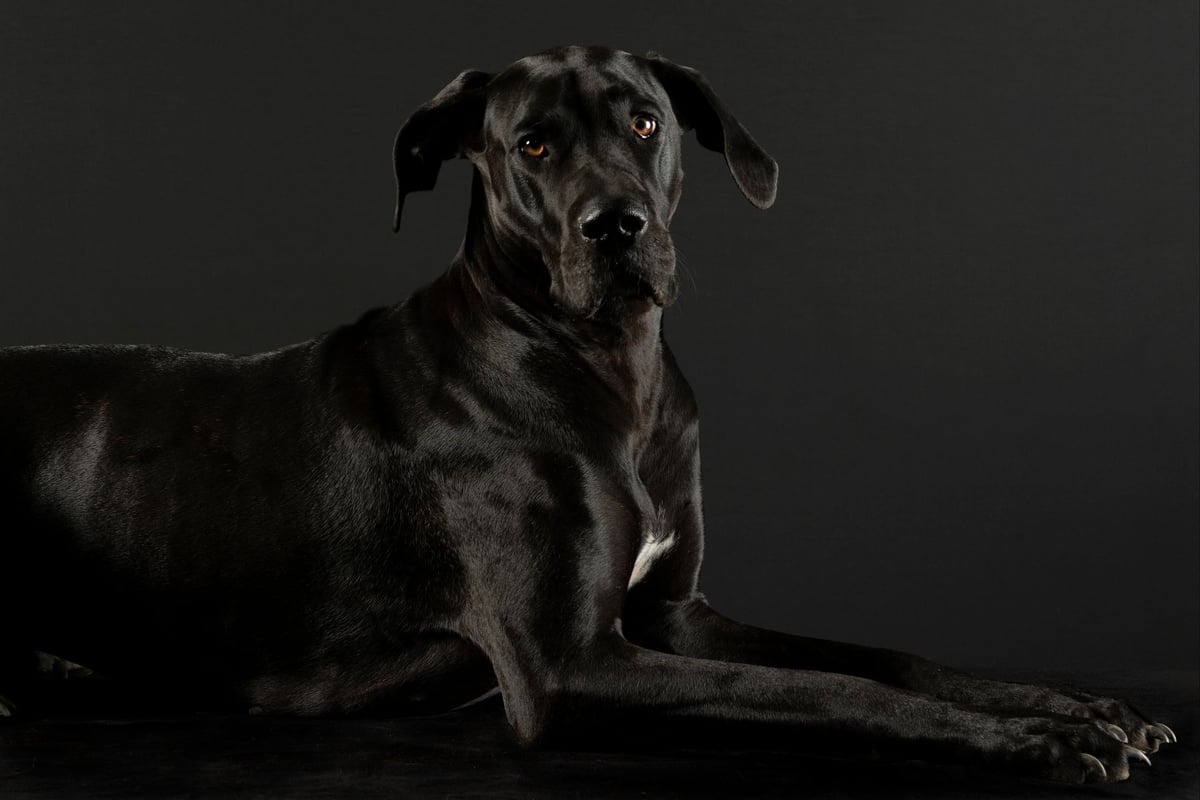
The Great Dane, nicknamed 'the Apollo of dogs', ranks among the tallest breeds at the withers — the Guinness World Record is held by Zeus at 111.8 cm, measured in 2012. Recognized by the FCI under number 235, it weighs 50 to 90 kg for 72 to 90 cm at the withers per the standard. Its 7 to 10 year life expectancy and its predisposition to gastric dilatation-volvulus (a lifetime risk estimated at 37%) make it a medically demanding breed.
Scores given on measured axes, data confidence: high.
Living with a Great Dane
A giant breed with a well-proportioned rectangular body, an elastic gait and a proud head carriage. Males stand ≥80 cm for 60-90 kg, females ≥72 cm for 50-75 kg. Short, sleek, glossy coat. FCI-recognized colors: fawn with a black mask, brindle, harlequin (white base with black patches), mantle (black with markings), steel blue and solid black. The harlequin coat, characteristic of the breed, results from a complex genetic mechanism: puppies homozygous for the harlequin gene are not viable.

A gentle, well-balanced dog despite its intimidating size — the term 'Apollo of dogs' refers as much to its behavioral nobility as to its stature. Deeply attached to its family, patient with children of the household it knows. Moderate wariness of strangers with no aggressive tendency except under provocation. Its size demands intensive early socialization from 8 weeks: a poorly socialized adult Great Dane weighing 80 kg becomes physically unmanageable, even without marked aggression.
Decent trainability for a molosser of this size: it picks up basic commands in 15 to 25 repetitions with a positive method. The point of training is not sport performance but physical control of an 80 kg dog in public. Loose-leash walking, sitting on command and a reliable recall take priority over any other learning. Enrolling in a dog training class from 3 months is mandatory — for the owner as much as for the dog.

700 to 1000 g of giant-breed kibble a day for a 70 kg adult, in 2 to 3 meals (never a single meal: multiplied GDV risk). Strict one-hour digestive rest before and after each meal. Calcium intake must be rigorously controlled until 18 months: excess calcium during growth promotes osteochondrosis and pathological bone development. Never supplement calcium freely without veterinary guidance. Transition to an adult diet at 18 months with weight supervision.
Affiliate links, no extra cost to you. Legal notice

A house with a fenced garden is strongly preferable. An apartment under 100 m² is unsuited to the size of an 80 kg animal that needs to be able to stretch out fully without constraint — two daily outings of at least 45 minutes each remain mandatory even in a large home. Short coat with almost no undercoat: poor tolerance of cold (<5 °C) and heat (>26 °C) — a coat is required in winter in northern regions. Growth is very slow until 18-24 months: impact exercise (jumping, repeated stairs) is forbidden during this period to protect the growth cartilage.

Minimal upkeep among large breeds: weekly brushing with a rubber grooming glove is enough outside of shedding season. It sheds moderately year-round with no dramatic shedding season. Bathe quarterly. Monthly inspection of the dewlap folds if pronounced. Claws need regular trimming — their fast growth, not offset by wear, causes foot deformities in dogs that are not very active on hard ground.

Life expectancy 7 to 10 years (median 8 years), short due to size and breed-specific conditions. Gastric dilatation-volvulus (GDV): a lifetime risk estimated at 37% according to epidemiological studies — an absolute veterinary emergency (<2h), life-threatening without immediate surgery. Dilated cardiomyopathy (DCM): documented genetic predisposition, annual echocardiographic screening recommended from age 2. Osteosarcoma more frequent than in the general dog population. Hip and elbow dysplasia to check in breeding stock.
Origins documented in 16th-century Germany as a boar- and bear-hunting dog for the Germanic nobility: a cross between the large English Mastiff and Irish sighthounds to combine power and speed. A written mention of 'Großer Deutschen Dogge' appears in Gesner's writings in 1557. Standardized in Germany in 1880, the Deutsche Doggen Klub was founded in 1888. Recognized by the FCI under number 235, with Germany as the country of origin and patronage. The Great Dane regularly appears in world height records: Gibson (107 cm, 2004), George (109.2 cm, 2010), Zeus (111.8 cm, 2012).
Five essentials to line up before day one.
Affiliate links, no extra cost to you. Legal notice
FCI, Fédération Cynologique Internationale, the world body that has codified breed standards since 1911. FCI number 235 is assigned to the Great Dane.
Pinscher and Schnauzer - Molossoid and Swiss Mountain and Cattledogs
45 to 68 kg

Pinscher and Schnauzer - Molossoid and Swiss Mountain and Cattledogs
40 to 50 kg

Pinscher and Schnauzer - Molossoid and Swiss Mountain and Cattledogs
42 to 60 kg