


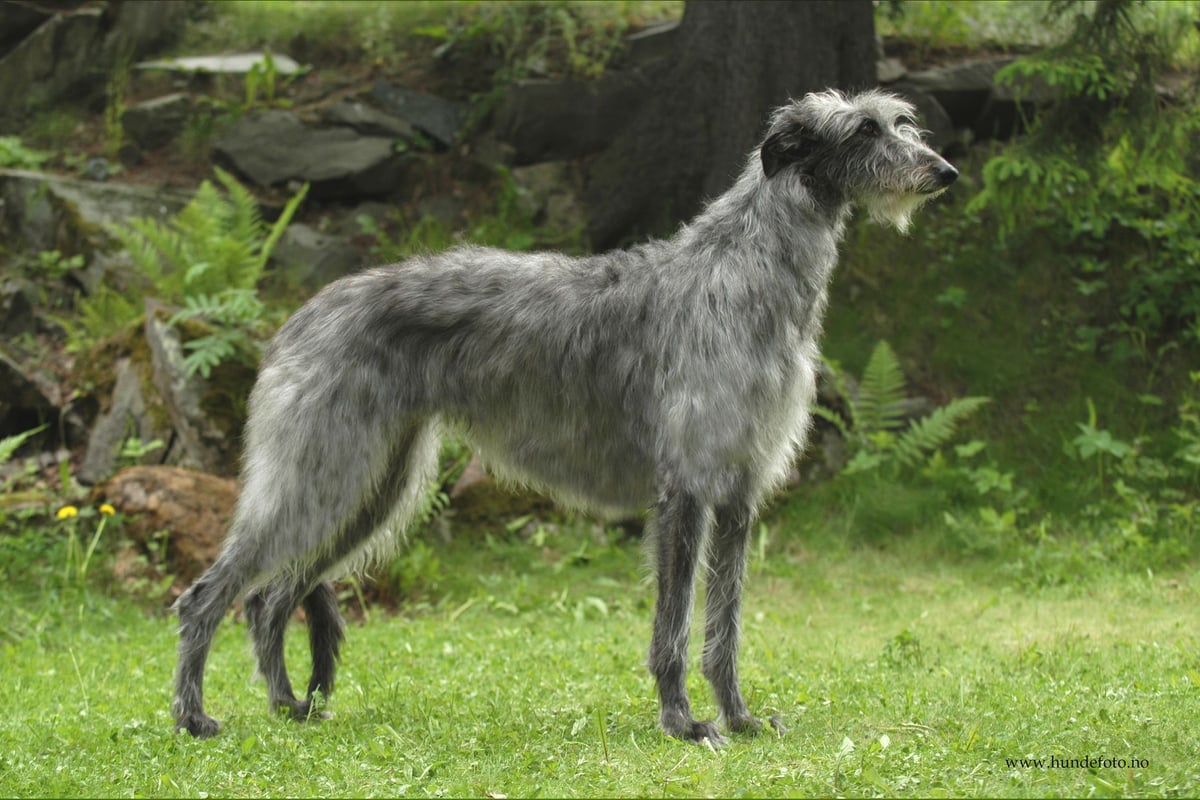
Scottish Deerhound
The Scottish Deerhound (FCI 164, Group 10) is a rough-coated sighthound from the Scottish Highlands, weighing 36 to 50 kg for 71 to 81 cm at the withers. An ancient breed selected by Scottish clans since the 16th century for hunting red deer, it was the only dog capable of catching this game across the mountainous moors. Ownership was reserved for the nobility — a commoner caught with a Deerhound risked death. Its 8 to 11 year life expectancy reflects the reality of giant breeds, with a prevalence of dilated cardiomyopathy estimated at 25-30%.
- Weight
- 36 to 50kg
- Height
- 71 to 81cm
- Life expectancy
- 10years
- Monthly cost
- 130 to 220€
Personality profile
Energy 4/5
Independence 4/5
Trainability 2/5
Good with children 4/5
Barking 2/5
Space needed 5/5
Attachment to home 4/5
Good with strangers 4/5
Good with dogs 4/5
Good with cats 1/5
Coat care 2/5
Exercise needs 4/5
Scores given on measured axes, data confidence: high.
Living with a Scottish Deerhound
Description
A slender, graceful build, finer than an Irish Wolfhound despite a comparable height — males reach 76-81 cm for 45-50 kg, females 71 cm for 36-43 kg. The rough, shaggy coat is its distinguishing mark: a double layer made up of a harsh outer coat 7 to 10 cm long and a dense undercoat, giving remarkable protection against Highland weather. Blue-gray is the most typical color and the most prized in the show ring; brindle, fawn and sandy are also permitted under FCI standard 164. The light bone structure, arched spine and long limbs make it a double-suspension running machine, built for endurance on rough terrain.

Temperament
Calm indoors, the Deerhound keeps a settled, quiet household pace and rarely barks — hard to compare to a guard dog. Its attachment to the family is deep but not demonstrative; it coexists without tension with other dogs, a legacy of hunting in packs. Its prey drive is considerable and non-negotiable: any moving object or animal can trigger an instinctive chase at full speed, with no possible return to recall. It is rarely wary of strangers — this sociability makes it a poor guard dog.
Training
Repetitive training is counterproductive with a Deerhound: a highly independent breed, it quickly abandons a sequence it perceives as pointless. The basics of obedience (sit, down, recall in an enclosed space) are learned through short positive reinforcement sessions — 10 minutes maximum. Its dog sport of choice remains lure coursing, which channels the prey drive safely and matches its natural mechanics. Daily exercise should include at least two long outings of 45 to 60 minutes, with the option of a gallop in a secure enclosed space several times a week.

Feeding
250 to 400 g of premium giant-breed kibble a day for a 45 kg adult, in two strictly spaced meals. Up to 18-24 months, controlled-growth large-breed kibble limits pressure on the joints of a light skeleton that grows fast. Glucosamine and chondroitin from age 5 as preventive joint support. Raw feeding (BARF) is practiced by some breeders, but requires heightened vigilance around factor VII deficiency — any cut or surgery can cause unusual bleeding if the coagulation disorder has not been screened for.
Affiliate links, no extra cost to you. Legal notice

Living conditions
The Deerhound needs a house with a large, tall fenced garden (minimum 1.8 m) — an apartment is unsuited to a 50 kg sighthound whose need for a running start and a full gallop is structural. The fence is not optional: once launched after prey, it reaches 60 km/h without any awareness of obstacles. Its double coat equips it well for harsh Highland winters; summer heat above 25 °C, on the other hand, works against it — a cool, shaded space is essential. Rural or semi-rural areas suit its profile; dense urban environments cause over-stimulation and make managing its prey drive risky.

Grooming and coat care
Care for the harsh coat is moderate: weekly brushing with a metal brush is enough to prevent tangles and remove dead undercoat. Hand-stripping twice a year (removing dead hair by hand) maintains the breed's characteristic harsh texture — scissor grooming damages the coat quality and is not recommended for show dogs. No regular professional grooming is required, unlike long-coated breeds. Clean the ears twice a month and check between the toes after outings on moorland to remove grass awns.

Health
Dilated cardiomyopathy (DCM) is the breed's main condition, with a prevalence estimated at 25-30% according to the Pankhurst and Cobb (2006) studies and OFA data — an annual cardiac workup from age 4 is recommended. Gastric torsion (GDV) is a real risk for this deep-chested build: two strict meals and an hour of rest after eating are non-negotiable preventive measures. Osteosarcoma and progressive retinal atrophy are documented in the breed. Factor VII deficiency, a coagulation disorder documented in the Deerhound, is detectable by DNA test — screening breeding stock is standard practice among serious breeders.
Breed history
Scottish Highlanders used this rough-coated sighthound from the 16th century to flush out and catch red deer on the mountainous moors — game no other dog of the time could catch at that speed on that terrain. Owning one was a privilege of clan nobility; the law prescribed death for any commoner who possessed a Deerhound, earning it the nickname 'royal dog'. Sir Walter Scott helped popularize the breed beyond the Highlands with his dog Maida, who died in 1824 and for whom he had a statue erected at Abbotsford. In the 19th century, the mechanization of hunting brought the breed to near extinction; brothers Archibald and Duncan McNeill rebuilt it in the 1830s from the few surviving lines. The FCI recognized the standard under number 164, Group 10, section 2.
Getting ready for your Scottish Deerhound
Five essentials to line up before day one.
Affiliate links, no extra cost to you. Legal notice
FAQ: Scottish Deerhound
Sources
- FCI Standard No 164 — Scottish Deerhound · FCI breed standard 164, Group 10 Sighthounds, Section 2 Rough-haired Sighthounds
- Société Centrale Canine — Scottish Deerhound · SCC official breed profile for the Scottish Deerhound, Group 10
- AKC Breed Profile — Scottish Deerhound · AKC Scottish Deerhound breed profile, Hound Group
FCI, Fédération Cynologique Internationale, the world body that has codified breed standards since 1911. FCI number 164 is assigned to the Scottish Deerhound.

