


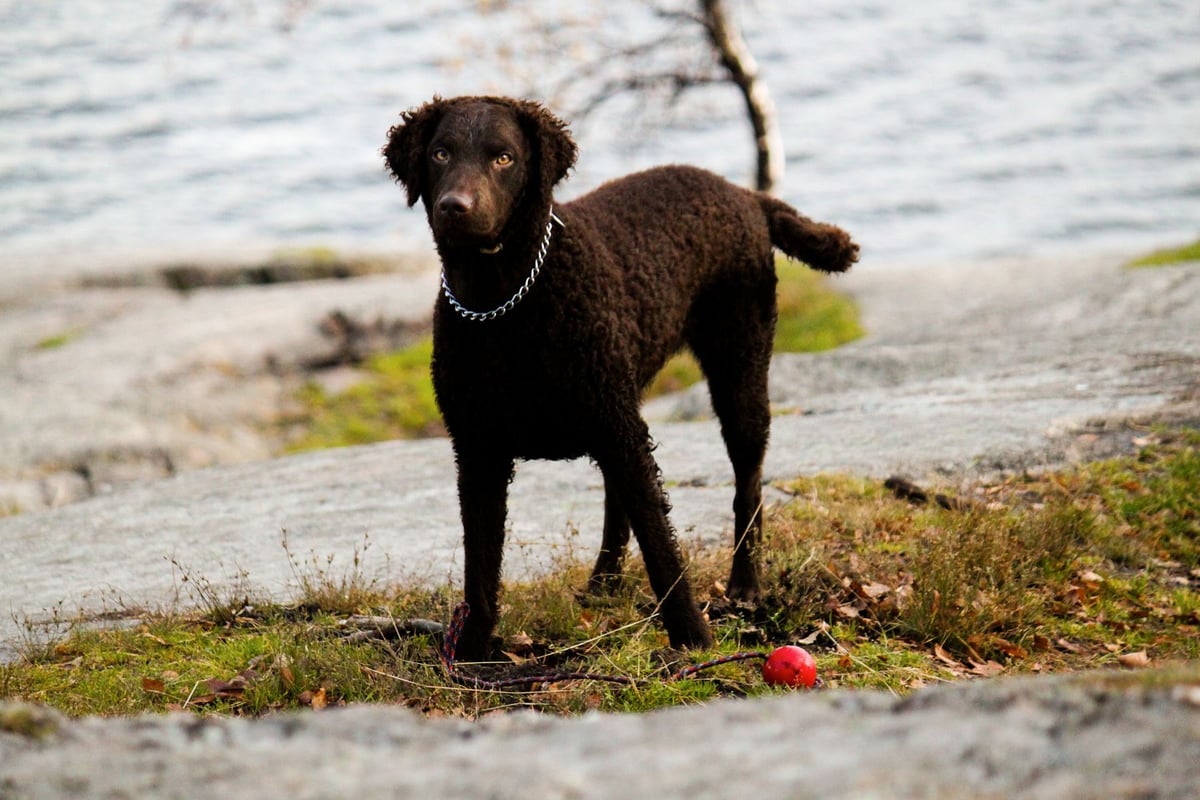
Curly Coated Retriever
The Curly Coated Retriever (FCI 110) is the oldest of the recognized retrievers: it was first exhibited in 1860, more than forty years before the Labrador Retriever (1903) and half a century before the Golden Retriever (1913). Selected in the north of England from the now-extinct English Water Spaniel and probably the Medium Poodle, it weighs 25 to 36 kg for 63 to 69 cm at the withers. A rare, low-profile breed, it totals around 150 annual LOF registrations in France and fewer than 100 in the United Kingdom. Its coat of tight, crisp, uniform curls is unique among all retrievers.
- Weight
- 25 to 36kg
- Height
- 63 to 69cm
- Life expectancy
- 11years
- Monthly cost
- 100 to 170€
Personality profile
Energy 4/5
Independence 3/5
Trainability 4/5
Good with children 4/5
Barking 2/5
Space needed 4/5
Attachment to home 4/5
Good with strangers 3/5
Good with dogs 4/5
Good with cats 3/5
Coat care 2/5
Exercise needs 4/5
Scores given on measured axes, data confidence: high.
Living with a Curly Coated Retriever
Description
The Curly Coated Retriever's coat is its most distinctive trait: tight, crisp, elastic curls uniformly cover the body, including the legs and tail — only the face carries shorter, smooth hair. The recognized colors are black and liver (chocolate brown), with no other variant. Unlike other retrievers, the breed has no dense undercoat: water beads on the curls without soaking in, providing natural insulation during retrieves in cold water. A broad, powerful build: 63 to 69 cm for 25 to 36 kg.

Temperament
The Curly Coated Retriever stands apart from other retrievers with a more independent character and greater reserve toward strangers — it is less outgoing than a Labrador Retriever or a Golden Retriever. Calm and stable at home, it develops deep bonds with its family without the demonstrative eagerness to please of other retrievers. Its initial reserve toward strangers fades with time and socialization, but it will never be a crowd-loving dog. Its balanced temperament makes it a safe companion for families with children, provided the first interactions are supervised.
Training
The Curly learns well and readily, but its moderate independence calls for a consistent, patient approach — it will sometimes question commands where a Labrador Retriever obeys immediately. Positive reinforcement works very well; coercive methods produce the opposite effect by reinforcing the breed's natural reserve. Regular, intense sport sessions — swimming, canicross, long hikes, water retrieves — are necessary to channel the energy of a retriever this size. Early socialization before 12 weeks is particularly important to soften its reserve toward strangers.

Feeding
280 to 420 g of premium large-breed kibble a day for a 30 to 35 kg adult, in two split meals. Sport-formula kibble (26-30% protein, omega-3 fatty acids for skin and coat) suits highly active individuals. Supplement with glucosamine and chondroitin from age 5 as prevention against joint dysplasia. An hour of digestive rest after meals to reduce the risk of gastric torsion, a real concern at this size.
Affiliate links, no extra cost to you. Legal notice

Living conditions
An enclosed garden and regular outings in large spaces are necessary for an active 30 kg Curly — an apartment is unsuitable without a commitment to several hours of daily exercise. A house with a garden in a rural or peri-rural setting is the ideal environment. Its waterproof coat suits it to cold-water work: access to rivers, ponds, or coastline is a genuine plus. It tolerates cold winters well but needs shade and fresh water during summer heat spells.

Grooming and coat care
The Curly's curly coat is, paradoxically, one of the easiest to maintain among retrievers: the crisp curls are self-maintaining and do not tangle. Brushing is discouraged, as it uncurls the curls — the coat is simply dampened to revive it after outings. A light trim of the extremities twice a year is enough. During shedding periods, the coat comes away in patches that just need to be pulled out by hand. No regular professional grooming is necessary, hence a grooming requirement rated 2/5.

Health
Life expectancy of 9 to 12 years, within the average for large breeds. Hip and elbow dysplasia require an X-ray assessment of breeding stock. Progressive retinal atrophy (PRA-prcd) is transmitted in an autosomal recessive manner — a genetic DNA test is available and mandatory in responsible breeding programs. Follicular alopecia (patchy hair loss) is specific to the breed and can affect up to 20% of individuals. Exercise-induced collapse (EIC) and idiopathic epilepsy are additional documented risks — EIC DNA tests available. Gastric torsion remains a risk to watch for at this size.
Breed history
The Curly Coated Retriever is the elder of the recognized retrievers: its first show appearance dates to 1860 in Birmingham, well before the Flat-Coated Retriever (1880), the Labrador Retriever (1903), and the Golden Retriever (1913). It was selected in the north of England from the English Water Spaniel, a now-extinct breed, with the probable addition of the continental Medium Poodle to fix the tight-curl type. The FCI assigned it number 110, Group 8. Despite its long history, it remained forever low-profile: about 150 annual LOF registrations in France against more than 10 000 for the Labrador Retriever. This rarity is, paradoxically, a guarantee of careful selection — breeders generally require PRA-prcd and EIC genetic tests before any mating.
Getting ready for your Curly Coated Retriever
Five essentials to line up before day one.
Affiliate links, no extra cost to you. Legal notice
FAQ: Curly Coated Retriever
Sources
- FCI Standard No 110 — Curly Coated Retriever · FCI breed standard 110, Group 8 Retrievers — Flushing Dogs — Water Dogs
- Société Centrale Canine — Curly Coated Retriever · SCC official breed profile for the Curly Coated Retriever, Group 8
- AKC Breed Profile — Curly-Coated Retriever · AKC Curly-Coated Retriever breed profile, Sporting Group
FCI, Fédération Cynologique Internationale, the world body that has codified breed standards since 1911. FCI number 110 is assigned to the Curly Coated Retriever.
Breeds similar to a Curly Coated Retriever

