


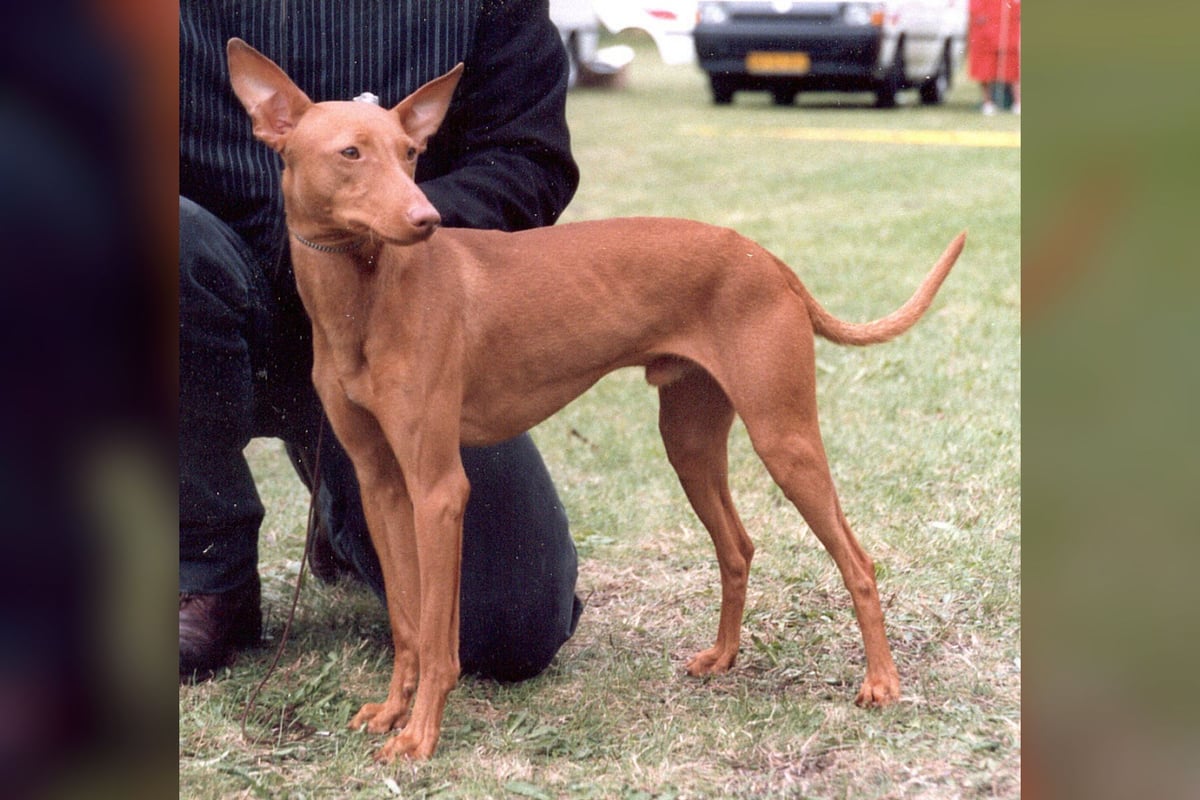
Cirneco dell'Etna
The Cirneco dell'Etna (FCI 199) weighs 8 to 12 kg for 42 to 52 cm at the withers — a primitive Sicilian sighthound documented on the island for about 3 000 years. A mosaic from the Villa Romana del Casale (Piazza Armerina, 3rd century AD) depicts a dog identical in appearance to the modern Cirneco, in a hunting scene. Specialized for millennia in hunting rabbit on the active volcanic slopes of Mount Etna, it has developed a heat resistance and an endurance on hostile terrain unmatched among sighthounds of similar size.
- Weight
- 8 to 12kg
- Height
- 42 to 52cm
- Life expectancy
- 14years
- Monthly cost
- 60 to 100€
Personality profile
Energy 5/5
Independence 4/5
Trainability 3/5
Good with children 4/5
Barking 3/5
Space needed 3/5
Attachment to home 4/5
Good with strangers 3/5
Good with dogs 4/5
Good with cats 2/5
Coat care 1/5
Exercise needs 5/5
Scores given on measured axes, data confidence: high.
Living with a Cirneco dell'Etna
Description
A compact sighthound silhouette: 8 to 12 kg, fine but solid bone structure, long, lean muscles. The coat is strictly uniform tan under the FCI 199 standard — from pale sand to brick red — with no white markings or patches on the body (a little white is permitted on the chest and feet). Ears large, triangular, rigid, and set close together at the top of the skull, nearly identical to those of the Pharaoh Hound but proportionally larger relative to the head. Fine, pinkish skin on unpigmented areas, flesh-toned nose. Long, slender muzzle, amber eyes.

Temperament
Lively and alert outdoors, affectionate and calm indoors with its close humans — an atypical balance for a primitive dog with this much energy. Hunting instinct remains dominant: any rabbit, squirrel, or small moving animal triggers a chase with no spontaneous return. It generally gets along better with other dogs than the Saluki or the Pharaoh Hound, a trait selected in Malta and Sicily where it hunted in light packs. Its initial reserve with strangers fades quickly, faster than in most primitive sighthounds.
Training
Quick learning, selective obedience — the hallmark of primitive breeds that hunted independently, without constant human direction. Positive reinforcement with high-value treats, sessions of 10 to 15 minutes maximum before attention saturates. The sport it excels at is FCI lure coursing, a discipline where its speed and endurance on uneven terrain fully express themselves. Recall in open space is never reliable in the presence of potential prey — never let it off leash without a secure fence. Compared with other primitive sighthounds, its relative sociability with other dogs makes group management easier.

Feeding
250 to 350 g of premium kibble a day for a 10 kg adult, in 2 meals. Recommended protein ratio of 26-30% to support the lean muscle mass of an endurance hunter. Avoid intense exercise sessions within an hour of eating — the sighthound build (deep, narrow chest) carries a theoretical risk of gastric dilatation-volvulus (GDV), even though it is lower than in large breeds. Watch body condition: palpable but not protruding ribs is the norm for this breed.
Affiliate links, no extra cost to you. Legal notice

Living conditions
An apartment can work provided its exercise needs are covered: two daily sessions of free sprinting in a fenced enclosure of at least 1.5 m (it can clear 1.2 m). Its 8-12 kg size and calm indoor behavior make it better suited to city life than the Pharaoh Hound, at an equivalent exercise level. Very low cold tolerance — fine skin, no undercoat, genetic adaptation to the Sicilian volcano where nighttime temperatures rarely drop below 5 °C. A waterproof coat is mandatory from 10 °C in France.

Grooming and coat care
Minimal upkeep: short, close coat needing only weekly brushing with a grooming mitt to remove dead hair. Bath every 6 to 8 weeks with a mild shampoo. Pink-skinned areas (nose, ear edges) can be sensitive to sunburn on intense summer days — veterinary sun protection is used by some Sicilian breeders. Nails to check every 3 to 4 weeks on lightly abrasive ground.

Health
A primitive breed with a low hereditary disease burden: Sicilian geographic isolation selected for a healthy population with a life expectancy of 13 to 15 years. No genetic disease specific to the Cirneco is listed in the FCI 199 standard or in the registries of the Ente Nazionale della Cinofilia Italiana (ENCI). Anesthetic sensitivity identical to other sighthounds (atypical barbiturate metabolism, very low body fat) — always inform the vet of the breed before any procedure. No brachycephaly: the long muzzle is an adaptation for thermoregulation on hot volcanic terrain.
Breed history
The Cirneco dell'Etna is one of the few dogs whose presence in its native territory can be traced over 3 000 years without documented interruption. The mosaic from the Villa Romana del Casale (Piazza Armerina, Sicily, 3rd century AD), a UNESCO World Heritage Site, depicts dogs with morphological characteristics identical to the current standard. On the slopes of Mount Etna, it was selected to hunt rabbit at high altitude on cooled volcanic lava substrate, uneven and scorching terrain, withstanding hours of exertion in intense heat. A morphological sister breed to the Maltese Pharaoh Hound but genetically distinct (Parker 2017): two island populations that followed separate evolutionary paths over several centuries. Recognized by the FCI under number 199, Group 5 Section 7 Spitz and Primitive Types, under its original Italian name, Cirneco dell'Etna.
Getting ready for your Cirneco dell'Etna
Five essentials to line up before day one.
Affiliate links, no extra cost to you. Legal notice
FAQ: Cirneco dell'Etna
Sources
- FCI Standard No 199 — Cirneco dell'Etna · FCI breed standard 199, Group 5 Spitz and Primitive types, Section 7 Primitive type — Hunting Dogs, country of origin Italy
- AKC Breed Profile — Cirneco dell'Etna · AKC Cirneco dell'Etna breed profile, Hound Group, height 16.5-19.5 inches (42-50 cm), weight 17-26 lbs (8-12 kg)
- Société Centrale Canine — Cirneco dell'Etna Standard · SCC LOF statistics Group 5 Section 7, Cirneco dell'Etna FCI 199, annual registrations France
- Parker et al. (2017) — Genomic analysis of the dog breeds · Parker HG et al., Genomic Analyses Reveal the Influence of Geographic Origin, Migration, and Hybridization on Modern Dog Breed Development, Cell Reports 2017 — genetic distinction between the Cirneco and the Pharaoh Hound despite morphological convergence
FCI, Fédération Cynologique Internationale, the world body that has codified breed standards since 1911. FCI number 199 is assigned to the Cirneco dell'Etna.

