


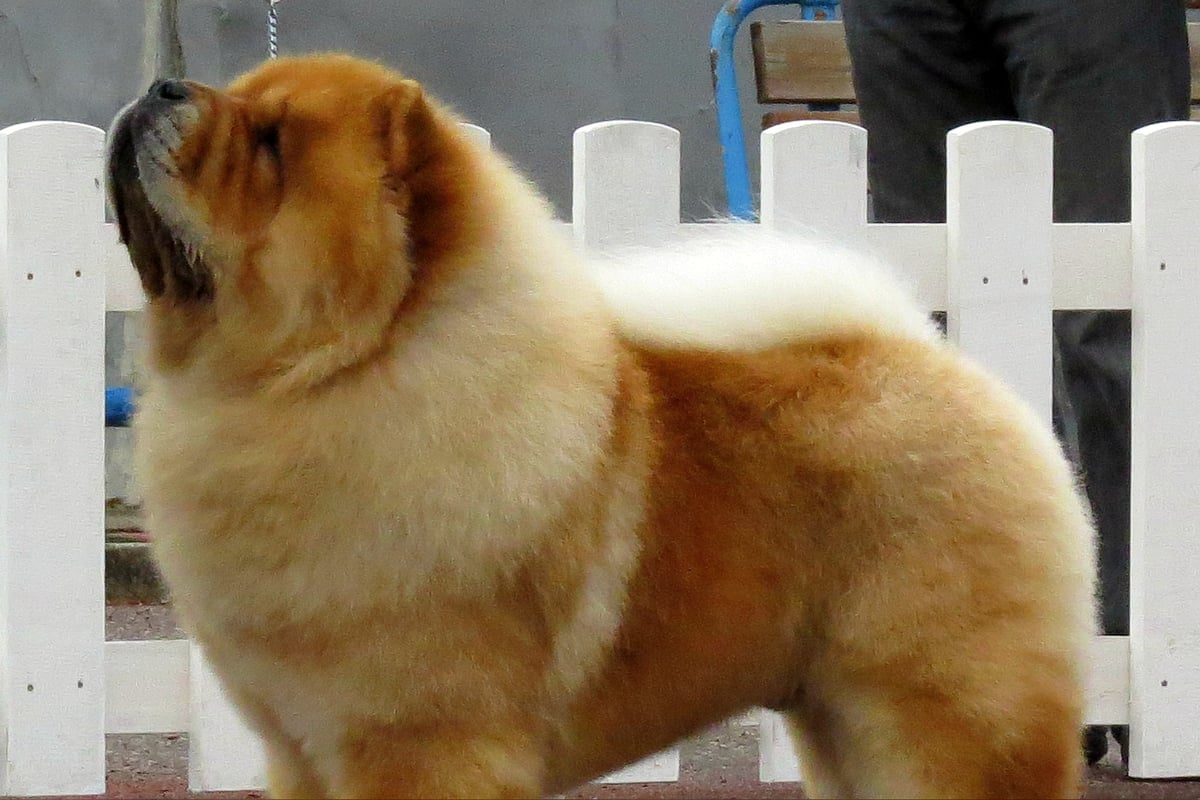
Chow Chow
The Chow Chow weighs 20 to 32 kg for 46 to 56 cm, recognized by the FCI under number 205, Group 5 (Spitz and Primitive Types). A breed documented as early as the Han dynasty (200 BC) — terracotta funerary statuettes depict it in imperial tombs. Blue-black tongue from 6 weeks of age, a trait shared only with the Shar Pei (distinct genetic pigmentation). Reserved, independent, and undemonstrative: distance toward strangers is a defining trait, not a behavioral flaw.
- Weight
- 20 to 32kg
- Height
- 46 to 56cm
- Life expectancy
- 11years
- Monthly cost
- 100 to 160€
Personality profile
Energy 2/5
Independence 5/5
Trainability 2/5
Good with children 2/5
Barking 2/5
Space needed 3/5
Attachment to home 2/5
Good with strangers 1/5
Good with dogs 2/5
Good with cats 2/5
Coat care 4/5
Exercise needs 2/5
Scores given on measured axes, data confidence: high.
Living with a Chow Chow
Description
A stocky, massive breed with an almost square build. Males 48-56 cm for 25-32 kg, females 46-51 cm for 20-27 kg. Two coat varieties: rough (thick undercoat, mane around the head and neck) and smooth (uniform dense velvet). Accepted colors: red, black, blue, cinnamon, and cream. Tongue and palate entirely blue-black — any trace of pink after 6 weeks is a standard fault. Characteristic gait with very straight hind legs (limited angulation), giving a recognizable, slightly stiff movement.

Temperament
Independence at 5/5: the Chow Chow is not a demonstrative breed and does not seek human approval. It tolerates members of its household, showing them calm, distant loyalty — without expressive outbursts. Wariness of strangers is deep and structural: an unsolicited approach triggers a firm refusal, even a warning without prior barking. Mandatory supervision with children outside its daily circle. Intolerance of same-sex dogs is documented in adults not socialized early. This reserve is not aggression: it is a primitive breed's autonomy, which calls for an owner able to respect it rather than correct it.
Training
Trainability at 2/5 — the Chow Chow understands requests but carries them out according to its own judgment. Positive reinforcement with high-value treats works better than any coercive method; direct confrontation triggers immediate shutdown. Intensive socialization between 7 and 16 weeks, a critical period for limiting structural wariness of strangers in adulthood. Modest physical activity: 30 to 45 minutes of walking a day is enough — intense exercise is contraindicated because of the build and heat sensitivity.

Feeding
350 to 550 g of premium kibble a day for a 28 kg adult, in 2 meals. Kibble with moderate protein content (28-32%) suited to the compact build and low-to-moderate activity level. Watch the weight rigorously: the breed is sedentary and gains weight easily as soon as the ration is not adjusted to actual activity. Raise the bowls to limit air intake (risk of bloat). Fresh feeding is possible but ration calculation with a veterinary nutritionist is mandatory.
Affiliate links, no extra cost to you. Legal notice

Living conditions
Can live in an apartment if daily outings are respected, but a house with an enclosed garden is preferable. Its build (thick double coat, reduced angulation) makes it extremely heat-sensitive: exercise should be avoided above 20 °C, air conditioning or access to shade is mandatory in summer. It withstands marked cold without difficulty. Not recommended for owners looking for an always-available outdoor dog: it prefers chosen interactions in a calm space. A fence of at least 1.60 m is recommended.

Grooming and coat care
Brushing at least 3 times a week for the rough-coated variety — daily during the two seasonal sheds (spring/fall), when the dense undercoat mats if neglected. The smooth-coated variety needs regular weekly brushing. Special attention to tangling behind the ears and at the ruff (friction zones). Monthly bath with thorough drying mandatory — an insufficiently dried Chow Chow stays damp in the undercoat for several hours and develops dermatitis. Quarterly professional grooming recommended to maintain the coat.

Health
Major documented predispositions: entropion (inward rolling of the eyelids, corrective surgery common and often necessary within the first months), hip and elbow dysplasia (X-rays recommended before any acquisition, selection on HD/ED-certified parents), documented predisposition to certain cancers (high frequency in the breed according to canine mortality studies, difficult to screen for). The thick double coat worsens heat-related risks: fatal heatstroke in under 10 minutes in a car parked in summer. Life expectancy 10 to 13 years. Eye check-up from 6 months, as entropion often develops before the first birthday.
Breed history
The Chow Chow is one of the breeds whose antiquity is best documented archaeologically: terracotta funerary statuettes from the Han dynasty (200 BC) depict it with precision in the tombs of Chinese aristocrats. Its Mandarin name 'songshi quan' (lion-muzzle dog) describes its characteristic profile. A versatile breed in ancient China: temple guardian, hunting dog, source of meat and fur. In Europe, the first imports came via English merchant ships in the 18th century — the term 'chow-chow' at the time referred to the miscellaneous goods stored in the holds, a name that stuck to the breed. Recognized by the FCI under number 205 in Group 5, Section 5.
Getting ready for your Chow Chow
Five essentials to line up before day one.
Affiliate links, no extra cost to you. Legal notice
FAQ: Chow Chow
Sources
- FCI Standard No 205 · FCI breed standard 205, Group 5 Spitz and Primitive Types, Section 5 Asian Spitz and related breeds
- AKC Breed Profile — Chow Chow · AKC Chow Chow breed profile, Non-Sporting Group
- Société Centrale Canine — Chow Chow · SCC breed profile for the Chow Chow, group 5, section 5, number 205
FCI, Fédération Cynologique Internationale, the world body that has codified breed standards since 1911. FCI number 205 is assigned to the Chow Chow.
Breeds similar to a Chow Chow


Shar Pei
Pinscher and Schnauzer - Molossoid and Swiss Mountain and Cattledogs
18 to 30 kg