


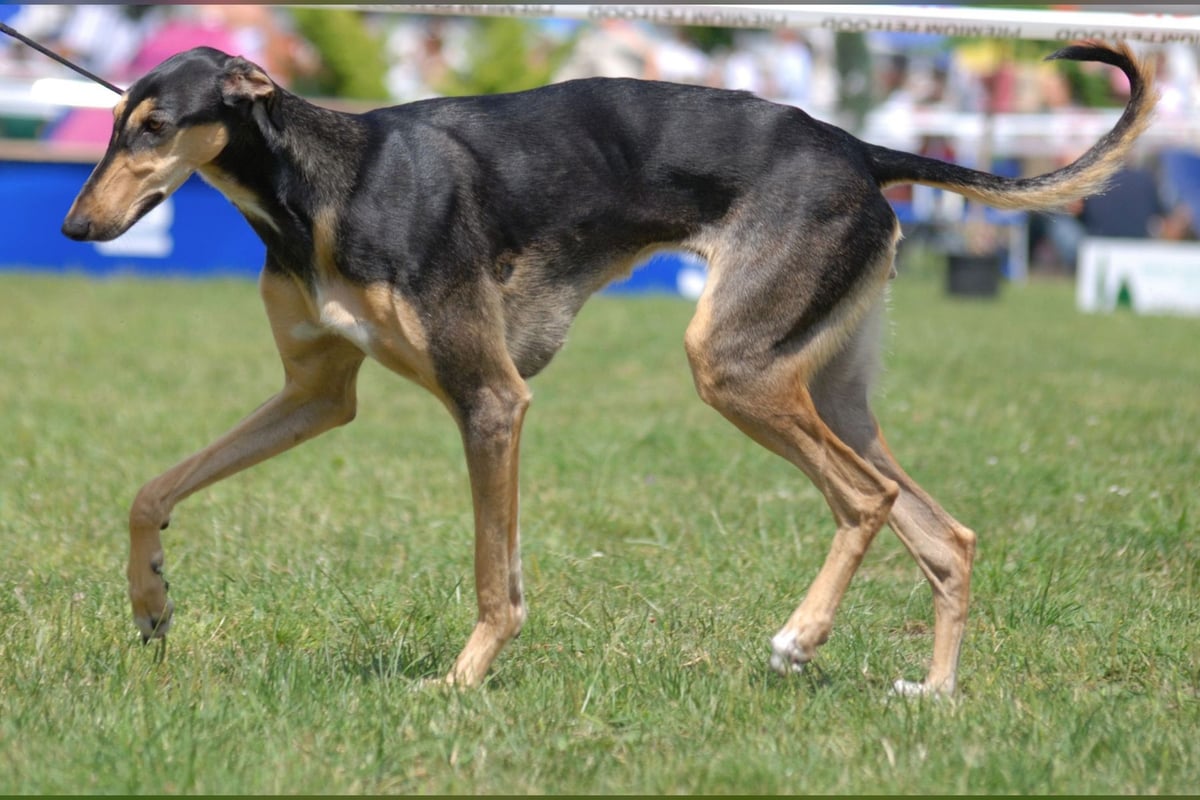
Polish Greyhound
The Chart Polski (Polish Greyhound, FCI 333, Group 10) is a native sighthound of the Polish plains, long used by the nobility for wolf and deer hunting. Sturdier and thicker-set than the Greyhound, with a short coat suited to the continental climate, it weighs 30 to 43 kg at 68 to 80 cm at the withers. Recognized by the FCI in 1989, it remains one of the rarest sighthounds outside its home country.
- Weight
- 30 to 43kg
- Height
- 68 to 80cm
- Life expectancy
- 12years
- Monthly cost
- 80 to 140€
Personality profile
Energy 3/5
Independence 4/5
Trainability 2/5
Good with children 3/5
Barking 1/5
Space needed 4/5
Attachment to home 3/5
Good with strangers 2/5
Good with dogs 3/5
Good with cats 2/5
Coat care 1/5
Exercise needs 4/5
Scores given on measured axes, data confidence: medium.
Living with a Polish Greyhound
Description
A powerful sighthound silhouette without excessive refinement: solid bone, well-developed muscle, a body slightly longer than tall — a build suited to the windy Polish plains rather than sandy deserts. A broad head with a marked stop (unlike the Greyhound, which has an almost absent stop), oblique eyes with a lively expression. Coat short, dense, and coarse on the body, slightly longer on the thighs and tail — this texture offers natural resistance to the Polish continental cold, between -10 °C and -20 °C. Accepted colors: all colors, brindle and fawn being the most common. Males 70-80 cm at 31-43 kg, females 68-75 cm at 30-40 kg.

Temperament
The temperament of an aristocratic hunting sighthound: reserved with strangers without being fearful, loyal to its family without excessive display. Polish dog fancier tradition describes it as a dog 'hard for strangers to tame but unmatched for its owner.' Its prey drive is intense — any small animal moving nearby can trigger an instinctive chase. Around children, it is tolerant if socialization began early, but boisterous young children can make it anxious through unpredictable movements.
Training
It learns quickly but decides sovereignly on its own level of engagement — sessions of 10 minutes maximum with positive reinforcement only. Its nature as an independent hunting sighthound means recall in unfenced open space is not 100% reliable: once the prey drive kicks in, instinct overrides commands. FCI lure coursing and open-field coursing are the sports that best draw on its natural abilities and offer it intense 10 to 15 minute sessions. Early socialization to varied urban environments is critical to avoid excessive wariness of strangers in adulthood.

Feeding
600 to 900 g of premium kibble a day for a 35-40 kg adult, in 2 meals at least 4 hours apart. Recommended protein ratio of 28-32% to support the lean muscle mass of an athletic sighthound. No feeding within an hour before or after exercise — prevention of gastric dilatation-volvulus. The breed has an efficient metabolism: an excessive ration quickly shows as visible weight gain on the flanks, hard to correct once established.
Affiliate links, no extra cost to you. Legal notice

Living conditions
A garden fenced to at least 1.5 m is required for free gallops — the Chart Polski can clear 1.2 m without a running start and reaches speeds of 50 to 55 km/h in a short sprint. An apartment is discouraged without daily access to a large open space. Its cold tolerance is good thanks to a short but dense coat, suited to Polish continental winters: it can stay outdoors in dry weather down to -5 °C. Minimum exercise is 1 hour a day with two free-gallop sessions; below that, restlessness sets in.

Grooming and coat care
Minimal upkeep: the short, coarse coat does not tangle and is fairly self-cleaning. Weekly brushing with a rubber grooming mitt is enough to remove dead hair and stimulate circulation. Shedding is moderate, twice a year, with a week of daily brushing to help the coat change. Bathe quarterly or as needed (after a muddy outing). Monthly check of the semi-erect ears and nails. No regular professional grooming needed.

Health
Life expectancy of 11 to 13 years — notably longer than the Irish Wolfhound or the Greyhound. Despite the 1945 population bottleneck (see history), the current population remains genetically sound, with no major hereditary condition documented at high frequency. Sensitivity to barbiturate anesthesia common to all sighthounds — flag this to the vet. Watch for bloat (GDV), as with all deep-chested breeds.
Breed history
The Chart Polski appears in the chronicles of the Polish nobility as early as the 13th century — the Ossoliński annals explicitly describe this native sighthound used for wolf and deer hunting on the plains of royal Poland. Unlike oriental sighthounds (Saluki, Sloughi) that developed in arid deserts, the Chart Polski developed on cold continental plains, which explains its denser bone structure and thicker coat. World War II nearly wiped out the breed: only about 30 specimens were counted in 1945. The Lubomirski sisters organized the reconstruction from these survivors, with controlled introductions to widen the genetic base. The FCI officially recognized the Chart Polski in 1989 under number 333, Group 10, Section 3 Short-haired Sighthounds.
Getting ready for your Polish Greyhound
Five essentials to line up before day one.
Affiliate links, no extra cost to you. Legal notice
FAQ: Polish Greyhound
Sources
- FCI Standard No 333 — Chart Polski · FCI breed standard 333, Group 10 Sighthounds, Section 3 Short-haired Sighthounds, country of origin Poland. Recognised 1989.
- Polski Klub Chartów — History and Standard · Polski Klub Chartów (Polish Chart Polski Club), documentation of the post-WWII reconstruction by the Lubomirski sisters, 1945 census (~30 surviving specimens).
- Société Centrale Canine — Chart Polski Standard · SCC, breed standard for the Chart Polski, Group 10, Section 3, Polish Greyhound, annual LOF registrations France.
FCI, Fédération Cynologique Internationale, the world body that has codified breed standards since 1911. FCI number 333 is assigned to the Polish Greyhound.

