


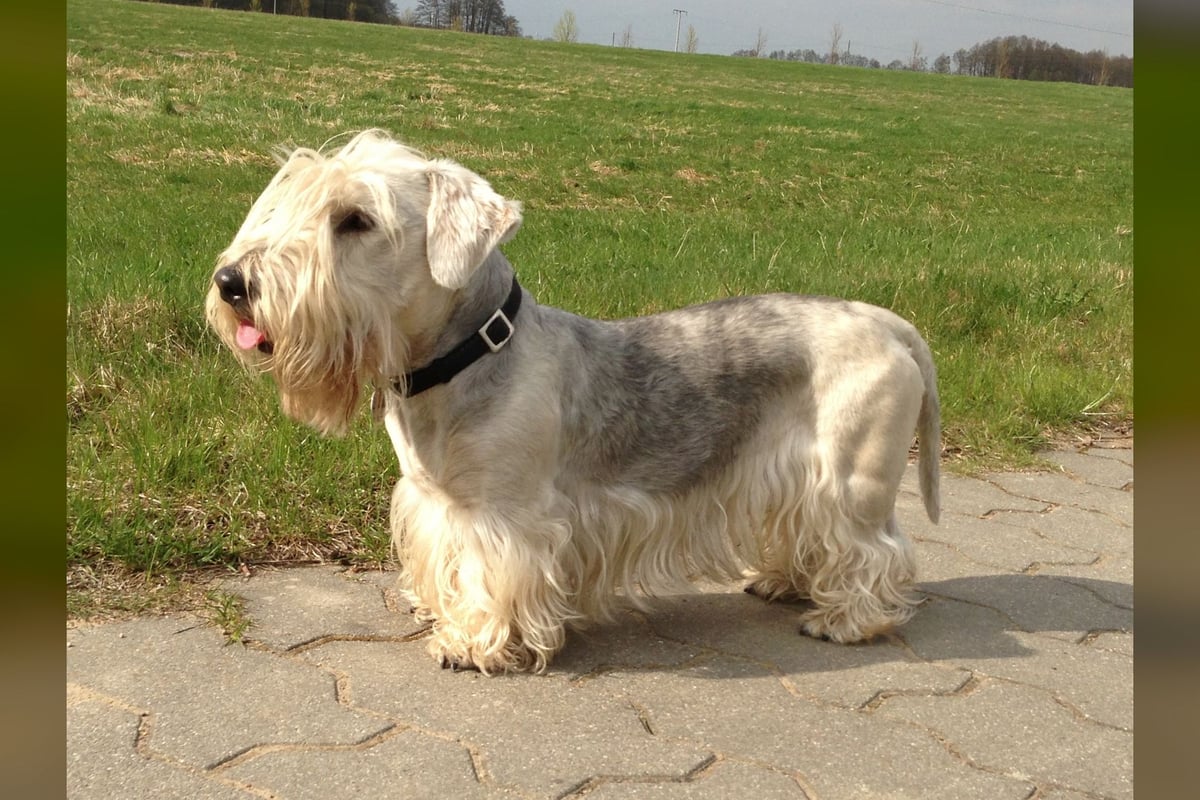
Cesky Terrier
The Cesky Terrier (FCI 246) is a breed created in 1949 by František Horák, a Czech cynologist, by crossing the Sealyham Terrier with the Scottish Terrier, aiming for a den-hunting terrier narrower and calmer than the Scottish. Recognized by the FCI in 1963, it weighs 6 to 10 kg at 25 to 32 cm at the withers — a build designed to enter fox and badger dens with less resistance. Its distinctive blue-gray coat comes from a paradox: puppies are born black and gradually turn gray until around age 2 to 3. It is one of the rarest breeds in the world.
- Weight
- 6 to 10kg
- Height
- 25 to 32cm
- Life expectancy
- 13years
- Monthly cost
- 80 to 140€
Personality profile
Energy 3/5
Independence 3/5
Trainability 4/5
Good with children 4/5
Barking 3/5
Space needed 2/5
Attachment to home 4/5
Good with strangers 3/5
Good with dogs 3/5
Good with cats 2/5
Coat care 4/5
Exercise needs 3/5
Scores given on measured axes, data confidence: high.
Living with a Cesky Terrier
Description
An elongated, low silhouette, a muscular but narrow body — a structural trait inherited from the Sealyham for hunting in tunnels. Coat exclusively blue-gray (from light to dark gray) or coffee-with-milk, clipped short on the body and flanks; the legs, beard, eyebrows, and chest keep longer hair forming a characteristic fringe. This grooming profile is the exact opposite of the stripping practiced on British terriers: clipping is mandatory, stripping is forbidden as it would alter the coat's texture. Deep-set eyes under bushy eyebrows, a lively and focused expression.

Temperament
Compared with other terriers, the Cesky stands out for a markedly less explosive temperament: moderate hunting instinct, reduced dog-to-dog aggression, an overall calmer demeanor. It forms a strong bond with its family and tolerates children well, without giving up its natural wariness of strangers — a wariness that stays at the level of watchfulness rather than declared aggression. It keeps a dose of typical terrier independence and can be stubborn if training lacks consistency.
Training
The Cesky is among the most responsive terriers to training: curious, attentive, less distracted by outside stimuli than the Jack Russell or the Fox Terrier. Basic cues (sit, down, recall) are learned with positive, progressive short sessions of 10 to 15 minutes. Its hunting instinct is still present — total off-leash freedom without a reliable recall is not advisable in areas where game or small animals are around. Nose work activities (mantrailing, object searches) fit its psychology as a den-hunting terrier perfectly and can supplement daily walks.

Feeding
150 to 200 g of premium kibble a day for an 8 kg adult, split into two meals. Choose a formula suited to small breeds with a caloric density sufficient to maintain weight without overloading the patella joint. Glucosamine supplementation recommended from age 5 to help prevent patellar luxation. Monitor weight regularly: a Cesky that is 500 g overweight carries 5 to 8% of its body weight in excess, with a direct impact on mobility.
Affiliate links, no extra cost to you. Legal notice

Living conditions
Its small size and moderate energy level make it suited to apartment life, provided daily walks are guaranteed. A minimum of 30 to 45 minutes of activity a day is enough to cover its physical needs; play or scent sessions (tracking, searching) effectively channel its hunting instinct without requiring a large space. In a house with a garden, it will make use of the space without strictly needing it. Its cold tolerance is good thanks to its dense coat, but intense summer heat should be managed with suitable outing times.

Grooming and coat care
The Cesky Terrier needs regular clipper grooming, ideally every 6 to 8 weeks with a professional groomer familiar with the breed — the characteristic silhouette (short body, long legs and beard) is not something to improvise. At home, weekly brushing of the areas left long (fringe, beard, eyebrows) prevents tangles and keeps the coat clean. Unlike almost all other terriers, which require hand stripping, the clipper is the strict rule here. This grooming frequency means a high maintenance need to budget for before adoption.

Health
Life expectancy of 12 to 15 years. The most breed-specific condition is Scottie Cramp, a hereditary muscle spasm shared with the parent Scottish Terrier — not painful but visible on exertion, showing as a jerky gait during intense excitement or prolonged exercise. Patellar luxation (variable grade) should be watched from a young age, especially in lighter individuals. Sporadic cases of juvenile cataracts have been documented in some lines. Responsible breeders have run Scottie Cramp DNA tests on breeding stock since the 2010s.
Breed history
František Horák, a Czech cynologist and trained biologist, began his breeding work in 1949 with a precise goal: to develop a den-hunting terrier able to work in Czech fox and badger tunnels, narrower than those found on British terrain. He crossed the Sealyham Terrier (for chest narrowness and calmer temperament) with the Scottish Terrier (for robustness and determination). The FCI recognized the breed in 1963, fourteen years after the work began. The Cesky became one of the few gray-coated terriers recognized by the FCI and remains rare worldwide: fewer than 1 000 births registered annually worldwide according to consolidated breeding data.
Getting ready for your Cesky Terrier
Five essentials to line up before day one.
Affiliate links, no extra cost to you. Legal notice
FAQ: Cesky Terrier
Sources
- FCI Standard No 246 — Cesky Terrier · FCI breed standard 246, Group 3 Terriers, Section 2 Small-sized Terriers
- Société Centrale Canine — Cesky Terrier · SCC official breed profile, Cesky Terrier, Group 3
- AKC Breed Profile — Cesky Terrier · AKC Cesky Terrier breed profile, Terrier Group
FCI, Fédération Cynologique Internationale, the world body that has codified breed standards since 1911. FCI number 246 is assigned to the Cesky Terrier.
Breeds similar to a Cesky Terrier

