


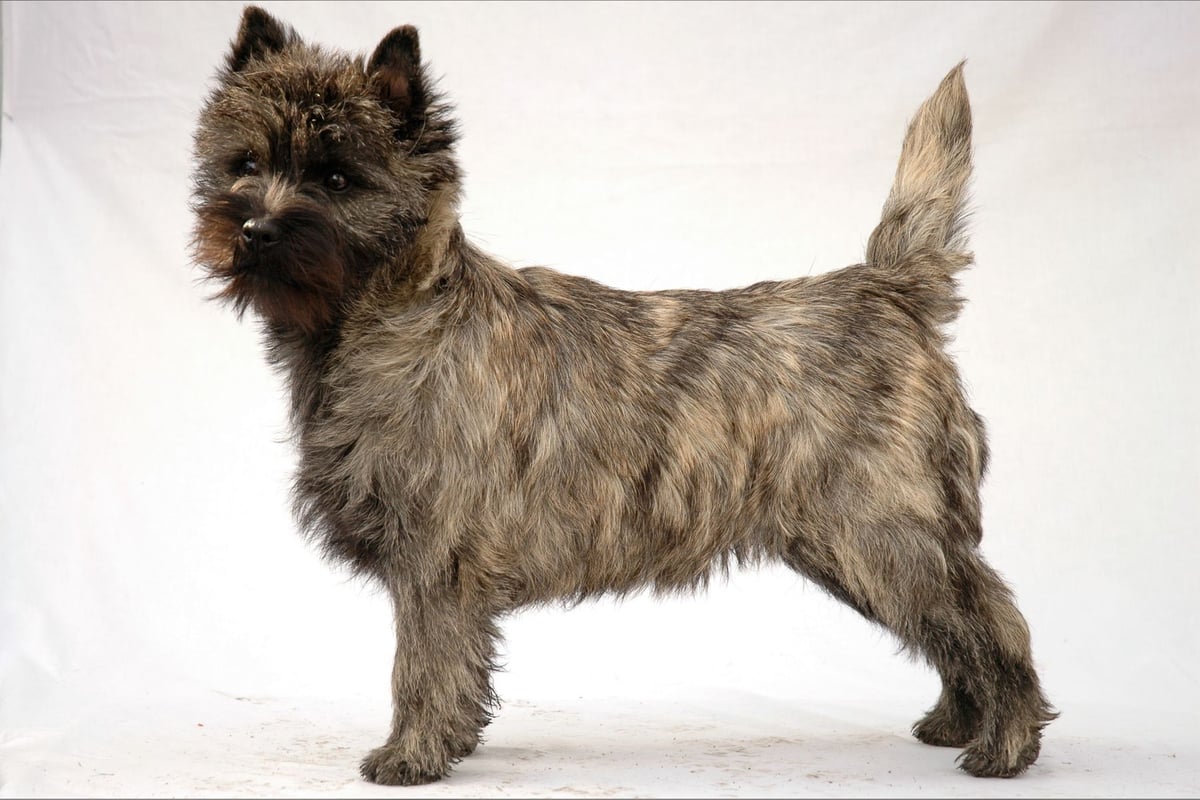
Cairn Terrier
The Cairn Terrier is a Scottish Highlands terrier of 6 to 8 kg and 28 to 31 cm, recognized by the FCI under number 4. A hardy breed, among the oldest of the British terriers, with a remarkable longevity of 13 to 15 years. Main serious genetic risk: globoid cell leukodystrophy (GLD, or Krabbe disease), a neurodegenerative disease testable by DNA. Overall health profile is favorable compared with other Scottish terriers.
- Weight
- 6 to 8kg
- Height
- 28 to 31cm
- Life expectancy
- 14years
- Monthly cost
- 55 to 95€
Personality profile
Energy 4/5
Independence 4/5
Trainability 3/5
Good with children 4/5
Barking 4/5
Space needed 2/5
Attachment to home 3/5
Good with strangers 3/5
Good with dogs 2/5
Good with cats 2/5
Coat care 3/5
Exercise needs 3/5
Scores given on measured axes, data confidence: high.
Living with a Cairn Terrier
Description
The Cairn Terrier is a compact dog, slightly longer than tall, with short, sturdy legs. The FCI 4 standard describes a double coat: a dense, woolly undercoat, with an abundant, hard, never-curly outer coat of 5 to 7 cm. Accepted colors are cream, wheaten, red, sandy gray and brindle — pure black and pure white are excluded. The ears are small, pointed and erect. The head is broad, with a full brow that gives the breed's characteristic keen expression. The name "cairn" refers to the piles of stones (cairns) in the Scottish Highlands where the breed hunted foxes and otters.

Temperament
Alert, curious and determined — the Cairn Terrier is a functional hunter that takes initiative without waiting for guidance. Its independence is tempered by genuine affection for its household; it is more demonstrative than the Scottish Terrier or the Westie. Toward strangers: open without being pushy, it welcomes visitors without excessive wariness. With children: one of the most accommodating Scottish terriers — tolerant of active play under adult supervision, without the Scottie's low defensive trigger threshold. Its hunting instinct remains intact: small animals, rodents and rabbits are seen as prey. Recall is unreliable once on a scent trail. Frequent barking, partly linked to the breed's natural vigilance.
Training
Average trainability (3/5): more cooperative than the Scottish Terrier, less than the Border Terrier. Learns quickly, especially if the task involves scent or search work — its origins as an independent hunter make it an excellent candidate for nose work and earthdog trials. Exclusively positive reinforcement, short sessions (8 to 12 minutes), high-value food rewards. Impatience or mechanical repetition breeds disinterest. Recall requires regular, specific work — it is never fully reliable in open terrain if a scent trail is available.

Feeding
130 to 180 g of premium kibble a day for a 6-8 kg adult, in 2 meals. Small-breed kibble, high in protein (26-30%). Watch the ration after spay/neuter — weight gain is rapid and worsens patellar luxation if present. Omega-3-enriched food recommended for atopic dogs.
Affiliate links, no extra cost to you. Legal notice

Living conditions
Apartment or house, with or without a garden — its compact size and moderate exercise needs make it adaptable. At least 45 to 60 minutes of activity a day in two outings. The garden must be fenced with a deep barrier (at least 50 cm) — the digging instinct is strong. It withstands cold and damp exceptionally well: built for the climate of the Hebrides and the Highlands. Do not leave it exposed to prolonged heat. It copes better with apartment life than the Jack Russell, provided its physical and scent stimulation needs are met.

Grooming and coat care
Moderate upkeep for a double-coated terrier. Hand-stripping recommended 2 to 3 times a year to maintain the outer coat's texture — less formal and less frequent than for the Scottish Terrier or the Westie. Clipping is acceptable for a companion dog and does not degrade the coat as much as it does in the other two Scottish terriers. Twice-weekly brushing with a slicker brush to prevent tangles in the dense undercoat. Hair around the eyes and mouth can be trimmed with scissors. Monthly ear cleaning; nails every 3 to 4 weeks.

Health
Globoid cell leukodystrophy (GLD, Krabbe disease): a hereditary neurodegenerative disease (autosomal recessive) caused by a deficiency of the galactosylceramidase enzyme. It causes progressive destruction of myelin in the nervous system — progressive muscle weakness, loss of coordination, blindness, and death before age 3 in severe forms. A DNA test is available and recommended: both parents must test clear or as healthy carriers (never breed two carriers together). Patellar luxation: grade 1 to 3, documented in the breed — watch for intermittent lameness. Skin atopy: lower prevalence than in the Westie, but present; onset between ages 1 and 3. Urinary stones occasionally reported. Life expectancy is 13 to 15 years, with some individuals reaching 17 to 18 — among the best longevity figures of the small terrier breeds.
Breed history
One of the oldest terrier breeds in the British Isles: its ancestors hunted among the cairns of the Highlands and the Hebrides for centuries. The first official mention dates back to 1887 under the name "Short-Haired Skye Terrier." Recognized by the British Kennel Club in 1912 as the Cairn Terrier, FCI number 4, Group 3 Section 2. The breed gained worldwide fame with Toto, Dorothy's Cairn Terrier in The Wizard of Oz (1939, MGM film) — played by a female named Terry.
Getting ready for your Cairn Terrier
Five essentials to line up before day one.
Affiliate links, no extra cost to you. Legal notice
FAQ: Cairn Terrier
Sources
- FCI Standard No 4 · FCI breed standard 4, Group 3 Terriers, Section 2 Small-sized Terriers
- AKC Breed Profile · AKC Cairn Terrier breed profile, Terrier Group
FCI, Fédération Cynologique Internationale, the world body that has codified breed standards since 1911. FCI number 4 is assigned to the Cairn Terrier.
Breeds similar to a Cairn Terrier

