


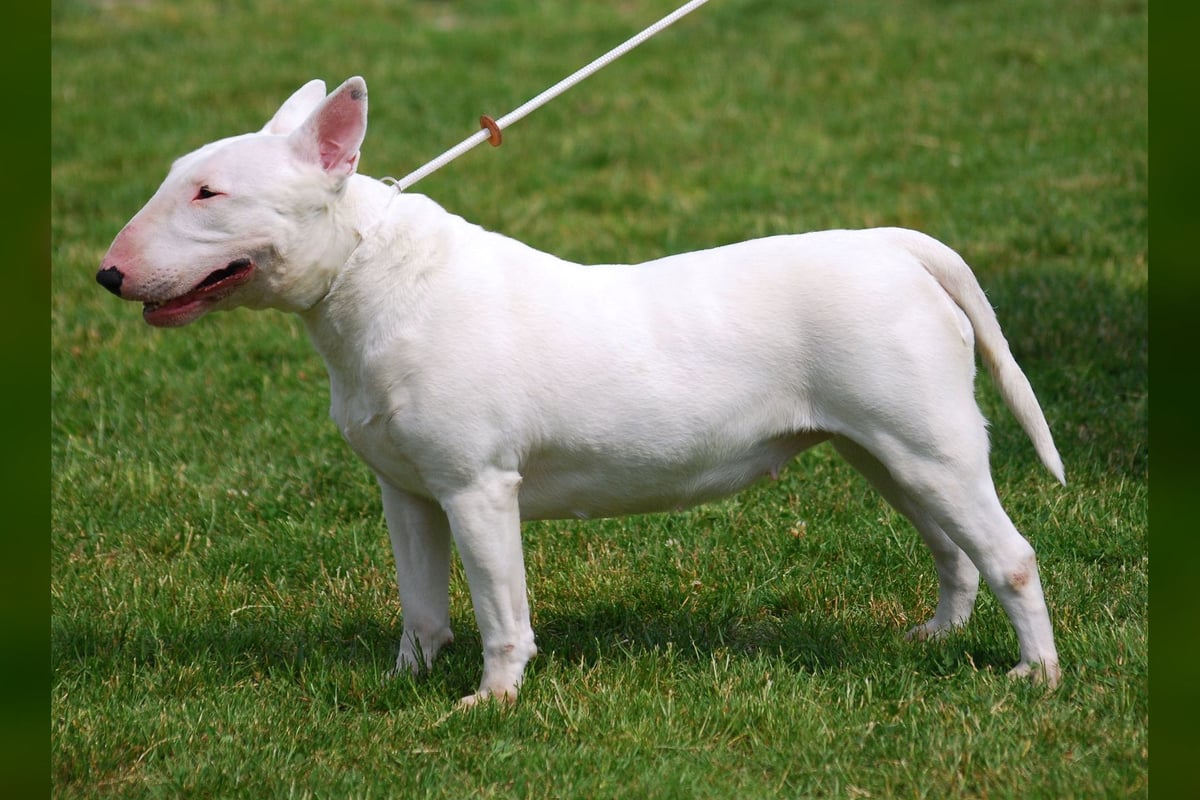
Bull Terrier
The Bull Terrier is a robust terrier native to England, recognized by the FCI under number 11, descended from 19th-century crosses between the English Bulldog and the White English Terrier. Identifiable by its egg-shaped head unique among all breeds, it weighs 22 to 38 kg. Deafness affects 12 to 20% of white dogs, and familial nephropathy can severely shorten life expectancy.
- Weight
- 22 to 38kg
- Height
- 35 to 55cm
- Life expectancy
- 12years
- Monthly cost
- 80 to 130€
Personality profile
Energy 4/5
Independence 3/5
Trainability 3/5
Good with children 4/5
Barking 3/5
Space needed 4/5
Attachment to home 5/5
Good with strangers 4/5
Good with dogs 2/5
Good with cats 2/5
Coat care 1/5
Exercise needs 4/5
Scores given on measured axes, data confidence: high.
Living with a Bull Terrier
Description
A medium-sized, stocky, muscular breed. There is no official height limit in the FCI standard; in practice males stand 50-55 cm for 28-38 kg, females 45-50 cm for 22-30 kg. An elongated, egg-shaped head — the only breed with this convex profile — with deep-set triangular eyes, a distinctive feature of the breed. Short, hard, glossy coat with no undercoat. Two varieties: solid white and colored (brindle, fawn, red, black-brindle with white markings permitted). Erect ears, short tail carried horizontally.

Temperament
A breed very sociable with people, with no strong guarding instinct — a poor watchdog, an excellent family dog. Intense attachment to its people, only moderate tolerance for solitude. Prone to stereotypies when physical activity and mental stimulation are lacking: spinning, compulsive tail-chasing (see FAQ). Wary of unfamiliar dogs, with a canine reactivity inherited from its fighting origins — multi-dog cohabitation to be managed carefully. Early socialization with cats from puppyhood strongly recommended.
Training
Average trainability: an intelligent but independent-minded breed, with a strong personality inherited from its terrier origins. It picks up commands but may choose not to obey if the session lacks interest. Positive reinforcement is mandatory, with short (10-15 min), varied sessions to hold its attention. Suitable dog sports: recreational agility, canicross, tracking games. Excluded from bite-sport disciplines authorized in France. Early socialization (3-4 months) with other dogs and cats is critical to avoid unmanageable reactivity in adulthood.

Feeding
300 to 420 g of premium kibble a day for a 30 kg adult, in 2 meals. Avoid kibble high in cereal carbohydrates for dogs with skin allergies — a diet rich in animal protein reduces the frequency of skin flare-ups. Annual kidney check (creatinine, urea) recommended from age 5 given the risk of nephropathy. Glucosamine/chondroitin after age 6.
Affiliate links, no extra cost to you. Legal notice

Living conditions
A house with an enclosed garden is the suitable setting to meet its intense activity needs and its need for space. An apartment is not advisable: without a garden, the amount of activity needed (two long walks a day plus play sessions) is hard to sustain long-term in an urban setting, and the breed compensates with destructive behavior. The garden must be perfectly fenced (a tenacious breed capable of digging). Sensitive to cold because of its short, undercoat-free coat: a coat recommended from 5 °C. The white variety is more prone to sunburn and skin irritation: avoid prolonged exposure to direct sun.

Grooming and coat care
Nearly no upkeep thanks to the short, hard coat: weekly brushing with a bristle grooming glove is enough. Light, steady shedding, with no pronounced seasonal molt. Quarterly or as-needed baths after the dog gets dirty. Regular skin checks (dermatitis in white dogs) and ear checks (moderate predisposition to ear infections). Monthly nail trim.

Health
Life expectancy is 11 to 13 years. Congenital deafness linked to a pigmentation defect: 12 to 20% of white dogs show bilateral or unilateral deafness (a BAER/BAEP test is mandatory before rehoming). Hereditary familial nephropathy (progressive kidney failure, which can severely shorten life in affected individuals). Heart conditions: murmurs, mitral valve dysplasia, aortic stenosis. Chronic skin problems: allergies, pyoderma, demodicosis, atopic dermatitis — more common in white dogs. Patellar dysplasia. Lens luxation (mainly in the miniature variety, DNA test available). Require a BAER test, cardiac workup, and nephropathy DNA test from breeding stock.
Breed history
Created in England in the 19th century by crossing the English Bulldog with the White English Terrier (a now-extinct breed), with later additions of Dalmatian and Staffordshire Bull Terrier blood. Initially used for badger hunting, then in animal fighting until it was banned by Parliament in 1835. The breed nearly disappeared after World War I because of deafness in white dogs. Colored dogs were officially admitted in 1920 to widen the gene pool. The modern standard was set in the first half of the 20th century, and the breed spread in France starting in the 1940s. Contrary to a common confusion with American bull-type terriers, it does not appear among the dogs categorized under the 1999 French law.
Getting ready for your Bull Terrier
Five essentials to line up before day one.
Affiliate links, no extra cost to you. Legal notice
FAQ: Bull Terrier
Sources
- FCI Standard No 11 · FCI breed standard 11, Group 3 Terriers, Section 3 Bull type Terriers
- AKC Breed Profile · AKC Bull Terrier breed profile, Terrier Group
FCI, Fédération Cynologique Internationale, the world body that has codified breed standards since 1911. FCI number 11 is assigned to the Bull Terrier.
Breeds similar to a Bull Terrier

