


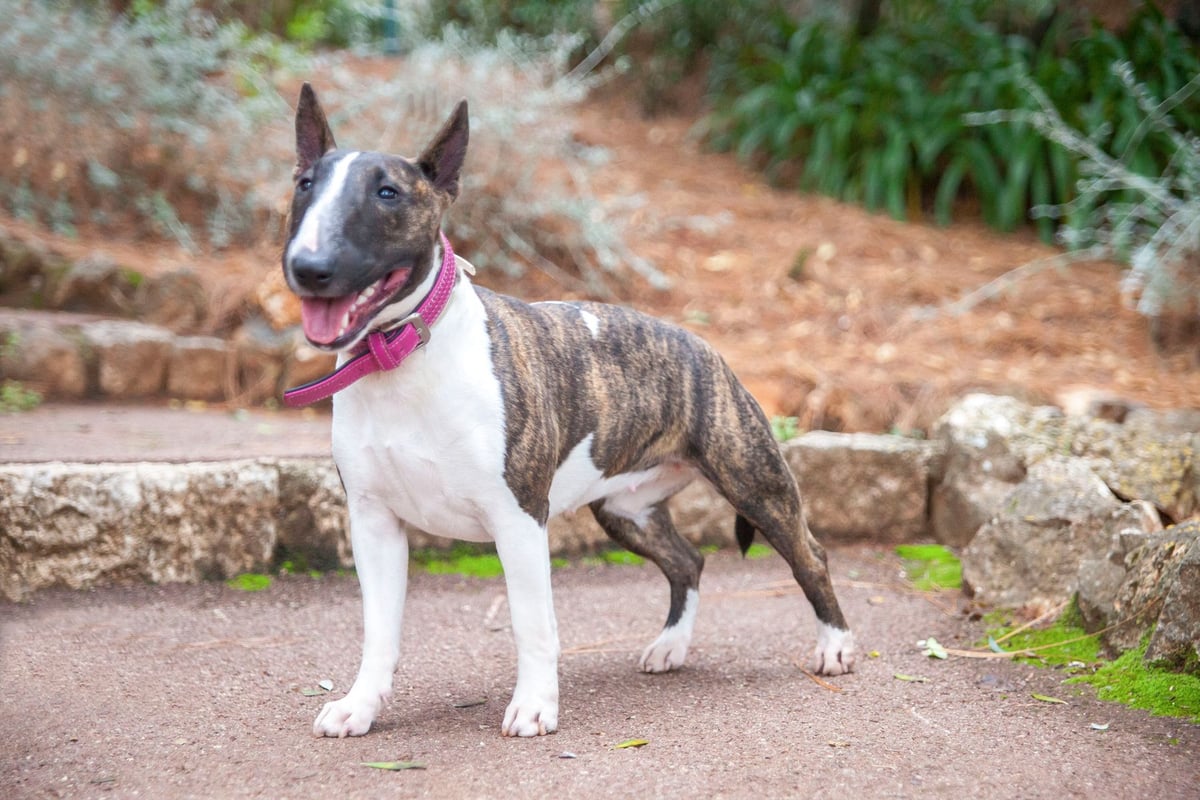
Miniature Bull Terrier
The Miniature Bull Terrier is a distinct breed, separately recognized by the FCI under number 359 since 1939, built on the same morphological standard as the standard Bull Terrier but capped at 35.5 cm at the withers and 11 to 15 kg. The convex, egg-shaped head — a profile unique among all breeds — is identical to that of the larger breed. About 80 dogs are registered annually with the French Livre des Origines (LOF), confirming a small but stable population.
- Weight
- 11 to 15kg
- Height
- 25 to 35cm
- Life expectancy
- 13years
- Monthly cost
- 70 to 110€
Personality profile
Energy 4/5
Independence 3/5
Trainability 3/5
Good with children 4/5
Barking 3/5
Space needed 2/5
Attachment to home 5/5
Good with strangers 3/5
Good with dogs 2/5
Good with cats 2/5
Coat care 1/5
Exercise needs 4/5
Scores given on measured axes, data confidence: medium.
Living with a Miniature Bull Terrier
Description
A compact build: maximum height 35.5 cm at the withers with no official minimum in the FCI standard, a practical weight of 11 to 15 kg depending on the individual. Same proportions as the standard Bull Terrier — stocky body, muscled legs, powerful neck — but in a build 30 to 40% smaller. Short, hard, glossy coat with no undercoat. Two varieties: solid white (facial markings permitted) and colored (brindle, fawn, tricolor). Small, deep-set, triangular, oblique eyes are, along with the convex head profile, one of the breed's most recognizable features.

Temperament
Intense human attachment: a breed with a strong need for contact with its people, and only moderate tolerance for long absences. Playful and energetic, its sustained energy level — score 4/5 — contrasts with its small build. Like the standard-sized breed, it can develop stereotypies — spinning, compulsive tail-chasing — under physical and mental under-stimulation, up to an obsessive disorder if nothing is done about it. Wary of unfamiliar dogs of the same sex, a legacy of its terrier function.
Training
Sharp intelligence combined with a pronounced terrier will: it picks up commands quickly but constantly weighs whether obeying is worth it. Positive reinforcement with high-value rewards (treats or tug play) and short sessions of 10 to 15 minutes maximum to hold its attention. Absolute rule consistency from every household member. Early socialization with other dogs and species between 3 and 4 months is decisive for reducing adult reactivity. Suitable dog sports: recreational agility, light canicross, tracking games.

Feeding
150 to 250 g of premium kibble a day for a 12-15 kg adult, in 2 meals. Favor a formula rich in animal protein (≥ 28%) to limit recurring skin flare-ups in sensitive dogs. Annual kidney check (creatinine, urea) recommended from age 5 given the risk of familial nephropathy. Glucosamine and chondroitin as a supplement after age 6 for active dogs. Watch the weight: the compact build can mask early weight gain.
Affiliate links, no extra cost to you. Legal notice

Living conditions
Its small build makes it workable in an apartment provided it gets two active outings a day, for at least 45 to 60 minutes of sustained exercise total. An enclosed garden remains preferable to meet its need for spontaneous physical release. Sensitive to cold: a short coat with no undercoat, a coat recommended from 7 °C. White dogs are prone to sunburn and skin irritation; avoid prolonged exposure to direct summer sun. The breed does not cope well with prolonged solitude beyond 4 to 5 hours.

Grooming and coat care
Minimal weekly upkeep: brushing with a bristle grooming glove once a week to remove dead hair and stimulate skin circulation. Continuous, moderate shedding, with no pronounced seasonal molt. Quarterly or as-needed baths. Regular skin checks on white dogs (prone to dermatitis and pyoderma). Nails to check and trim monthly; nail trimming is especially important for dogs that are not very active on hard surfaces.

Health
Life expectancy is 11 to 14 years. Congenital deafness linked to pigmentation: about 20% of white puppies show unilateral or bilateral deafness — a BAER test (Brainstem Auditory Evoked Response) is mandatory on every puppy before it is rehomed. Hereditary lens luxation (PLL): a condition documented in both Bull Terrier sizes, DNA test available, refuse any untested breeding stock. Hip dysplasia and patellar luxation to watch, especially in sporting dogs. Hereditary familial nephropathy is possible, inherited from the shared lineage with the standard-sized breed.
Breed history
This is not a recent downsizing: the FCI has recognized it as a distinct breed since 1939. It shares the same historical origins — 19th-century crosses between the English Bulldog and the White English Terrier (a now-extinct breed) in England, with later additions of Dalmatian and Staffordshire Bull Terrier blood. British breeders were already selecting smaller dogs alongside the standard size as early as the late 19th century. In France, the breed — like the standard Bull Terrier — does not appear among the dogs categorized under the 1999 law: owning one is not subject to any special conditions.
Getting ready for your Miniature Bull Terrier
Five essentials to line up before day one.
Affiliate links, no extra cost to you. Legal notice
FAQ: Miniature Bull Terrier
Sources
- FCI Standard No 359 — Miniature Bull Terrier · FCI breed standard 359, Group 3 Terriers, Section 3 Bull type Terriers, country of origin Great Britain, recognized 1939
- Société Centrale Canine — Miniature Bull Terrier · SCC breed profile Miniature Bull Terrier, Group 3, FCI standard 359, ~80 annual LOF registrations
FCI, Fédération Cynologique Internationale, the world body that has codified breed standards since 1911. FCI number 359 is assigned to the Miniature Bull Terrier.
Breeds similar to a Miniature Bull Terrier

