


Briard
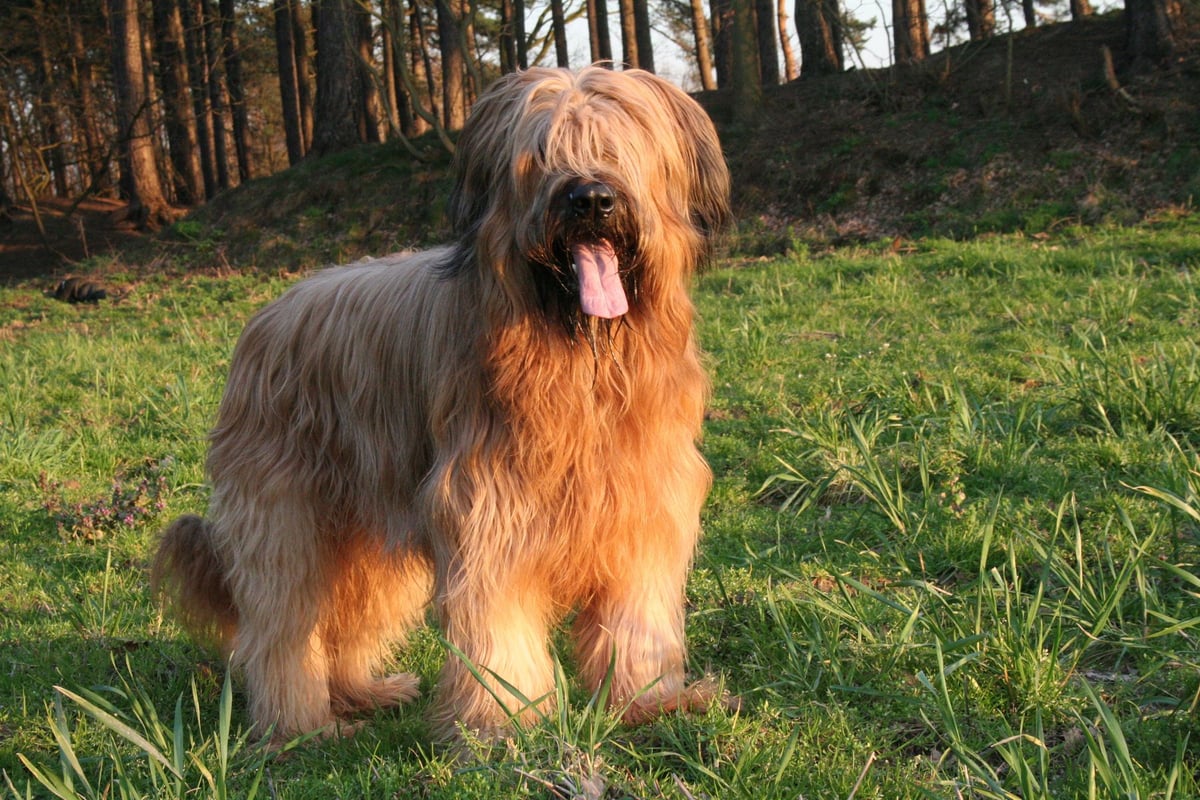
The Briard, or Berger de Brie, is a French long-haired herding dog recognized by the FCI under number 113. Native to the Île-de-France region, it weighs 30 to 40 kg for 56 to 68 cm at the withers. Its double rear dewclaws, mandatory under the FCI standard, and its long, wavy, dry coat make it one of the oldest documented herding breeds in France.
- Weight
- 30 to 40kg
- Height
- 56 to 68cm
- Life expectancy
- 12years
- Monthly cost
- 100 to 160€
Personality profile
Energy 4/5
Independence 3/5
Trainability 4/5
Good with children 3/5
Barking 4/5
Space needed 4/5
Attachment to home 4/5
Good with strangers 2/5
Good with dogs 3/5
Good with cats 3/5
Coat care 5/5
Exercise needs 4/5
Scores given on measured axes, data confidence: high.
Living with a Briard
Description
A large breed with a long coat (6 cm minimum per the FCI standard), slightly wavy, of a dry texture — never curly or woolly. The coat comes in any solid color except white: fawn is dominant, along with gray and black. A strong head with a full mustache and beard. The double dewclaw on each hind leg is an eliminating fault under the standard: its absence or one-sided presence disqualifies the dog in the show ring. Males 63-68 cm for 35-40 kg; females 56-64 cm for 30-35 kg.

Temperament
Naturally wary of strangers — a trait inherited from its flock-guarding and watching duties, to be channeled through intensive early socialization (exposure to varied people, places and situations before 4 months). A barking breed: it systematically barks to signal any intruder or suspicious movement on its territory, a behavior that needs to be managed from puppyhood in a residential setting. With its family, the attachment is deep and exclusive; it copes poorly with prolonged absences beyond 5-6 hours.
Training
Intelligent and hardworking, it was used during World War I to carry messages and locate the wounded on the front line — proof of its aptitude for intense collaborative work. It excels in dog sports demanding speed and reactivity: herding, agility, competitive obedience, French ring sport. Training needs to be varied to prevent boredom, a source of destructive behavior. A first-time owner with no experience of strong-willed breeds will need support from a behaviorist trainer.

Feeding
A 35 kg adult eats 350 to 480 g of premium kibble a day, split into 2 meals. An active breed with real energy expenditure — do not underfeed during periods of intensive dog sport. Large-breed food until 18 months for controlled bone growth. Weight monitoring: the long coat visually hides body changes, making monthly weigh-ins essential to adjust the ration.
Affiliate links, no extra cost to you. Legal notice

Living conditions
It needs an enclosed garden and space to express its herding and watchdog instincts. An apartment is not advisable unless the owner commits to sustained physical activity (at least 1.5 hours a day) and a highly enriched environment. Its herding instinct can surface toward children or other animals — a behavior to redirect through training from the earliest age.

Grooming and coat care
Brushing is the most demanding commitment with the Briard: at least 2 to 3 times a week, with a wide-toothed comb to detangle the dense undercoat, then a flat brush for the long outer coat. Skipping this routine produces mats (compact, irreversible tangles that must be shaved out). Professional grooming 2 to 4 times a year is recommended to even out the silhouette. The beard and mustache trap water, mud and food debris — weekly targeted cleaning is essential.

Health
Progressive retinal atrophy (PRA) is the most well-documented hereditary condition in the breed: an incurable degenerative disease leading to total blindness, detectable via DNA testing of breeding stock since the 2000s. Hip dysplasia is also present at a moderate level (a large, active breed). The life expectancy of 10 to 14 years is satisfactory for the breed's size, provided serious selection against hereditary conditions is practiced. Require the available eye DNA tests for the breed from both parents, along with an official reading of hip X-rays.
Breed history
The Berger de Brie is one of the oldest French pastoral breeds: mentions of Île-de-France herding dogs date back to the reign of Charlemagne (8th century), and the Briard appears in 12th-century writings. The breed is mentioned as early as 1809 in French agronomic writings devoted to herding dogs. The official standard was set in 1897 under the impetus of the Club des Chiens de Berger Français. Recognized by the FCI in Group 1, Section 1 of herding dogs.
Getting ready for your Briard
Five essentials to line up before day one.
Affiliate links, no extra cost to you. Legal notice
FAQ: Briard
Sources
- FCI Standard No 113 — Briard · FCI standard 113, Group 1 Section 1 Herding Dogs
- AKC Breed Profile — Briard · AKC Briard breed profile, Herding Group
- Centrale Canine — Recognized Breeds · SCC breed profile Briard, LOF France
FCI, Fédération Cynologique Internationale, the world body that has codified breed standards since 1911. FCI number 113 is assigned to the Briard.
Breeds similar to a Briard

Belgian Shepherd Dog (Tervuren)
Sheepdogs and Cattledogs (except Swiss Cattledogs)
20 to 30 kg
