


Belgian Shepherd Dog (Malinois)
Sheepdogs and Cattledogs (except Swiss Cattledogs)
20 to 30 kg
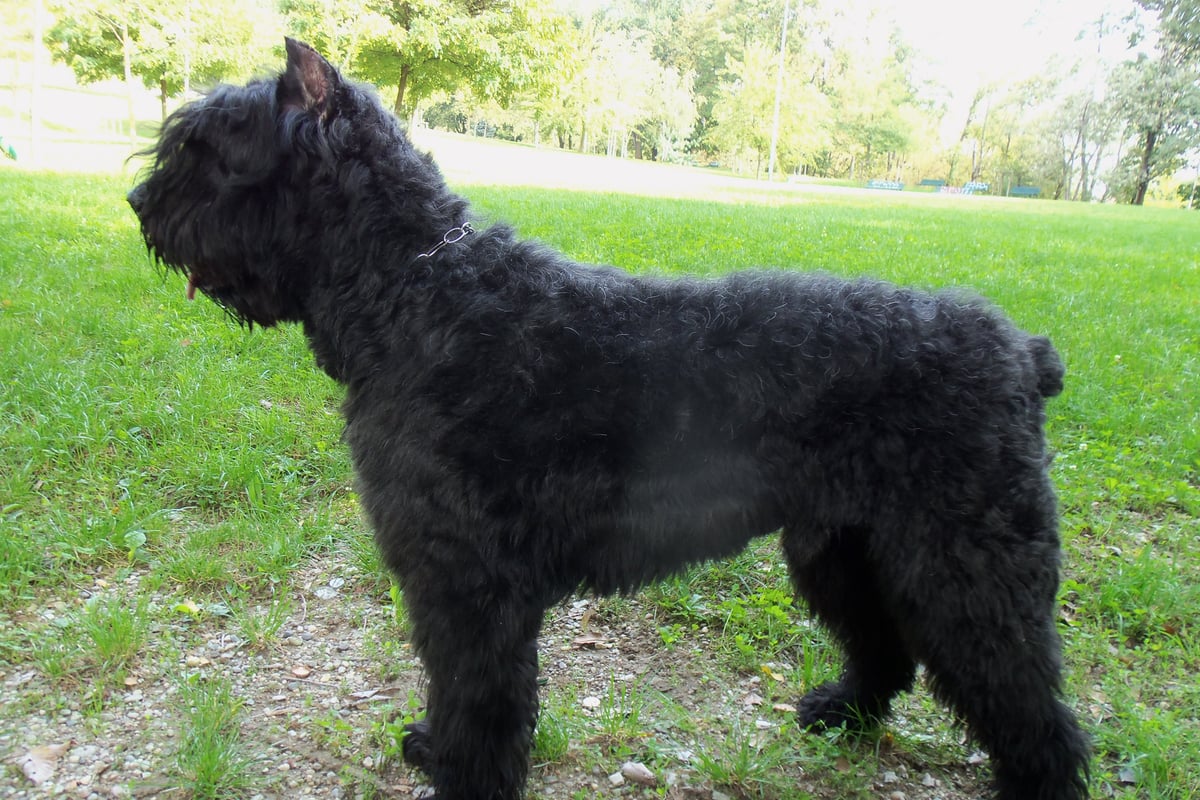
The Bouvier des Flandres weighs 27 to 40 kg for 59 to 68 cm at the withers. Born in the Franco-Belgian border region of Flanders as a herding, dairy-cart-pulling and farm-guarding dog, it nearly disappeared on the Flemish battlefields of the First World War. A versatile breed recognized by the FCI under number 191 (group 1), it is used today in police work, the military, service dog roles and dog sport.
Scores given on measured axes, data confidence: high.
Living with a Bouvier des Flandres
A compact, muscular silhouette, with a full beard that earns it the Flemish nickname 'vuilbaard' (dirty beard). Males 62-68 cm / 35-40 kg, females 59-65 cm / 27-35 kg. Double coat: dense undercoat and a rough, weather-resistant topcoat. Accepted colors: fawn, gray-brindle, black. Annual LOF registrations remain modest in France — far behind the Malinois — but have been stable for about a decade.

A balanced, self-assured character: neither fearful nor aggressive per the FCI 191 standard. Strong loyalty to its family group, structural wariness of strangers — a guarding quality without aggressive drift if well socialized before 4 months. Supervision with children is recommended not because of any tendency to bite but because of its bulk and energy; it interacts best with calm children over 6. Neither a compulsive barker nor a silent dog: it barks to signal, then stops.
Solid trainability (4/5): a breed designed to understand and carry out complex tasks with partial autonomy. Used in French Ring sport, obedience, tracking, therapy work and service for people with disabilities. Unstructured long walks alone are not enough: 30 minutes of obedience work or scent games daily, on top of outings. Positive reinforcement is the reference method; coercive methods are counterproductive on a dog of this sensitivity.

320 to 450 g of premium kibble a day for a 30-35 kg adult, split into 2 meals. 26-30% animal protein recommended to support the muscle mass of a working dog. Glucosamine and chondroitin as a supplement from age 4 given its joint predispositions. Strict weight control: excess weight disproportionately worsens hip dysplasia in moderate-effort breeds.
Affiliate links, no extra cost to you. Legal notice

A house with an enclosed garden is the minimum setting: its energy level of 4/5 and its robust build make it unsuited to an apartment without a structured daily exercise program. 1.5 to 2 hours of varied physical activity a day — long walks, biking, dog sport. Excellent cold tolerance thanks to its double coat, a legacy of Flemish winters; heat is bearable up to 25-28 °C with access to shade.

Professional grooming every 6 to 8 weeks to keep its shape and clear the eyes, ears and paw pads. Twice-weekly brushing in normal periods to prevent tangles in the dense undercoat, daily during seasonal sheds. Despite its abundance of coat, shedding onto fabric stays moderate: the rough topcoat holds onto dead hairs rather than scattering them.

Life expectancy 10 to 12 years according to SCC and AKC data. Documented predispositions: hip and elbow dysplasia (LOF X-rays should be required from both parents), hereditary glaucoma (an official eye exam — ECVO in Europe, OFA/CERF in the United States — is recommended for breeding stock). Hypothyroidism reported at a moderate prevalence in the breed. No musculoskeletal condition comparable to those of giant breeds, but an annual orthopedic checkup remains useful from age 5.
Originally from the Franco-Belgian border region of Flanders (present-day western Belgium), the Bouvier played a triple role in the 19th century: cattle droving, pulling dairy carts and farm guarding. The First World War devastated its numbers across the Flemish plains — the trenches wiped out entire bloodlines. After the Second World War, patient reconstruction under the Club National Belge du Bouvier des Flandres stabilized the breed. Notable anecdote: US President Ronald Reagan owned a Bouvier des Flandres named Lucky, who lived at the White House in the mid-1980s.
Five essentials to line up before day one.
Affiliate links, no extra cost to you. Legal notice
FCI, Fédération Cynologique Internationale, the world body that has codified breed standards since 1911. FCI number 191 is assigned to the Bouvier des Flandres.
Sheepdogs and Cattledogs (except Swiss Cattledogs)
20 to 30 kg


Pinscher and Schnauzer - Molossoid and Swiss Mountain and Cattledogs
42 to 60 kg