


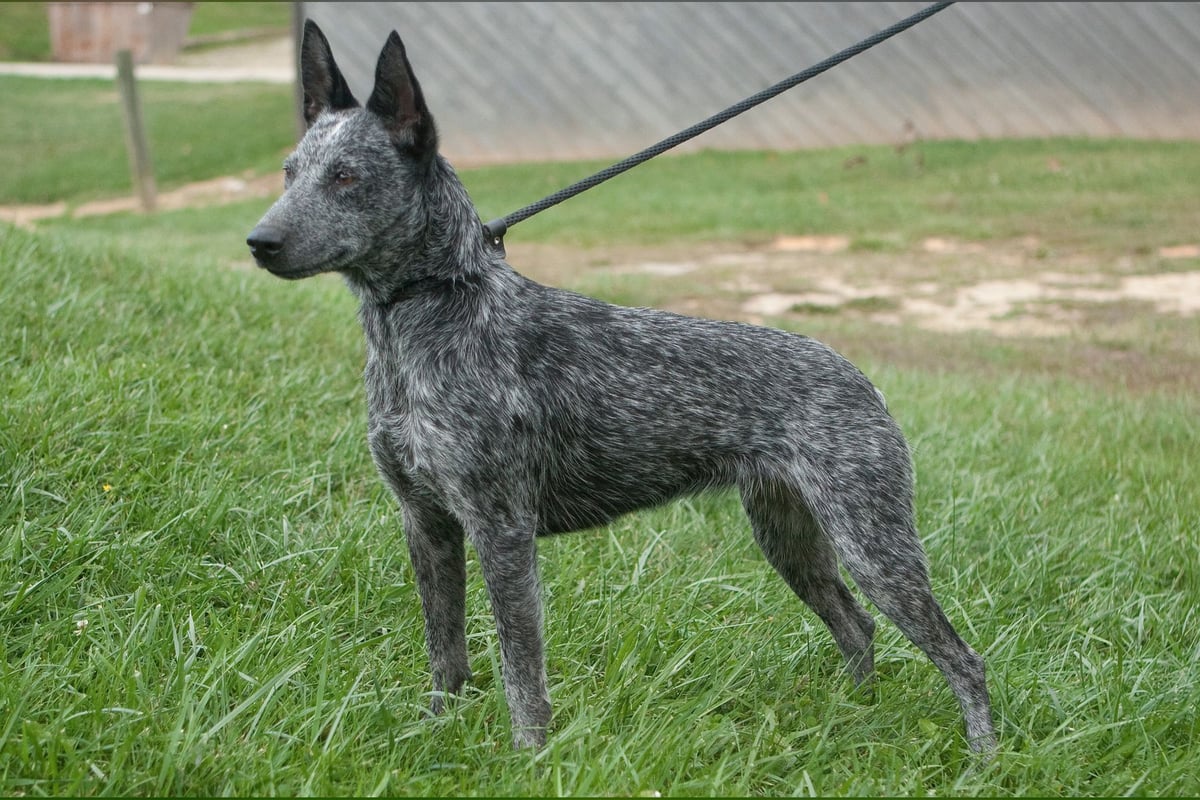
Australian Cattle Dog
The Australian Cattle Dog (nicknamed Blue Heeler or Red Heeler depending on coat color) is an Australian herding breed of 14 to 23 kg, recognized by the FCI under number 287. Developed in New South Wales in the 1840s by Thomas Hall — the 'Hall's Heelers' — from crosses between the Smithfield Collie and tamed Dingoes, later incorporating Dalmatian and Kelpie blood, it was bred to drive cattle over distances of up to 1 000 km across the Australian outback. Bluey, an Australian Cattle Dog who died in 1939 at 29 years and 5 months old, holds the Guinness-recognized world record for canine longevity.
- Weight
- 14 to 23kg
- Height
- 43 to 51cm
- Life expectancy
- 14years
- Monthly cost
- 60 to 100€
Personality profile
Energy 5/5
Independence 3/5
Trainability 4/5
Good with children 3/5
Barking 3/5
Space needed 4/5
Attachment to home 4/5
Good with strangers 2/5
Good with dogs 3/5
Good with cats 2/5
Coat care 2/5
Exercise needs 5/5
Scores given on measured axes, data confidence: high.
Living with an Australian Cattle Dog
Description
A medium-sized breed, compact and muscular, with a short back and deep chest. Males 46-51 cm for 18-23 kg, females 43-48 cm for 14-18 kg. Short double coat: blue mottled base ('blue mottle') or red speckled base ('red speckle'), with characteristic tan markings. Notable trait: puppies are born white, with the blue or red pigmentation only appearing from 4 weeks on, a legacy from the Dalmatian. A solid body built for endurance on rough terrain and under extreme heat.

Temperament
Active, alert, wary of strangers — this guarding instinct inherited from the Dingo remains very present. The 'heel nipping' behavior is rooted in herding genetics, and must be channeled with children and visitors from the very first weeks. Deeply attached to its primary owner without being clingy; it tolerates solitude better than the Border Collie (up to 5-6 hours with sufficient exercise). Left without occupation, its inventiveness turns against the furniture.
Training
An intelligent breed with a quick response to repeated commands (masters a command in 5 to 15 repetitions) but more independent and stubborn than the Border Collie or the Australian Shepherd. Positive reinforcement with varied rewards — alternating play and food. Naturally suited sports: herding, agility, flyball, mantrailing, frisbee, bikejoring. Extensive early socialization (0-16 weeks) is essential to limit its structural wariness of strangers.

Feeding
180 to 280 g of premium kibble a day for an 18 kg adult, split into 2 meals. Fast metabolism and high energy expenditure: kibble rich in animal protein (26-30%) and fat (14-18%) works well. Do not skimp on rations on days of intense activity in the heat — supplement with electrolytes for prolonged work. Constant access to water; rapid dehydration risk in outback conditions.
Affiliate links, no extra cost to you. Legal notice

Living conditions
Not suited to a sedentary lifestyle or an apartment without daily access to large spaces. A minimum of 2 hours of intense physical activity per day is required — not just slow walks. A rural or suburban setting with a house and enclosed garden is recommended; a fence of at least 1.8 m is needed since it jumps easily. It handles dry Australian heat and cold well, but should avoid prolonged humid heat without shade or fresh water.

Grooming and coat care
Low maintenance thanks to the short double coat, which naturally resists dirt. Weekly brushing in normal periods; two to three times a week during the spring and fall seasonal sheds. Infrequent bathing (every 6 to 8 weeks, or after intensive work in mud). Weekly inspection of the erect ears to prevent ear infections. Nails to monitor: an active breed on hard ground wears them down naturally, but they should still be checked monthly in less active dogs.

Health
Hereditary deafness: 5 to 10% of the breed's puppies show partial or total deafness linked to pigmentation (piebald gene inherited from the Dalmatian) — a BAER (Brainstem Auditory Evoked Response) test is mandatory before sale. Progressive retinal atrophy (PRA): DNA screening of breeding stock is recommended. Moderate prevalence of hip dysplasia (LOF radiographic screening). Exceptional life expectancy: 12 to 16 years, among the highest of the working breeds.
Breed history
Thomas Hall developed the 'Hall's Heelers' in the Hunter Valley region (New South Wales) in the 1840s, crossing Smithfield Collies imported from England with tamed Dingoes. Later bloodlines incorporated Dalmatian blood (for stamina and bonding with horses) and Kelpie blood (precise herding instinct). After Hall's death in 1870, the breed spread throughout Queensland and New South Wales. The Australian standard was set in 1902; FCI recognition came under number 287 in 1963. Exported to Europe mainly after 1980, it remains uncommon in France (fewer than 300 annual LOF registrations) compared to its popularity in the United States and Australia.
Getting ready for your Australian Cattle Dog
Five essentials to line up before day one.
Affiliate links, no extra cost to you. Legal notice
FAQ: Australian Cattle Dog
Sources
- FCI Standard No 287 — Australian Cattle Dog · FCI breed standard 287, Group 1 Sheepdogs and Cattle Dogs
- AKC Breed Profile — Australian Cattle Dog · AKC Australian Cattle Dog breed profile, Herding Group
- ANKC Official Breed Standard · Australian National Kennel Council — Official breed standard, Australian Cattle Dog, revised 2017
FCI, Fédération Cynologique Internationale, the world body that has codified breed standards since 1911. FCI number 287 is assigned to the Australian Cattle Dog.
Breeds similar to an Australian Cattle Dog


Belgian Shepherd Dog (Malinois)
Sheepdogs and Cattledogs (except Swiss Cattledogs)
20 to 30 kg