


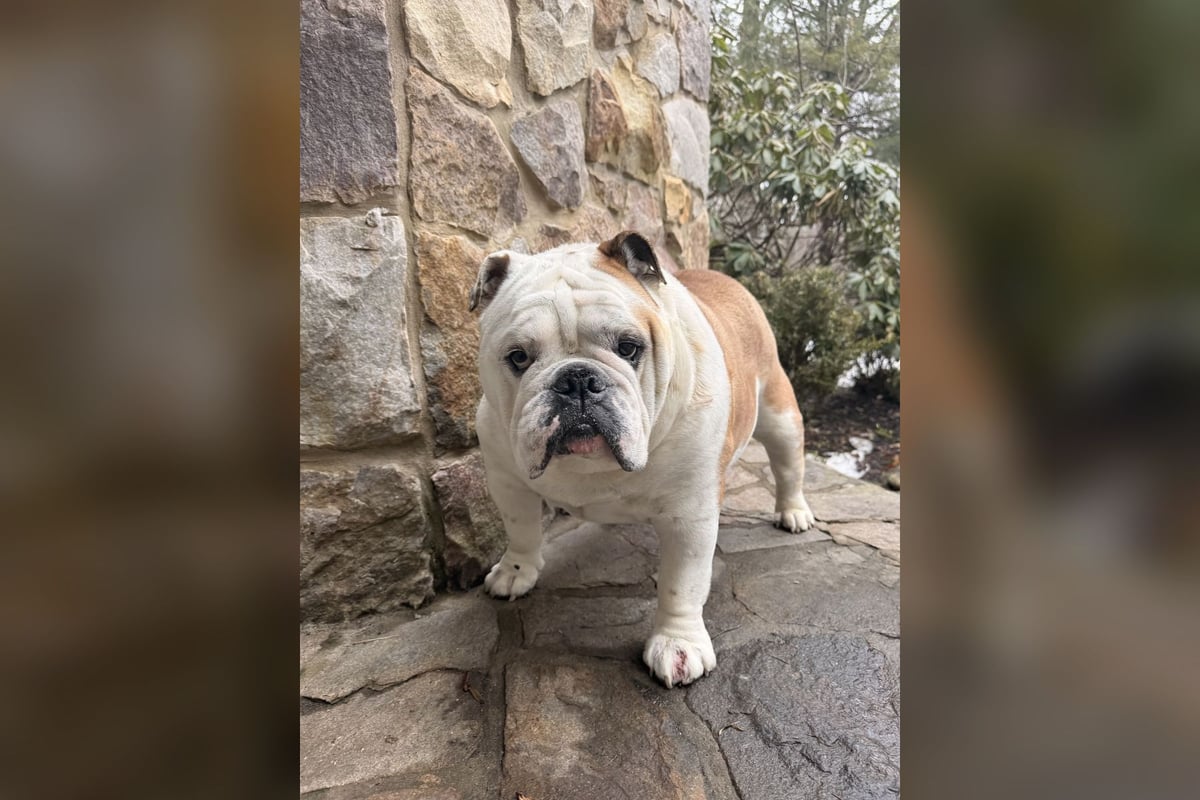
Bulldog
The Bulldog weighs 23 to 25 kg for 31 to 40 cm. An extreme brachycephalic with a near-nonexistent muzzle, severe BOAS syndrome in 80% of dogs, heat intolerance from 22 °C onward with a risk of fatal pulmonary edema. Dystocia is near-universal: 95% of births require a cesarean section. Life expectancy often cited at 8 to 10 years, shortened by chronic respiratory and cardiac disorders.
- Weight
- 23 to 25kg
- Height
- 31 to 40cm
- Life expectancy
- 9years
- Monthly cost
- 100 to 180€
Personality profile
Energy 2/5
Independence 3/5
Trainability 2/5
Good with children 3/5
Barking 2/5
Space needed 2/5
Attachment to home 4/5
Good with strangers 3/5
Good with dogs 2/5
Good with cats 3/5
Coat care 2/5
Exercise needs 1/5
Scores given on measured axes, data confidence: high.
Living with a Bulldog
Description
The Bulldog is a compact molossoid with a broad, low body, recognized by the FCI under number 149. Its massive head is wider than its shoulders, its deep facial folds hang over an almost flat muzzle with a pronounced undershot jaw. Its body structure — very broad chest, narrow hips, splayed forelegs — comes directly from selection for bull-baiting, and is unsuited to natural reproduction and physical exertion. Recognized colors: brindle, red, fawn, white and pied.

Temperament
Calm and not very active indoors, it sleeps on average 12 to 14 hours a day. Attached to its household, fairly tolerant of adult strangers. May become dominant with same-sex dogs — cohabitation needs monitoring. Its low reactivity does not mean a lack of character: it can be stubborn about territory and food. Supervision recommended around young children at mealtimes.
Training
Stubborn and not very motivated by performance, it responds to very short sessions (5 minutes maximum) with high-value food rewards. Physical exertion tied to training should be avoided: a Bulldog in respiratory distress cannot learn. Housetraining often takes longer than average (5 to 8 months). Recall is unreliable — always work in a secure space.

Feeding
200 to 280 g of premium kibble a day for a 24 kg adult, in 2 meals. Heart-shaped or brachycephalic-specific kibble to make eating easier with the undershot jaw. High risk of obesity: every extra kilogram worsens BOAS and shortens life expectancy. Never feed just before or after a period of activity, to reduce the risk of gastric dilatation.
Affiliate links, no extra cost to you. Legal notice

Living conditions
Suited to urban apartment living because of its low energy and minimal exercise needs (20 to 30 min/day of slow walking). Any intense exertion is off-limits: repeated stair climbing, active fetch games or outings in hot weather (above 22 °C) carry a fatal risk. In summer, outings only before 8am or after 9pm, on flat ground, with water available at all times. Sensitive to cold and damp: a coat is recommended in winter below 5 °C.

Grooming and coat care
Weekly brushing with a grooming glove is enough for the short coat. Mandatory cleaning of the facial folds 2 to 3 times a week with a neutral wipe or mild antiseptic solution to prevent contact dermatitis. Corkscrew or embedded tail: monitor for irritation at the base. Bathe monthly at most with a gentle shampoo for sensitive skin.

Health
Brachycephalic obstructive airway syndrome (BOAS) is severe in 80% or more of dogs: stenotic nostrils, an elongated soft palate, a hypoplastic trachea — together these drastically restrict airflow. From 22 °C onward, panting is no longer enough for thermoregulation; above 28 °C, hyperthermia can be fatal in under 30 minutes. Keratoconjunctivitis sicca and cherry eye (prolapse of the third eyelid gland) are common, often requiring surgical correction. Recurring dermatitis in the facial and tail folds (Malassezia, bacteria). Bilateral hip dysplasia documented. Gastric dilatation-volvulus reported sporadically despite the stocky build. Heart conditions (pulmonic stenosis, patent ductus arteriosus) detectable via puppy ultrasound. Life expectancy often cited at 8 to 10 years, but the 2022 British VetCompass epidemiological study found a median of 7.4 years.
Breed history
Descended from English bull-baiting dogs, a practice banned by the Cruelty to Animals Act in 1835. Recreated in the second half of the 19th century as a companion dog by British breeders who amplified morphological traits — a wider head, a shorter muzzle — at the expense of respiratory function. Classified in FCI Group 2. In January 2022, an Oslo court ruled that breeding the breed violated Norway's animal welfare law, finding its genetic traits incompatible with a life free of chronic suffering — a landmark decision in the European debate over brachycephalic extreme types.
Getting ready for your Bulldog
Five essentials to line up before day one.
Affiliate links, no extra cost to you. Legal notice
FAQ: Bulldog
Sources
- FCI Standard No 149 · FCI breed standard 149, Group 2 Pinscher and Schnauzer, Molossoid breeds, Swiss Mountain and Cattle Dogs
- AKC Breed Profile · AKC Bulldog breed profile, Non-Sporting Group
FCI, Fédération Cynologique Internationale, the world body that has codified breed standards since 1911. FCI number 149 is assigned to the Bulldog.
Breeds similar to a Bulldog

Boxer
Pinscher and Schnauzer - Molossoid and Swiss Mountain and Cattledogs
25 to 35 kg
