


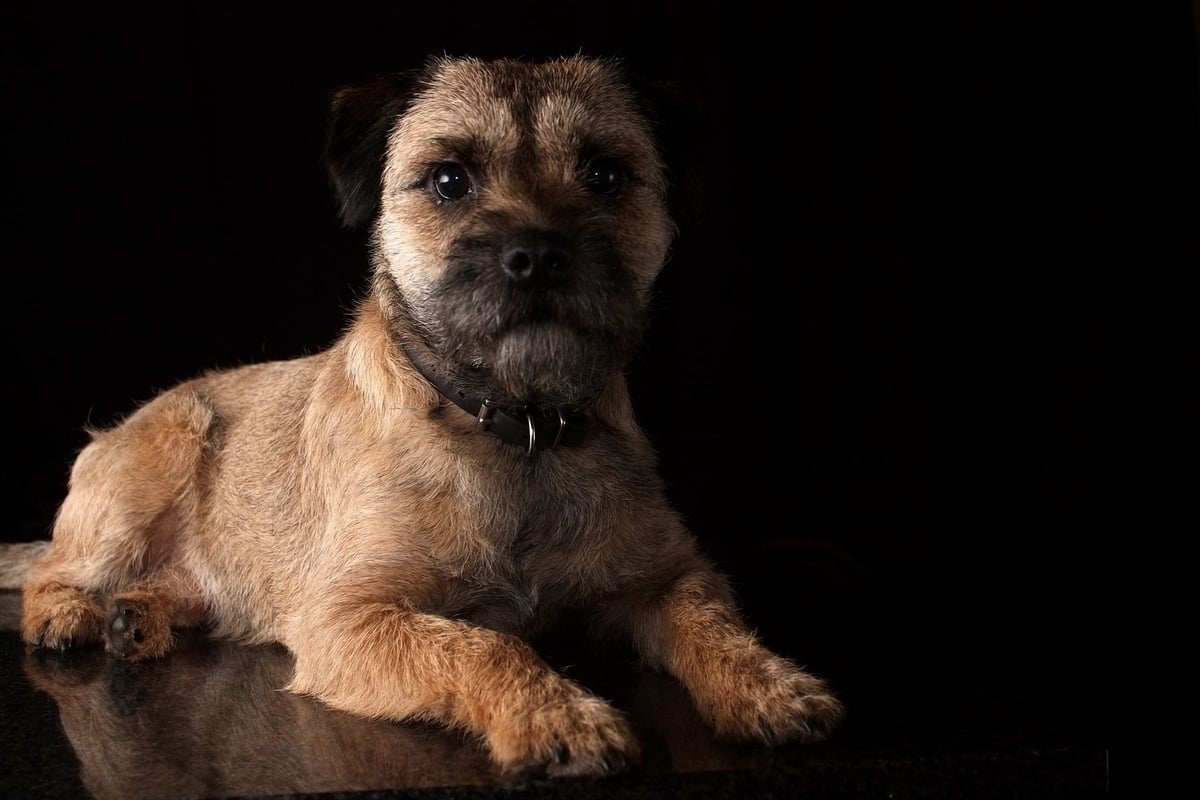
Border Terrier
The Border Terrier weighs 5 to 7 kg for 25 to 30 cm at the withers, originating from the Anglo-Scottish border (Northumberland). Recognized by the FCI under number 10, Group 3, Section 1 (Large and medium-sized Terriers). It is consistently described as the terrier with the most stable, balanced temperament: less independent, less prone to barking and more sociable with children and other dogs than most other terriers. Life expectancy of 14 years per a 2024 UK study.
- Weight
- 5 to 7kg
- Height
- 25 to 30cm
- Life expectancy
- 14years
- Monthly cost
- 50 to 80€
Personality profile
Energy 4/5
Independence 3/5
Trainability 4/5
Good with children 5/5
Barking 3/5
Space needed 2/5
Attachment to home 4/5
Good with strangers 3/5
Good with dogs 4/5
Good with cats 2/5
Coat care 3/5
Exercise needs 4/5
Scores given on measured axes, data confidence: high.
Living with a Border Terrier
Description
The Border Terrier is distinguished by a characteristic otter-shaped head, narrow with a moderately broad skull. Its coat is double: a harsh, dense outer coat lying close against a short, dense undercoat. FCI-recognized colors are grizzle and tan, red, wheaten and blue and tan. The body is sturdy but narrow in build, which allows it to work underground: its rib cage must be spannable by two adult hands behind the shoulders — a unique FCI standard criterion among terriers. The tail is moderately short, carried happily without curling over the back. Not to be confused with other small terriers from the same region (Lakeland Terrier, Bedlington Terrier), with which it shares common ancestors.

Temperament
The most stable and approachable temperament of all hunting terriers: lively, brave and affectionate, without the pronounced aggression toward other dogs or the barking level found in the Jack Russell Terrier or the Fox Terrier. Its canine sociability is documented as notably better than most terriers — the result of selection for working in a pack alongside hounds. Excellent with children, it tolerates handling and lively play without a pronounced defensive reflex. It remains an active hunter: its predatory instinct toward small animals (rodents, rabbits) stays intact, and recall off-leash remains unreliable whenever the scent of prey draws its interest. Less vocal than the average terrier — barks to signal, not out of anxiety or boredom.
Training
Good trainability (4/5) for a terrier: cooperative, attentive and motivated by food rewards, while retaining a degree of terrier independence. Learns quickly if sessions stay short (10 to 15 minutes), varied and based on positive reinforcement. Monotonous repetition loses its attention. Suited to agility and recreational obedience; its sport performance often exceeds expectations given its size. Recall remains the weak point: it needs specific work and is never fully reliable in the presence of prey.

Feeding
120 to 180 g of premium kibble a day for a 6 kg adult, split into 2 meals. Some owners adopt a gluten-free diet to ease CECS episodes — the correlation is not scientifically proven but is positively reported by specialized breeders. Moderate risk of weight gain after spaying/neutering; adjust the ration accordingly to protect joint mobility.
Affiliate links, no extra cost to you. Legal notice

Living conditions
Suited to an apartment if exercise needs are met — 45 minutes to 1 hour of sustained activity a day, split into 2 to 3 outings. Its compact size (5-7 kg) and moderate barking level make it one of the terriers best suited to urban life, provided outings are regular and stimulating. A garden is appreciated but not essential; if available, a sturdy fence is required — digging and fence-jumping are inherited terrier behaviors from working life. Tolerates cold well thanks to its double coat; monitor during periods of intense heat.

Grooming and coat care
Moderate upkeep, suited to the breed's active profile. The harsh coat should not be clipped: it is hand-stripped (by hand or with a stripping knife) 2 to 4 times a year to remove dead hair and maintain the protective texture. Clipping with scissors or clippers softens the coat and alters its water-repellent properties — to be avoided for working or show dogs. Light shedding compared with most terriers; weekly brushing is enough between stripping sessions. Occasional bathing only for noticeable dirt.

Health
Life expectancy of 14.2 years per a 2024 UK study — among the best of all terrier breeds. Documented predisposition to hip dysplasia, less common than in large breeds but to be watched in intensively bred lines. A breed-specific neurological syndrome: CECS (Canine Epileptoid Cramping Syndrome), also known as Spike's Disease — episodes of muscle cramping from which the dog recovers on its own, with frequency varying by individual. Notable predisposition to gallbladder mucocele: a UK study measured a very strongly elevated risk compared with the breed average — a point to watch during annual veterinary checkups.
Breed history
Born on the Anglo-Scottish border, in the counties of Northumberland and Roxburghshire, to accompany mounted fox-hunting parties. Its job: keep pace with galloping horses over the rough terrain of the Borders, then bolt the fox out of its den without killing it. Known as the Coquetdale Terrier and Redesdale Terrier before adopting the name Border Terrier around 1880. Recognized by the British Kennel Club in 1920 and by the AKC in 1930. The FCI granted definitive recognition under number 10 (standard published June 24, 1987). The breed remained rare in France until 1985, and has been steadily rising since thanks to its consensus-building temperament.
Getting ready for your Border Terrier
Five essentials to line up before day one.
Affiliate links, no extra cost to you. Legal notice
FAQ: Border Terrier
Sources
- FCI Standard No 10 · FCI breed standard 10, Group 3 Terriers, Section 1 Large and medium sized Terriers, recognized definitively June 26, 1963
- AKC Breed Profile · AKC Border Terrier breed profile, Terrier Group, recognized 1930
FCI, Fédération Cynologique Internationale, the world body that has codified breed standards since 1911. FCI number 10 is assigned to the Border Terrier.
Breeds similar to a Border Terrier

