


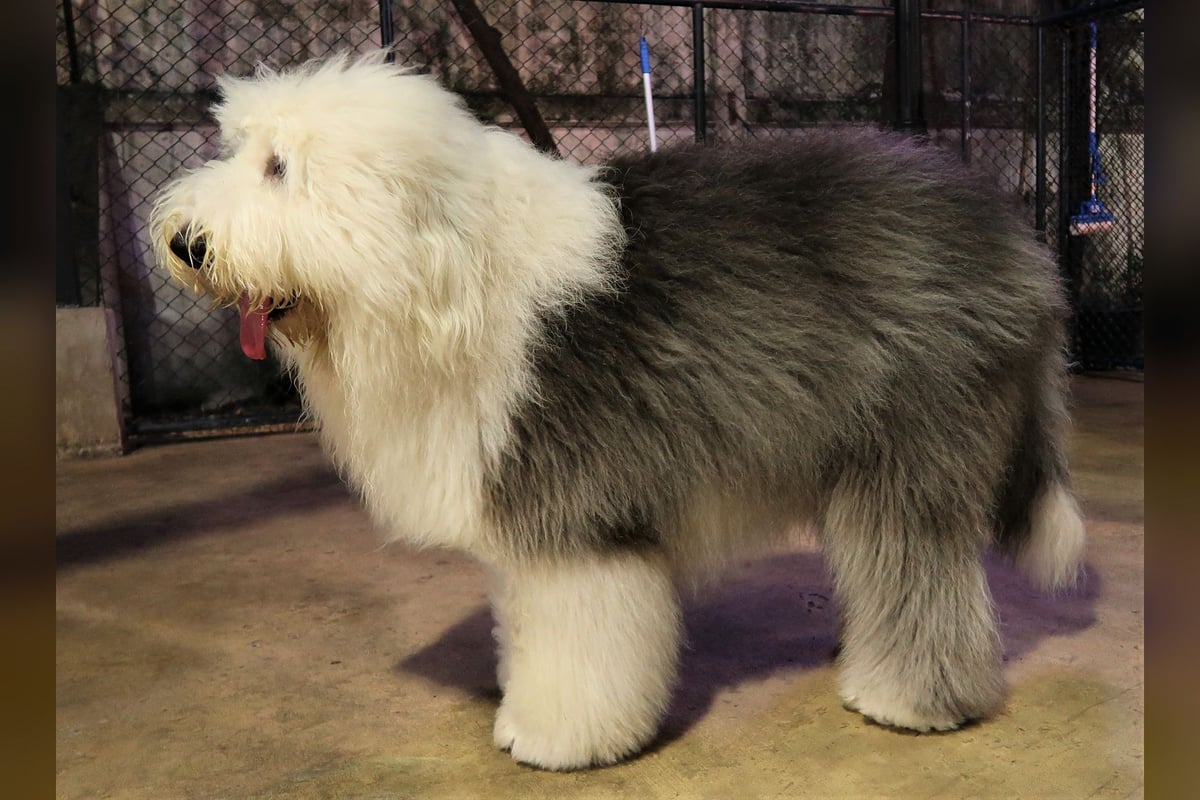
Old English Sheepdog
The Old English Sheepdog — also known as the Bobtail — is recognized by the FCI under number 16. It weighs 30 to 45 kg for 56 to 61 cm at the withers and is defined by its thick double coat in blue-gray and white and its natural lack of a tail, or its tail traditionally docked (a practice banned in France since 2004). A British cattle-driving breed from the 19th century, made famous in the 1960s-1970s by advertising campaigns and British pop culture.
- Weight
- 30 to 45kg
- Height
- 56 to 61cm
- Life expectancy
- 11years
- Monthly cost
- 110 to 180€
Personality profile
Energy 3/5
Independence 3/5
Trainability 3/5
Good with children 4/5
Barking 4/5
Space needed 4/5
Attachment to home 5/5
Good with strangers 3/5
Good with dogs 4/5
Good with cats 3/5
Coat care 5/5
Exercise needs 3/5
Scores given on measured axes, data confidence: high.
Living with an Old English Sheepdog
Description
A large, square breed with a compact, powerful build. The double coat is the breed's defining trait: a waterproof, woolly undercoat covered by a flat, harsh outer coat, in a blue-gray (slate, grizzle) color with white on the head, neck and forelegs. Males stand at least 61 cm for 34-45 kg; females at least 56 cm for 30-40 kg. A broad head with abundant hair falling over the eyes — a distinctive look at shows. The tail is naturally absent in some dogs — a heritable bobtail trait — or was traditionally docked; in France, cosmetic tail docking has been banned since 2004.

Temperament
A jovial, affectionate temperament, deeply oriented toward its family — a team spirit inherited from collective flock work. The breed barks with a characteristic deep, resonant tone, historically used to gather livestock and signal predators. This vocal level (4/5) needs managing from puppyhood in residential settings. With children, the Old English Sheepdog is naturally attentive, but its size (30-45 kg) and its herding instinct can unintentionally knock over young children — supervision recommended before age 6.
Training
Intelligent and cooperative, the breed is ready to learn but with a less intense drive than working shepherds like the Malinois or Dutch Shepherd Dog — which makes it more approachable for owners without advanced experience. It excels in sport obedience, agility and herding, disciplines where its natural instinct resurfaces. Short, varied sessions (15-20 minutes) prevent boredom. Guidance from a behavioral trainer is advisable for managing vocal behavior and herding instinct in the first weeks.

Feeding
A 35-40 kg adult eats 350 to 480 g of premium kibble a day, split into 2 meals. A large breed: specific feeding until 18 months for controlled bone growth and to prevent dysplasia. The long coat visually hides weight changes — monthly weigh-ins are mandatory to adjust the ration. Glucosamine/chondroitin after age 4 for the joints. Avoid intense exercise within an hour of meals, as this breed is prone to gastric distension.
Affiliate links, no extra cost to you. Legal notice

Living conditions
The breed prefers a house with a closed garden, the ideal setting to express its herding and watchdog instincts. An apartment is not advisable without a firm commitment to sustained physical activity (at least 1.5 hours a day) and regular outings — an uncanalized herding instinct produces destructiveness and compulsive behaviors in confined space. Its double coat gives it excellent tolerance to cold and damp — built for British winters — but makes it sensitive to heat: avoid outings in direct sun above 28 °C and ensure access to shade. Daily exercise remains essential to prevent anxiety.

Grooming and coat care
Brushing is the Old English Sheepdog's most demanding commitment: at least 2 to 3 times a week with a wide-toothed comb to reach the woolly undercoat, followed by a stiff brush for the outer coat. Skipping this routine for 10 to 15 days produces irreversible compacted mats — breeders describe felting down to the skin within a few weeks in humid conditions. Professional grooming 3 to 4 times a year is recommended. The area around the eyes accumulates discharge and debris: cleaning twice a week is essential to prevent irritation.

Health
Life expectancy of 10 to 12 years, average for large breeds. Two documented hereditary conditions: hip dysplasia (moderate to high prevalence, radiographs of both parents mandatory) and hereditary cerebellar abiotrophy, a rare but serious degenerative neurological disease affecting motor coordination, detectable via DNA testing of breeding stock at serious kennels. Heat stress in summer is a real risk to take seriously (a very thick coat) — avoid intense exertion in hot weather.
Breed history
The Old English Sheepdog is documented in 18th-19th century Great Britain as a market driver, moving cattle and sheep herds toward towns. Its tail was traditionally docked to distinguish working dogs (exempt from a tax on companion dogs) — a practice at the origin of the nickname "Bobtail" (short tail). The first standard was set by the Kennel Club in 1888. The breed achieved worldwide popularity in the 1960s-1970s through advertising and British pop culture. Recognized by the FCI in Group 1, Section 1, number 16.
Getting ready for your Old English Sheepdog
Five essentials to line up before day one.
Affiliate links, no extra cost to you. Legal notice
FAQ: Old English Sheepdog
Sources
- FCI Standard No 16 — Old English Sheepdog · FCI standard 16, Group 1 Section 1 Sheepdogs
- AKC Breed Profile — Old English Sheepdog · AKC Old English Sheepdog breed profile, Herding Group
- Centrale Canine — Old English Sheepdog · SCC breed profile Old English Sheepdog (Bobtail), LOF France
FCI, Fédération Cynologique Internationale, the world body that has codified breed standards since 1911. FCI number 16 is assigned to the Old English Sheepdog.
Breeds similar to an Old English Sheepdog

