


Kangal Shepherd Dog
Pinscher and Schnauzer - Molossoid and Swiss Mountain and Cattledogs
40 to 65 kg
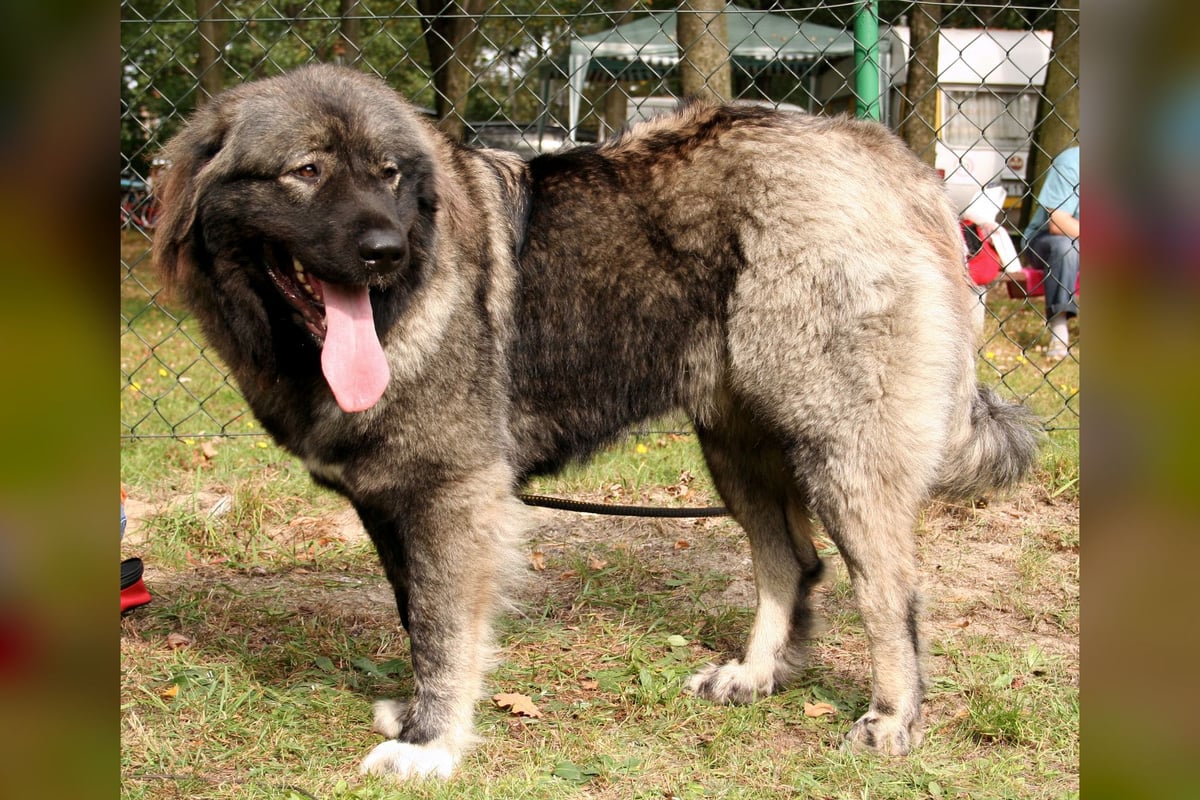
The Caucasian Shepherd Dog (FCI 328, Кавказская овчарка) is a giant molosser weighing 45 to 90 kg for 64 to 75 cm at the withers, selected for roughly 2 000 years in the highlands of Georgia, Dagestan, Azerbaijan and Armenia to protect flocks against wolves, bears and thieves. Used by the Soviet military as a guard dog for gulags and border zones — around 7 000 dogs patrolled East Berlin until 1989 — it retains a structural wariness of strangers and marked territorial aggression. Not a breed recommended for novice owners or urban settings.
Scores given on measured axes, data confidence: high.
Living with a Caucasian Shepherd Dog
A massive, imposing silhouette: heavy bone structure, a broad and powerful head, a muscular neck often framed by a dense fur ruff. The double coat comes in two variants — mountain (long, abundant) and steppe (shorter and tighter) — both providing extreme thermal insulation, proven for temperatures down to -30 °C. The coat can be gray, fawn, off-white, brindle or pied. Males weigh 50-90 kg and stand 68-75 cm; females weigh 45-70 kg and stand 64-69 cm. The dense undercoat retains body heat, which in turn means low tolerance for summer heat.

An independent, decisive guardian, it does not seek human validation before acting against a perceived threat — real or assumed. Its wariness of strangers is intrinsic to the breed and does not disappear through socialization alone. Vocal and prone to barking the moment it senses an intrusion, its deep, powerful bark serves as a first deterrent signal — an innate behavior that training cannot suppress. Toward its core family, it shows calm, protective loyalty; with children in the household that it knows, it is tolerant, but its 70 kg mass requires constant supervision of interactions.
Training a Caucasian Shepherd Dog is reserved for experienced owners who have already handled highly independent breeds. The basics (reliable recall, leash walking, sit-down) are attainable with consistency, but coercive or authoritarian methods produce dangerous pushback in an 80 kg dog. Early socialization before 12-14 weeks is absolutely decisive: without controlled exposure to varied people and animals, the puppy will become an unpredictable, uncontrollable adult. A canine socialization class with a trainer specialized in protection breeds is strongly recommended from the first weeks.

400 to 700 g of premium giant-breed kibble a day for a 70 kg adult, split into 2 strict meals. Giant-breed food with controlled calcium levels is mandatory throughout growth (until 24 months) to limit joint stress. Glucosamine and chondroitin recommended as a supplement from age 4-5 given the breed's dysplasia prevalence. Avoid any intense exercise within 60 minutes of meals — the risk of gastric torsion is real for a dog of this size.
Affiliate links, no extra cost to you. Legal notice

Apartment living is unsuited and not recommended for a dog of this size and temperament. A large, solidly fenced rural property, with a house that has a garden of at least 1 000 m², is the viable minimum. Regular nighttime barking makes any dense peri-urban setting a source of conflict with neighbors. Its mountain-variant double coat gives it remarkable tolerance for extreme cold, but heat above 25 °C requires permanent access to shade and fresh water. In France, its molossoid morphotype can expose it to a dangerous-category classification depending on the préfecture — check with the town hall before acquiring one.

The dense double coat requires weekly brushing outside of shedding periods and regular brushing, ideally twice weekly, during the spring and fall seasonal sheds. The mountain variant produces large amounts of undercoat that, if not removed regularly, forms compact mats that are hard to detangle. The drop ears trap moisture and should be checked every two weeks to prevent ear infections. Professional grooming twice a year, particularly for undercoat management, is recommended for the long-coated variants.

Life expectancy is 10 to 12 years, in line with giant breeds. Hip and elbow dysplasia is the most documented condition: OFA or SCC radiographs of breeding stock are essential to verify with the breeder. Gastric dilatation-volvulus is a serious risk at this size: 2 split meals a day and an hour of rest after each meal are essential. Dilated cardiomyopathy has been reported in some lines — annual cardiac monitoring recommended from age 5. Slow growth until 18-24 months requires a suitable giant-breed diet to avoid overloading developing joints.
Selected for roughly 2 000 years on the mountain slopes of the Caucasus — Georgia, Dagestan, Azerbaijan, Armenia — by nomadic herders who needed a guardian capable of driving off wolves and brown bears alone without human intervention. Its massive build and courage made it the guardian of choice for Soviet border zones: deployed in Siberian gulags from the 1930s onward, it was later assigned to patrol the East Berlin Wall, where around 7 000 dogs of this breed patrolled the no man's land zones until the wall fell in 1989. The FCI recognizes the breed under number 328, within Group 2.
Five essentials to line up before day one.
Affiliate links, no extra cost to you. Legal notice
FCI, Fédération Cynologique Internationale, the world body that has codified breed standards since 1911. FCI number 328 is assigned to the Caucasian Shepherd Dog.
Pinscher and Schnauzer - Molossoid and Swiss Mountain and Cattledogs
40 to 65 kg

Pinscher and Schnauzer - Molossoid and Swiss Mountain and Cattledogs
50 to 90 kg

Pinscher and Schnauzer - Molossoid and Swiss Mountain and Cattledogs
40 to 60 kg