


Pyrenean Mountain Dog
Pinscher and Schnauzer - Molossoid and Swiss Mountain and Cattledogs
40 to 60 kg
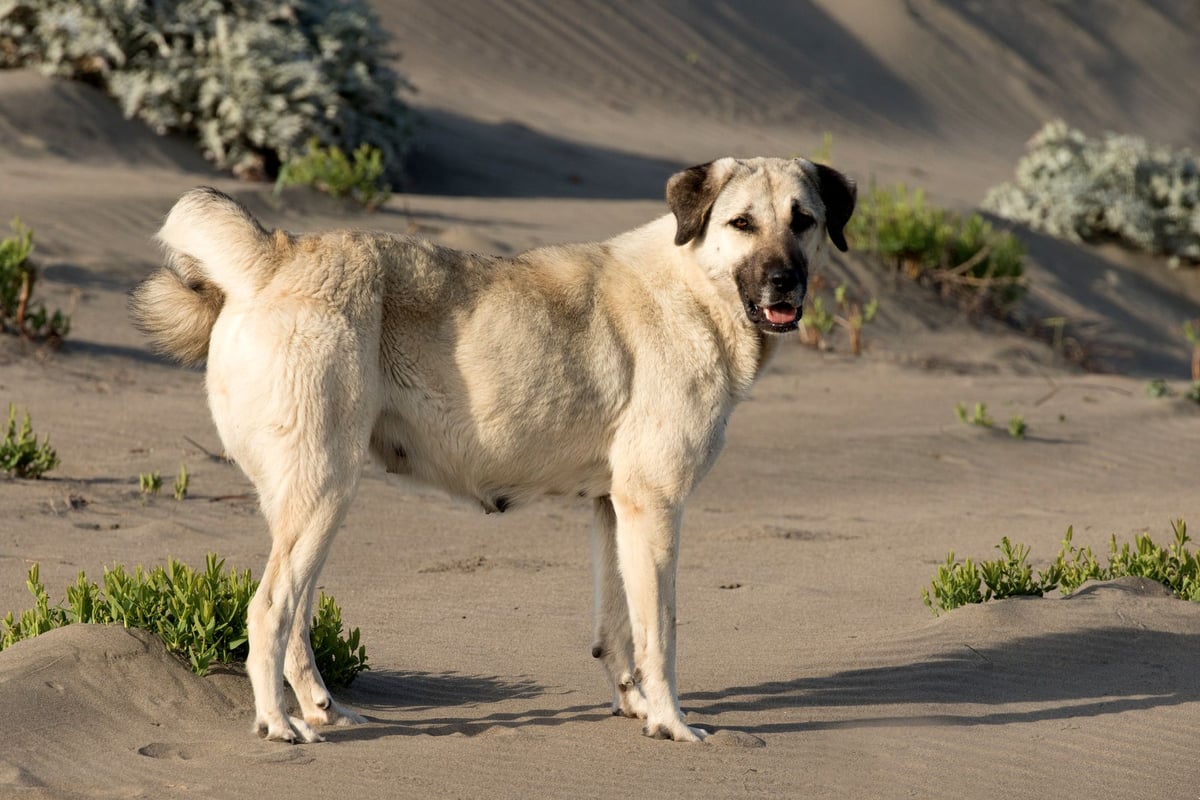
The Kangal Shepherd Dog (Kangal / Karabaş / Çoban Köpeği, FCI 331) is a Turkish livestock guardian weighing 40 to 65 kg for 71 to 81 cm at the withers, native to the Sivas region in central Anatolia. Descended from the Karabaş dogs of antiquity, it has protected flocks against wolves, bears and leopards without human direction for millennia. Its bite force was measured at 743 PSI by National Geographic in 2007 — the record among all dog breeds, ahead of the Rottweiler at 328 PSI. Turkey has banned the export of purebred stock since 1996 and recognizes it as a national heritage.
Scores given on measured axes, data confidence: high.
Living with a Kangal Shepherd Dog
A powerful, lean silhouette, lighter than the Tibetan Mastiff at a comparable size: solid bone structure without excessive bulk. Short to medium coat in sandy fawn to brown, with a characteristic black mask on the muzzle and ears — a distinctive breed marker. Males stand 74-81 cm and weigh 50-65 kg, females stand 71-79 cm and weigh 40-55 kg. Moderate double coat: dense undercoat in winter, short to medium outer coat depending on the variant. Its balanced build gives it endurance and speed, two qualities selected for the vast expanses of the Anatolian steppe.

An independent guardian that decides alone what counts as a threat and how to respond — it does not seek human approval before intervening. Structurally wary of strangers, this wariness does not disappear through socialization alone and forms the functional core of the breed. It barks powerfully and at length at night to deter predators — an innate behavior that training cannot suppress. Toward its core family, it shows calm, undemonstrative loyalty; with children in the household it is patient, but its size requires supervising interactions with young children.
Training a Kangal Shepherd Dog demands absolute consistency and prior mastery of handling independent breeds — novice owners are regularly overwhelmed. The basics (recall, sit, leash walking) are attainable but require constant repetition; coercive methods reinforce wariness rather than obedience. Early socialization before 14 weeks is decisive: an unsocialized puppy will become an uncontrollable 60 kg adult. Moderate daily exercise of 45 to 60 minutes of walking is enough — this is not a sport dog or a driving herder but a guardian on static patrol.

350 to 550 g of premium large-breed kibble a day for a 50 kg adult, in 2 strict meals. Giant-breed kibble until 18-24 months to support growth without forcing it. Glucosamine and chondroitin recommended from age 5 as joint prevention. Avoid intense exercise within an hour of meals to limit gastric dilatation-volvulus risk — a real risk at this size.
Affiliate links, no extra cost to you. Legal notice

A large, enclosed rural property is mandatory — neither an apartment nor a standard city garden suits a 55 kg Kangal. A house with a large garden is a minimum; in peri-urban areas, its intense nighttime barking creates near-certain conflict with neighbors. It handles extreme temperatures well thanks to its double coat and a millennia-old adaptation to Anatolia's hot summers and harsh winters. In France, the breed is not classified in category 1 or 2, but a guardian dog of this size justifies liability insurance and a preliminary check with the local town hall on local rules.

Minimal upkeep relative to its size: twice-weekly brushing is enough outside of shedding. The spring seasonal shed lasts 3 to 4 weeks and requires regular brushing to prevent undercoat buildup. Unlike long-coated breeds such as the Pyrenean Mountain Dog or the Tibetan Mastiff, the Kangal needs neither regular professional grooming nor laborious detangling. Ear cleaning to watch — the drop ears can trap moisture and encourage ear infections if neglected.

Life expectancy is 12 to 15 years, remarkably long for a dog of this size. Hip dysplasia: monitoring recommended, moderate prevalence — serious breeders provide OFA or SCC radiographs of breeding stock. Entropion (inward-rolling eyelids) reported in some lines — consult a veterinary ophthalmologist if there is excessive tearing. Gastric dilatation-volvulus (GDV) is possible at this size: 2 strict meals a day and an hour of digestive rest after each meal are essential. Few serious genetic diseases documented — natural selection under harsh living conditions has preserved constitutional robustness.
The Kangal Shepherd Dog descends from the Karabaş dogs ("black head" in Turkish) present in central Anatolia since antiquity, selected by nomadic shepherds of the Sivas region to guard flocks against large predators — wolves, brown bears and Anatolian leopards. Its history connects to that of the livestock guardian dogs of the Near East, whose archaeological traces go back several millennia. The breed was recognized by the FCI under number 331 in 1989. Since 1996, Turkish law has banned the export of purebred Kangals — they are considered a national heritage on par with the language and the flag. Programs led by the Cheetah Conservation Fund have introduced the Kangal to Namibia and South Africa to protect livestock from cheetahs, markedly reducing livestock losses and, with them, retaliation against the cats.
Five essentials to line up before day one.
Affiliate links, no extra cost to you. Legal notice
FCI, Fédération Cynologique Internationale, the world body that has codified breed standards since 1911. FCI number 331 is assigned to the Kangal Shepherd Dog.
Pinscher and Schnauzer - Molossoid and Swiss Mountain and Cattledogs
40 to 60 kg

Pinscher and Schnauzer - Molossoid and Swiss Mountain and Cattledogs
50 to 90 kg

Pinscher and Schnauzer - Molossoid and Swiss Mountain and Cattledogs
45 to 90 kg