


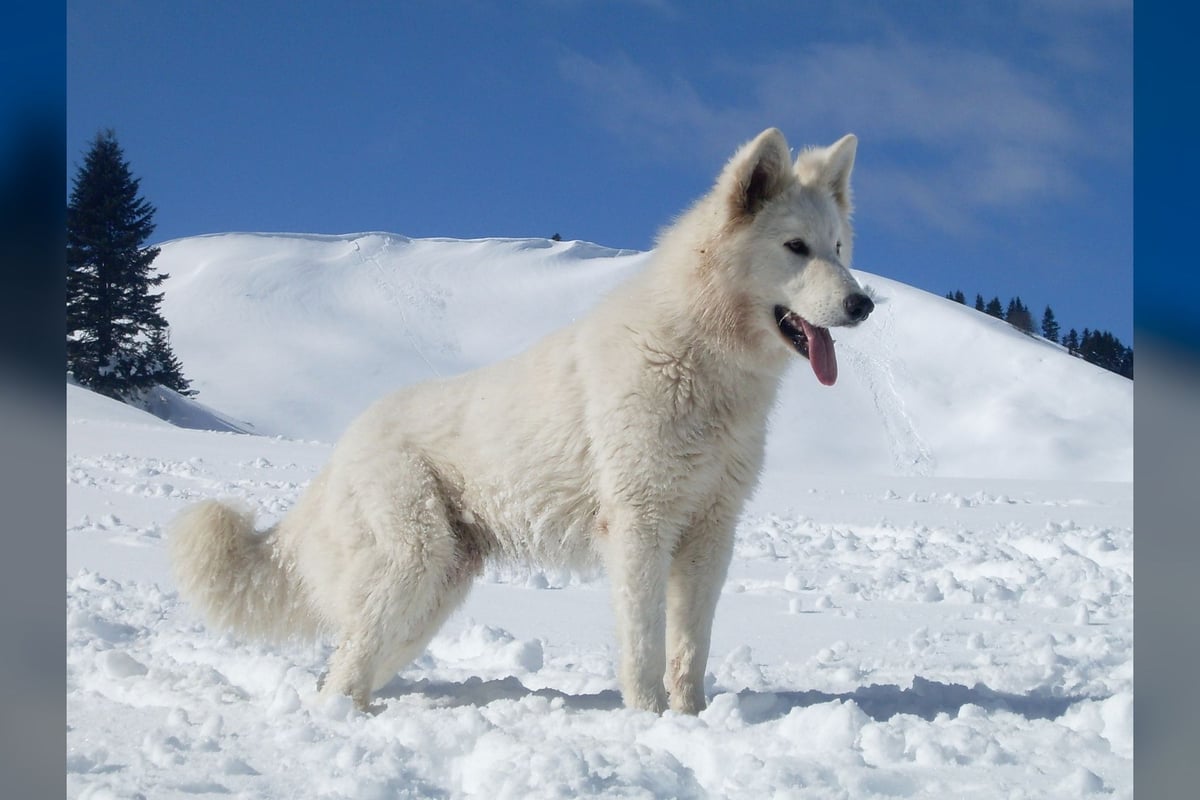
White Swiss Shepherd Dog
The White Swiss Shepherd Dog (Weisser Schweizer Schäferhund, FCI 347) is a herding breed weighing 25 to 40 kg for 53 to 66 cm at the withers, officially recognized by the FCI in 2002 under Swiss patronage. A breed distinct from the German Shepherd Dog, with which it shares its origin, it was purged from German registries in 1933 — the white coat being associated at the time with traits considered undesirable — and survived thanks to breeders in Switzerland, the United States and Canada. Its straighter topline and the absence of the excessive hip angulation seen in its German cousin give it an orthopedically more balanced build. Life expectancy is 11 to 13 years.
- Weight
- 25 to 40kg
- Height
- 53 to 66cm
- Life expectancy
- 12years
- Monthly cost
- 100 to 170€
Personality profile
Energy 4/5
Independence 3/5
Trainability 5/5
Good with children 5/5
Barking 3/5
Space needed 4/5
Attachment to home 5/5
Good with strangers 3/5
Good with dogs 4/5
Good with cats 3/5
Coat care 3/5
Exercise needs 4/5
Scores given on measured axes, data confidence: high.
Living with a White Swiss Shepherd Dog
Description
The pure white coat is the only color accepted in the FCI standard: medium or long hair, always with a dense double coat. The woolly undercoat provides effective thermal insulation in winter; shedding is marked and seasonal, with significant hair loss in spring. Build is identical to the German Shepherd Dog — sturdy bone structure, developed chest, well-angulated limbs — but the topline is noticeably more level, without the GSD's characteristic rear slope. Males stand 60-66 cm and weigh 30-40 kg, females stand 53-61 cm and weigh 25-35 kg; sexual dimorphism is well marked.

Temperament
A calmer and more sensitive breed than the classic German Shepherd Dog: it responds poorly to authoritarian methods and integrates instructions much better through positive reinforcement. It is deeply attached to its family group and shows genuine affection toward children, with whom it is patient and attentive. Wary of strangers, it observes before accepting contact — without being aggressive or fearful once properly socialized. A natural swimmer, it enjoys water activities and outdoor sports.
Training
A breed highly receptive to positive training: it memorizes commands quickly and enjoys short, varied sessions. It gets bored and disengages with mechanical repetition; splitting exercises into 10-15 minute sessions keeps its attention. Recommended activities: obedience, agility, treibball, canicross — a sport that channels its energy over long distances. Early socialization (0-16 weeks) is decisive for how it handles unfamiliar people as an adult; neglecting this phase produces anxious adults that are hard to rehabilitate.

Feeding
250 to 350 g of premium large-breed kibble a day for a 30 kg adult, in two meals. Large-breed or medium-breed kibble suited until 18 months for gradual joint growth. Adding glucosamine and chondroitin from age 5-6 is recommended to prevent joint problems. At least an hour of digestive rest after each meal to limit gastric torsion risk.
Affiliate links, no extra cost to you. Legal notice

Living conditions
An active breed that needs a house with an enclosed garden and several outings a day — an apartment is not recommended without regular access to a large outdoor space. Two to three active outings a day are a minimum; an accessible garden gives it autonomy but does not replace structured walks. Its double coat lets it tolerate sub-zero temperatures without difficulty, but summer heat above 28 °C is hard on it: shade and fresh water must be available in summer. In Mediterranean regions or during heatwaves, limit exercise to the cooler morning and evening hours.

Grooming and coat care
Brushing two to three times a week outside of shedding is enough to maintain the double coat. The spring shed is heavy and lasts three to five weeks: daily brushing with an undercoat rake (such as a FURminator) limits hair loss around the home. The white coat requires extra vigilance for grass and mud stains and yellowish discoloration around the muzzle. Professional grooming recommended twice a year for trimming hair around the paws and ears.

Health
Life expectancy is 11 to 13 years. Hip and elbow dysplasia: documented incidence lower than the German Shepherd Dog thanks to the absence of excessive rear angulation, but SCC or OFA radiographs of breeding stock remain essential. Idiopathic epilepsy reported in some lines — a neurological workup is recommended if seizures occur before age 5. Degenerative myelopathy (DM): a genetic test is available (SOD1 mutation), to require from both breeding parents. Skin allergies and atopic dermatitis are the most common veterinary complaint; the white coat makes redness and irritation more visible. Watch for gastric torsion risk in medium-to-large adults.
Breed history
The white coat has been present in the German Shepherd Dog population since the breed's origins in the late 19th century. In 1933, Germany excluded white coats from the official standard, considering the color associated with so-called "degenerate" puppies by the standards of the time — an ideologically motivated decision. Swiss, American and Canadian breeders rigorously maintained the white variant. Switzerland officially registered the breed with the FCI, which assigned it number 347 in 2002, creating a fully distinct breed. In the United States, the White Shepherd has been separately recognized by the UKC since 1999; the AKC still does not recognize the White Swiss Shepherd Dog as an independent breed.
Getting ready for your White Swiss Shepherd Dog
Five essentials to line up before day one.
Affiliate links, no extra cost to you. Legal notice
FAQ: White Swiss Shepherd Dog
Sources
- FCI Standard No 347 — White Swiss Shepherd Dog · FCI breed standard 347, Group 1 Sheepdogs and Cattledogs (except Swiss Cattledogs)
- Société Centrale Canine — White Swiss Shepherd Dog · SCC official breed record, White Swiss Shepherd Dog, Group 1
- White Swiss Shepherd Dog — Wikipedia FR · Encyclopedic article, White Swiss Shepherd Dog, history of the 2002 FCI recognition
FCI, Fédération Cynologique Internationale, the world body that has codified breed standards since 1911. FCI number 347 is assigned to the White Swiss Shepherd Dog.
Breeds similar to a White Swiss Shepherd Dog

Belgian Shepherd Dog (Malinois)
Sheepdogs and Cattledogs (except Swiss Cattledogs)
20 to 30 kg

Belgian Shepherd Dog (Tervuren)
Sheepdogs and Cattledogs (except Swiss Cattledogs)
20 to 30 kg