


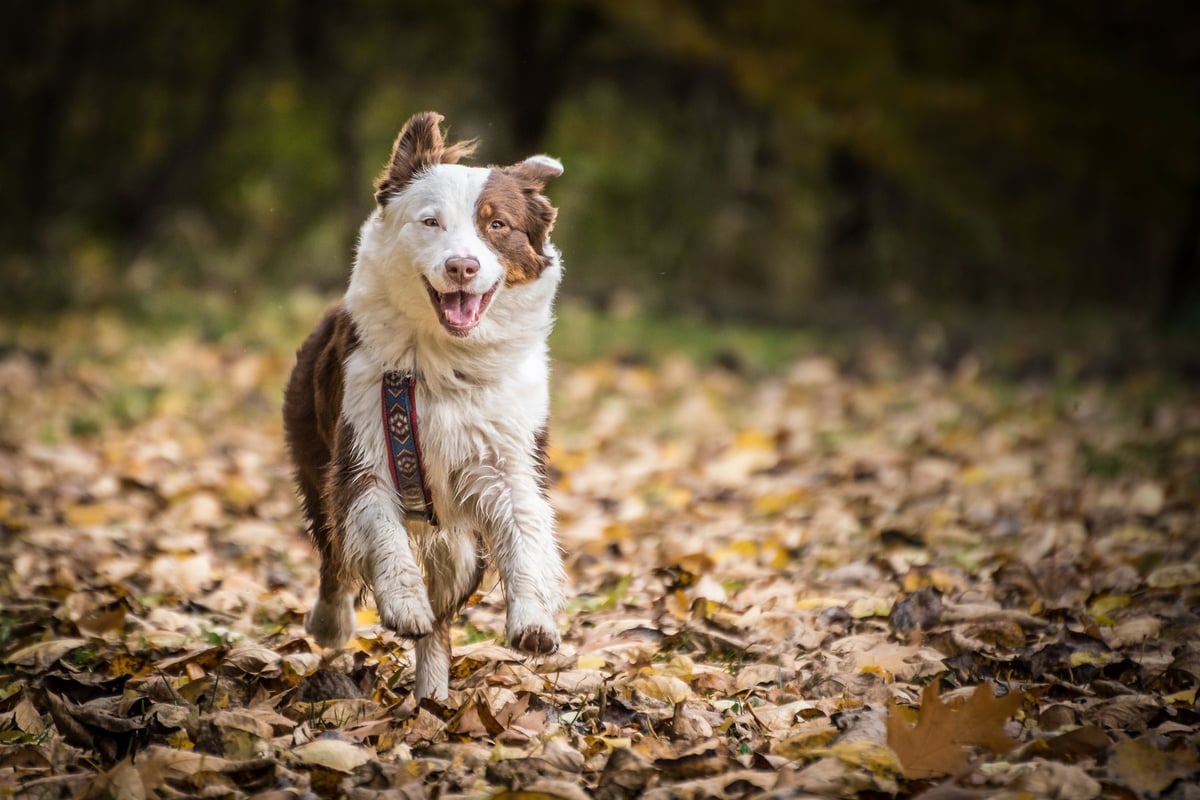
Australian Shepherd
The Australian Shepherd is an American herding dog of 21 to 32 kg, developed in California in the 19th century from Basque herding dogs. Recognized by the FCI under number 342, it combines maximum energy with a high working capacity, and needs 1.5 to 2 hours of daily activity to stay balanced.
- Weight
- 21 to 32kg
- Height
- 48 to 58cm
- Life expectancy
- 12years
- Monthly cost
- 80 to 120€
Personality profile
Energy 5/5
Independence 2/5
Trainability 5/5
Good with children 4/5
Barking 3/5
Space needed 5/5
Attachment to home 5/5
Good with strangers 3/5
Good with dogs 4/5
Good with cats 3/5
Coat care 4/5
Exercise needs 5/5
Scores given on measured axes, data confidence: high.
Living with an Australian Shepherd
Description
A versatile herding breed, the Australian Shepherd excels at agility, obedience, herding trials and dog dancing. Its merle coat, blue or red, and its tricolor coat are its signature. Males stand 51 to 58 cm at the withers, females 48 to 54 cm, on a compact athletic frame with a tail that is often naturally short.

Temperament
Sharp and deeply attached to its owner, it copes badly with solitude and can develop separation anxiety after 4 to 5 hours alone. Reserved with strangers, it may nip at heels out of herding instinct, a behavior to channel from puppyhood through socialization and redirection.
Training
Trainability sits at the top of the scale: it picks up a new cue in fewer than 5 repetitions. Positive reinforcement is non-negotiable, as it shuts down completely under punishment. Suited to demanding dog sports such as agility, obedience, IGP, dog dancing, herding and mantrailing, often several hours of technical work per week.

Feeding
Budget 300 to 400 g of premium kibble a day for a 25 kg adult, split into 2 meals. Its high energy expenditure handles high-protein kibble well (28 to 32%). Watch for weight gain after age 7 if exercise drops without adjusting the ration.
Affiliate links, no extra cost to you. Legal notice

Living conditions
Not suited to apartment life without 1.5 to 2 hours of daily physical and mental activity. It does better in a house with garden access, but space alone is not enough: it needs mental work such as scent games, advanced obedience or dog sports to keep destructive behavior at bay.

Grooming and coat care
Brush 2 to 3 times a week under normal conditions, daily during the two annual shedding seasons in spring and fall. The weatherproof double coat does not call for professional grooming; baths stay reserved for real dirt.

Health
The breed frequently carries the MDR1 mutation, which makes some antiparasitics such as ivermectin toxic, so genetic testing is mandatory before you buy. It is predisposed to hip and elbow dysplasia (LOF radiographs required) as well as Collie eye anomaly and cataracts. Merle x merle breeding statistically produces 25% double-merle puppies, often blind, deaf or both. The double coat makes it heat-sensitive: avoid any intense exercise above 25 °C, and provide shade and fresh water in summer.
Breed history
Born in the Californian ranches of the 19th century, the Australian Shepherd descends from Basque herding dogs that arrived from Australia with settlers, hence the name. Officially recognized by the FCI in 2007, it has ranked in the top 3 of French LOF registrations since 2010.
Getting ready for your Australian Shepherd
Five essentials to line up before day one.
Affiliate links, no extra cost to you. Legal notice
FAQ: Australian Shepherd
Sources
- FCI Standard No 342 · FCI breed standard 342, Group 1 Sheepdogs
- AKC Breed Profile · AKC Australian Shepherd breed profile, Herding Group
FCI, Fédération Cynologique Internationale, the world body that has codified breed standards since 1911. FCI number 342 is assigned to the Australian Shepherd.
Breeds similar to an Australian Shepherd


Belgian Shepherd Dog (Malinois)
Sheepdogs and Cattledogs (except Swiss Cattledogs)
20 to 30 kg