


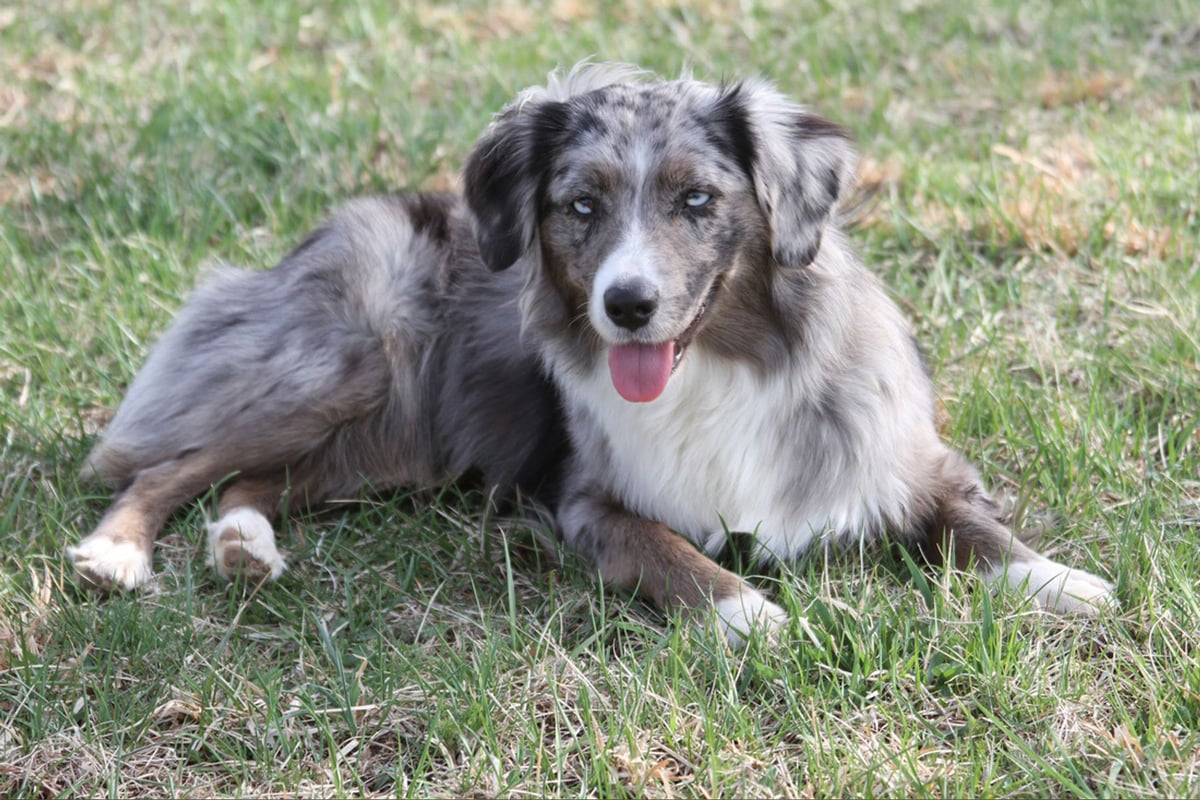
Miniature Australian Shepherd
The Miniature Australian Shepherd weighs 7 to 15 kg for 33 to 46 cm at the withers. Not recognized by the FCI, but recognized by the UKC (United Kennel Club), the ASCA (Australian Shepherd Club of America), and registered in France's supplementary register by the SCC since 2020. A full-fledged herding dog, with the same exercise and mental stimulation requirements as its standard-sized counterpart, on a reduced frame. Not a lapdog — its physical and mental activity needs remain those of an Aussie.
- Weight
- 7 to 15kg
- Height
- 33 to 46cm
- Life expectancy
- 14years
- Monthly cost
- 70 to 110€
Personality profile
Energy 5/5
Independence 2/5
Trainability 5/5
Good with children 4/5
Barking 3/5
Space needed 4/5
Attachment to home 5/5
Good with strangers 3/5
Good with dogs 4/5
Good with cats 3/5
Coat care 4/5
Exercise needs 5/5
Scores given on measured axes, data confidence: medium.
Living with a Miniature Australian Shepherd
Description
Built like the standard Australian Shepherd but at roughly two-thirds the size, the Miniature Australian Shepherd keeps the same athletic lines, the same double coat in blue merle, red merle, black tricolor or red tricolor, and the same expressive eyes, which can be blue, brown, amber or odd-colored. The tail is often naturally short. Its size is deceptive: a weight cut in half does not mean needs cut in half. Its abilities in herding, agility, obedience and mantrailing are identical to those of the full-sized version. It should be distinguished from the Miniature American Shepherd (MAS), a related breed recognized by the FCI under number 369 since 2019 and by the AKC since 2015: the two share a common origin but diverge in their official standards.

Temperament
An Aussie temperament in compact form: strongly attached to its owner, a confirmed velcro dog, with an active herding instinct and a tendency to nip at heels that should be channeled from puppyhood through socialization and redirection. Excellent with children in a family setting — its smaller size reduces the risk of accidental knock-downs compared to the full-sized Aussie. Reserved with strangers, without aggression, but broad socialization from 8 to 12 weeks of age is essential to avoid excessive shyness. Boredom and inactivity generate separation anxiety, barking and destructive behavior on the same timeline as in the standard Aussie.
Training
Trainability at the highest level (5/5): picks up commands in a few repetitions, responsive to body and voice cues, capable of complex sequences in agility, advanced obedience or intense sports like herding and mantrailing. Positive reinforcement is the only suitable method — punishment produces inhibition or counterproductive anxiety. Its mental needs are just as pressing as its physical ones: deprived of daily mental work (training, scent games, tricks), it becomes a problem dog. Budget 1.5 to 2 hours of intense exercise a day to maintain behavioral balance.

Feeding
200 to 300 g of premium kibble a day for a 12 kg adult, split into 2 meals. High energy expenditure is sustained by activity; high-protein-density kibble (28-32%) suits active medium-sized breeds. Watch weight after age 7 or after spay/neuter — reduced activity without adjusting the ration favors weight gain, which worsens joint predispositions.
Affiliate links, no extra cost to you. Legal notice

Living conditions
Not suited to a standard apartment despite its smaller frame. The myth of the "mini Aussie for the city" ignores its real needs: 1.5 to 2 hours of sustained physical activity a day, plus 30 to 45 minutes of mental stimulation (obedience, scent games, dog sports). A house with a secure garden is the ideal setting — not to leave the dog there alone, but to let it run and decompress between structured outings. The reduced size has not reduced the behavioral demands inherited from herding selection. Sensitive to heat because of its double coat: avoid any intense exercise above 25 °C, and provide shade and fresh water in summer.

Grooming and coat care
Brush 2 to 3 times a week under normal conditions, daily during the two seasonal sheds (spring and fall). The weatherproof double coat does not need regular professional grooming; baths stay the exception. During heavy shedding, a detangling comb and an undercoat rake help reduce hair loss around the home. Budget for upkeep: shedding is heavy and similar to that of the standard Aussie.

Health
A health profile nearly identical to the standard Aussie, on a smaller frame. Major points of vigilance: the MDR1 mutation (ABCB1 gene) — genetic testing mandatory before purchase, or risk severe toxicity from several common antiparasitics (ivermectin, moxidectin); Collie eye anomaly (CEA) and hereditary cataracts — an eye exam is required; hip and elbow dysplasia — LOF radiographs recommended for breeding stock. Double-merle risk: breeding two merle parents statistically produces 25% double-merle puppies, often blind, deaf or both — require that the breeder never pair merle with merle. Life expectancy is 13 to 15 years.
Breed history
Born on Californian ranches in the 1960s and 1970s, selected by breeders looking for a more compact Australian Shepherd to work in tighter spaces, notably around rodeos and equestrian events. Recognized by the UKC under the name Miniature Australian Shepherd. In France, the SCC has listed it in the supplementary register since 2020, allowing imported dogs to be tracked without entering the Livre des Origines Français (LOF). The ASCA considers it a breed distinct from the Australian Shepherd. Not to be confused with the Miniature American Shepherd (MAS), the related branch described above.
Getting ready for your Miniature Australian Shepherd
Five essentials to line up before day one.
Affiliate links, no extra cost to you. Legal notice
FAQ: Miniature Australian Shepherd
Sources
- AKC Miniature American Shepherd · AKC Miniature American Shepherd breed profile, Herding Group, recognized 2015 — a related breed sharing the miniaturized Aussie's origin
- UKC Miniature Australian Shepherd · UKC breed standard Miniature Australian Shepherd, Herding Dog Group — reference standard for the non-FCI branch
Breeds similar to a Miniature Australian Shepherd


Belgian Shepherd Dog (Tervuren)
Sheepdogs and Cattledogs (except Swiss Cattledogs)
20 to 30 kg