


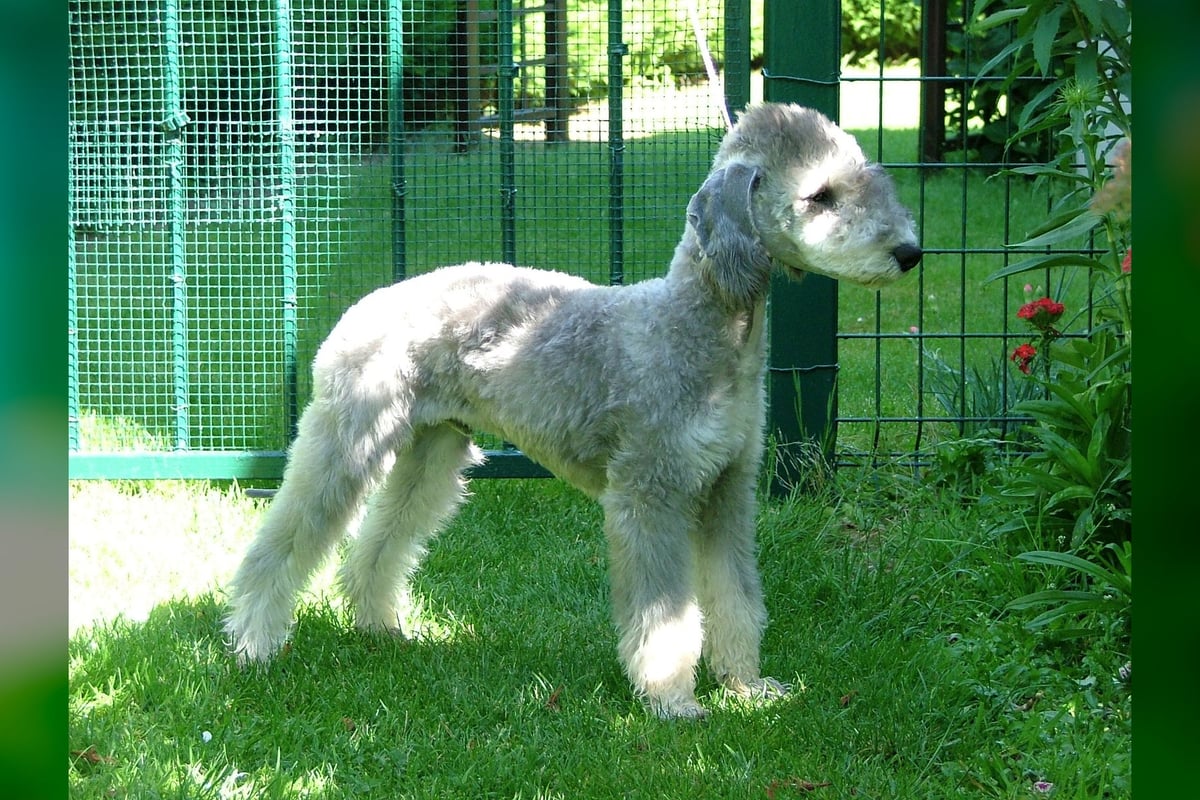
Bedlington Terrier
The Bedlington Terrier is a northern English terrier weighing 7 to 10 kg, recognized by the FCI under number 9, famous for its lamb-like silhouette that hides a hunter of otters and badgers. Its cottony, non-shedding coat is often described as hypoallergenic, a qualification worth qualifying based on individual sensitivity. The main serious genetic risk is copper storage disease (canine Wilson's disease, COMMD1 mutation), which is DNA-testable and clearly declining in kennels that screen systematically. Life expectancy is 12 to 14 years.
- Weight
- 7 to 10kg
- Height
- 38 to 43cm
- Life expectancy
- 13years
- Monthly cost
- 70 to 120€
Personality profile
Energy 3/5
Independence 3/5
Trainability 3/5
Good with children 4/5
Barking 3/5
Space needed 2/5
Attachment to home 4/5
Good with strangers 3/5
Good with dogs 2/5
Good with cats 2/5
Coat care 4/5
Exercise needs 3/5
Scores given on measured axes, data confidence: high.
Living with a Bedlington Terrier
Description
A morphology unique among terriers: an arched topline, fine limbs, a narrow pear-shaped head topped with a characteristic topknot, giving it the silhouette of a lamb at rest. The FCI 9 standard describes a double coat, a mix of hard and soft hair, forming distinct tufts on the legs and head, with a cottony, woolly texture that is never silky. Accepted colors are blue, liver and sandy, with or without tan points.

Temperament
The nickname "lamb that hunts like a lion" precisely captures the Bedlington's behavioral contrast: calm and affectionate at home, combative and tenacious with other dogs or on the hunt. Its predatory instinct toward small animals is intact — otters, badgers and rodents were its historical prey. With children in the household, it is one of the most tolerant terriers: patient during active play, less explosive than the Jack Russell. Toward strangers, its response ranges from curiosity to reserve depending on early socialization. Barking is moderate for a terrier — it expresses more through behavior than voice.
Training
Trainability is average (3/5): more cooperative than the Scottie or the Cairn, less focused than the Border Terrier. The Bedlington learns quickly when exercises engage its nose and hunting instinct, but resists mechanical repetition. Positive reinforcement only, sessions of 8 to 12 minutes, high-value food rewards. Its origins as an independent ratter selected for individual initiative — recall requires regular specific work and is never fully reliable off-lead if a scent trail is available. Nose work and earthdog trials are the activities best suited to its profile.

Feeding
140 to 190 g of premium kibble a day for a 7 to 10 kg adult, split into 2 meals. For dogs that are carriers of or affected by copper storage disease, a low-copper diet is recommended — avoid organ meats (liver, kidney) and foods rich in shellfish. Zinc supplementation is sometimes prescribed to limit intestinal copper absorption in genetically at-risk individuals — confirm with your veterinarian. Watch the ration after spay/neuter to prevent weight gain.
Affiliate links, no extra cost to you. Legal notice

Living conditions
An apartment or a house without a garden is acceptable: its exercise needs are moderate, 45 to 60 minutes of daily activity across two outings. A fenced garden is recommended where available, since hunting and digging instincts are present. It tolerates cold well thanks to its insulating coat; moderate heat is not a particular problem. It handles urban living better than more energetic terriers: the Bedlington accepts calm to semi-active lifestyles without frustration.

Grooming and coat care
The cottony coat produces relatively few airborne allergens and retains dead hair — very little shedding onto furniture and clothing, unlike terriers with open coats. It requires specialized professional grooming every 6 to 8 weeks to maintain the characteristic lamb silhouette — head topknot, full legs, short body. Clipping is the standard technique for pet dogs; hand-stripping is rarely used on this breed. Twice-weekly brushing is recommended between grooming visits to prevent matting. Monthly ear cleaning and nail trims every 3 to 4 weeks.

Health
Copper storage disease (canine Wilson's disease, COMMD1 mutation): progressive accumulation of copper in liver cells, which can lead to cirrhosis and liver failure. Without testing or treatment, the disease stays silent for years before becoming critical. A cheek-swab DNA test distinguishes clear, carrier and affected dogs — demand this result for both parents before any purchase. In kennels that test systematically, the prevalence of affected dogs has dropped to around 5%, down from roughly 30% before screening programs began. Liver biopsy is recommended for confirmation in at-risk dogs. Patellar luxation and retinopathy are also documented in the breed. Life expectancy is 12 to 14 years.
Breed history
The Bedlington Terrier descends from Northumberland terriers used by the miners and craftsmen of the village of Bedlington in the 19th century. First nicknamed the "Rothbury Terrier" after the region, it hunted otters, badgers, foxes and rodents in the rough terrain of the mining district. The first mention of the name "Bedlington Terrier" dates to 1825. The first standard was drawn up in 1877. The breed remains rare in France — around 80 LOF registrations a year according to SCC records — which makes it hard to find but ensures more rigorous health selection in kennels that test systematically for copper storage disease.
Getting ready for your Bedlington Terrier
Five essentials to line up before day one.
Affiliate links, no extra cost to you. Legal notice
FAQ: Bedlington Terrier
Sources
- FCI Standard No 9 · FCI breed standard 9, Group 3 Terriers, Section 1 Large and medium-sized Terriers
- AKC Breed Profile · AKC Bedlington Terrier breed profile, Terrier Group
- SCC LOF Registry — Bedlington Terrier · Société Centrale Canine, LOF breed registry, annual Bedlington Terrier birth statistics
FCI, Fédération Cynologique Internationale, the world body that has codified breed standards since 1911. FCI number 9 is assigned to the Bedlington Terrier.
Breeds similar to a Bedlington Terrier

