


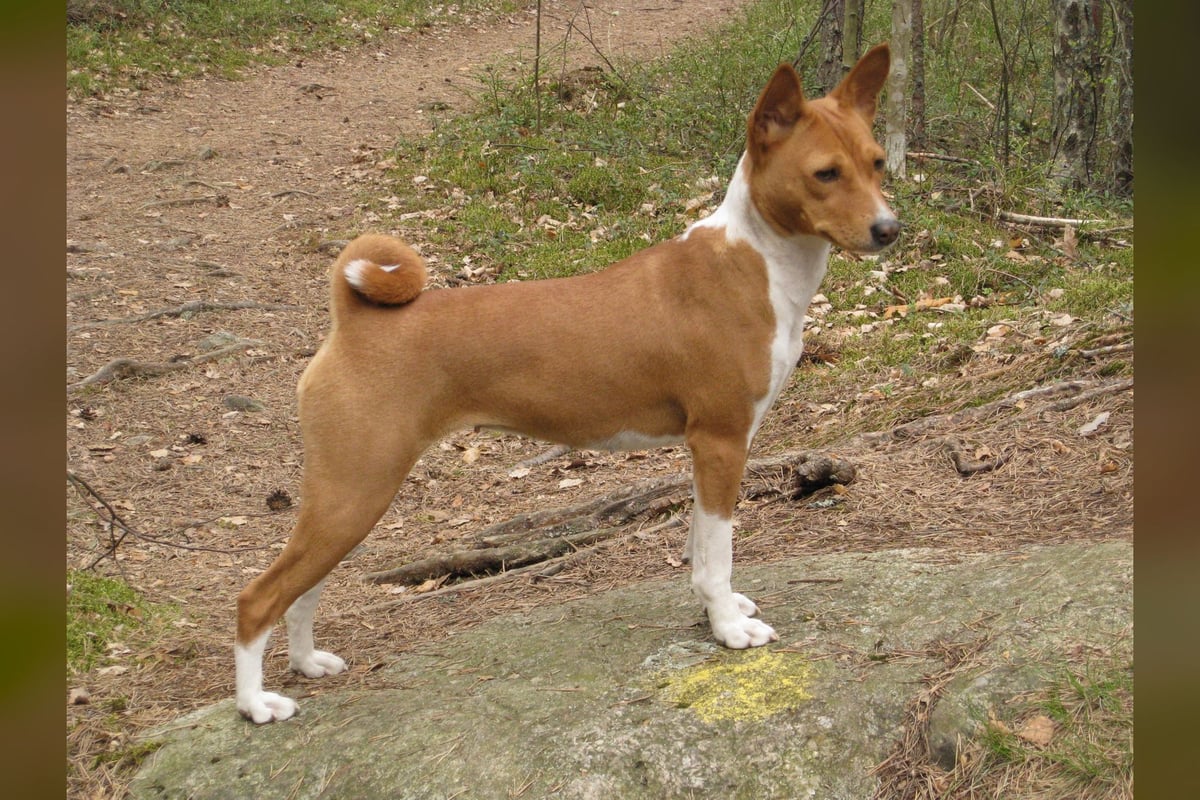
Basenji
The Basenji (FCI 43, Group 5) is a primitive breed from Central Africa standing 40 to 43 cm at the withers for 9 to 12 kg, whose genetic divergence from the wolf dates back more than 14 000 years — one of the oldest known breed lineages. Its most remarkable trait: it does not bark. Its atypical larynx, with narrow vocal cords, lets it produce a characteristic yodel called the 'baroo,' but no bark. Depictions of similarly built dogs have been found in Egyptian tombs of the Fifth and Sixth Dynasties.
- Weight
- 9 to 12kg
- Height
- 40 to 43cm
- Life expectancy
- 14years
- Monthly cost
- 70 to 130€
Personality profile
Energy 4/5
Independence 5/5
Trainability 2/5
Good with children 3/5
Barking 1/5
Space needed 3/5
Attachment to home 3/5
Good with strangers 2/5
Good with dogs 3/5
Good with cats 1/5
Coat care 1/5
Exercise needs 4/5
Scores given on measured axes, data confidence: high.
Living with a Basenji
Description
A light, athletic silhouette: a short, close coat, a tail tightly curled over the back, erect ears, and a wrinkled forehead that gives an almost human expression of surprise. Recognized colors are red-fawn, black, tricolor, and brindle, always with mandatory white points — feet, chest, and tail tip. Males reach 43 cm for about 11 kg; females 40 cm for 9.5 kg. The body is square and compact, with a short back, a well-let-down chest, and legs that are fine yet powerful, suited to the varied terrain of equatorial forest and savanna.

Temperament
No other domestic dog really resembles it: independent to the point of appearing aloof, cunning, and capable of autonomous decisions that puzzle owners used to more cooperative breeds. It does not bark — instead, it produces growls, whines, and its famous 'baroo' yodel, a hoarse, melodious sound entirely its own. Its hunting instinct is intact and strong: it chases any prey it sees, cats and small animals included, making recall unreliable without intensive training and a secure fence. Wary of strangers, it does not spontaneously approach unfamiliar people and keeps its distance.
Training
Intelligent but deliberately uncooperative: it understands what is asked of it and decides whether it feels like doing it. Recall is particularly difficult — in an unfenced outdoor space, it should not be let off leash without thorough prior training, since its hunting instinct overrides any verbal signal. Short sessions (5 to 10 minutes), positive and enriched with high-value food rewards, produce better results than long sessions. Activities such as lure coursing, nosework, or agility channel its energy and intelligence. Plan for at least 1.5 hours of active exercise a day — including long walks and exploratory play.

Feeding
120 to 170 g of premium medium-breed kibble a day for a 10 kg adult, in 2 meals. Watch its weight: despite their modest size, these dogs are prone to overweight if their activity level drops. Kibble suited to active primitive breeds, rich in animal protein (minimum 28%) and low in grains, matches their metabolism well. If Fanconi syndrome is diagnosed, food formulated for kidney insufficiency is prescribed by the veterinarian — some cases require electrolyte supplementation.
Affiliate links, no extra cost to you. Legal notice

Living conditions
Apartment living suits it provided it gets at least two active outings a day — without enough activity, its overflowing energy turns against the furniture and household objects. Its lack of barking makes it particularly well tolerated in dense urban settings, but its tendency to climb (fences, furniture, high shelves) calls for secure arrangements. Native to equatorial Africa, it is very sensitive to cold: below 10 °C, a dog coat and quick access indoors are necessary. An enclosed garden remains ideal, with a fence at least 1.8 m high and no footholds that would let it climb over.

Grooming and coat care
It is one of the cleanest dogs: it licks its paws and body cat-style, has no body odor, and sheds very little — 1 out of 5 on the shedding scale. Weekly brushing is enough to remove dead hair. Baths are rare (2 to 4 times a year, or as outdoor activities warrant). Check the nails regularly, as they grow quickly in this active breed, along with the erect ears, which, being exposed, should be cleaned monthly.

Health
Life expectancy is 13 to 14 years, solid for a dog of this size. The major genetic condition to watch for is Fanconi syndrome — a proximal renal tubulopathy that impairs reabsorption of electrolytes and glucose, historically present in about 10% of Basenjis. Since 2007, a genetic test developed by Dr. Gary Johnson at the University of Missouri (available through the OFA) can identify carriers and affected dogs before breeding — serious breeders always test their breeding stock. Other conditions to watch for: pyruvate kinase deficiency (hemolytic anemia), progressive retinal atrophy (PRA-BJ1), and hypothyroidism.
Breed history
The Basenji comes from the Congo Basin and the forested regions of Central Africa, where Bantu peoples used it for millennia to drive game toward hunting nets. Depictions of dogs with curled tails and erect ears appear on Egyptian artifacts and in tombs of the Fifth and Sixth Dynasties. DNA analyses published since the 2000s confirm that the breed is among those with the oldest genetic divergence from the gray wolf — more than 14 000 years — making it a precious genetic relic. It arrived in Europe in 1937, presented at Crufts in London by Olivia Burns after several import attempts that ended in losses from tropical diseases. The FCI standard 43 is recognized in Group 5 (Spitz and primitive types). The female has only one heat cycle a year, a trait shared with dingoes and wild canids — a further sign of its primitive nature.
Getting ready for your Basenji
Five essentials to line up before day one.
Affiliate links, no extra cost to you. Legal notice
FAQ: Basenji
Sources
- FCI Standard No 43 — Basenji · FCI breed standard 43, Group 5 Spitz and primitive types, Section 6 Primitive type
- Société Centrale Canine — Basenji · SCC official breed profile Basenji, Group 5
- AKC Breed Profile — Basenji · AKC Basenji breed profile, Hound Group
FCI, Fédération Cynologique Internationale, the world body that has codified breed standards since 1911. FCI number 43 is assigned to the Basenji.
Breeds similar to a Basenji

